
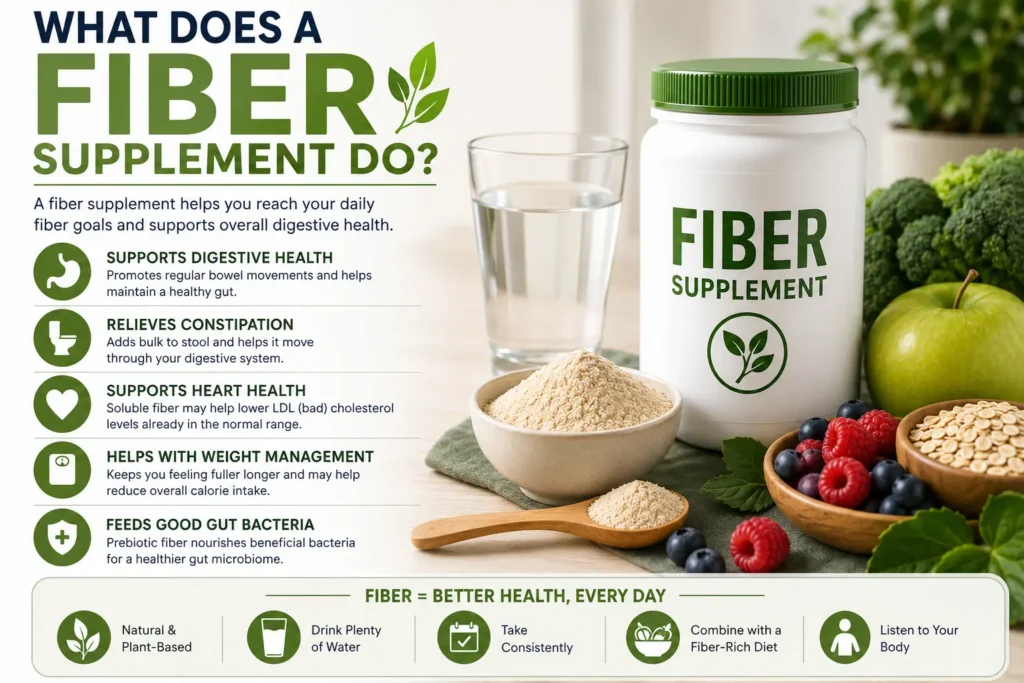
A fiber supplement adds concentrated plant fiber to your diet in the form of a powder, capsule, or gummy. Once inside your digestive system, it either absorbs water to soften and bulk up stool, or it passes through mostly undigested to feed gut bacteria and add bulk to waste. Depending on the type you choose, a fiber supplement can support regular bowel movements, help manage cholesterol and blood sugar, feed beneficial gut bacteria, and support a feeling of fullness after meals. It is not a replacement for fiber-rich food, but it is a practical way to close the gap when your diet falls short.
Most adults need 25–38 grams of fiber a day, and the Mayo Clinic notes that most Americans get only about half of that amount from food alone. A fiber supplement is designed to help close that gap.
Table of Contents
What Is a Fiber Supplement, Exactly?
A fiber supplement is a concentrated source of dietary fiber, extracted from plants, grains, or synthesized in a lab, and sold separately from whole food. Instead of eating a bowl of oats or a handful of chia seeds, you take the fiber itself: as a powder mixed into water, a capsule swallowed with a drink, or a chewable gummy.
The active ingredient is what matters most. Common types include:
- Psyllium husk — a soluble fiber from the seeds of the Plantago ovata plant
- Methylcellulose — a semi-synthetic soluble fiber made from plant cellulose
- Wheat dextrin — a soluble fiber derived from wheat starch
- Inulin and chicory root fiber — plant-based prebiotic fibers
- Calcium polycarbophil — a synthetic fiber that absorbs water in the gut
Each of these behaves a little differently once it reaches your digestive tract, which is why “what does a fiber supplement do” doesn’t have a single, one-size-fits-all answer. The mechanism depends on the fiber type.
If you’re comparing forms, our guides on fiber powder, fiber pills, and fiber gummies break down how each format is absorbed and dosed.
How Fiber Supplements Work Inside Your Body
To understand what a fiber supplement does, it helps to separate the two main categories of fiber. Nearly every commercial supplement is built around one or both.
Soluble Fiber: The Gel-Former
Soluble fiber dissolves in water and forms a thick, gel-like substance in your stomach and intestines. This gel:
- Slows down digestion, which helps you feel full longer
- Slows the absorption of sugar into the bloodstream, which can help moderate post-meal blood sugar spikes
- Binds to bile acids (which are made partly from cholesterol), prompting your liver to pull more cholesterol from the blood to make more bile — a mechanism linked to modest reductions in LDL cholesterol
- Softens stool by holding onto water
Psyllium husk is the most researched soluble fiber supplement and is the type most consistently linked to cholesterol and blood sugar benefits in clinical research.
Insoluble Fiber: The Bulking Agent
Insoluble fiber does not dissolve in water. Instead, it passes through the digestive tract largely intact, adding physical bulk to stool. This bulk:
- Speeds up how quickly waste moves through the intestines
- Presses against the intestinal walls, stimulating contractions that promote regularity
- Helps prevent straining and constipation
Wheat bran is the classic example of insoluble fiber, though most supplements marketed as “insoluble fiber” combine it with other ingredients since pure insoluble fiber supplements are less common than soluble ones.
Fermentable Fiber: The Gut Bacteria Feeder
Some fibers, particularly inulin, chicory root, and acacia fiber, are fermentable. Your gut bacteria break them down in the large intestine, producing short-chain fatty acids like butyrate. These compounds:
- Nourish the cells lining your colon
- Support a healthier balance of gut bacteria
- May play a role in immune function, though this area of research is still developing
Not all fiber supplements are fermented the same way, and heavily fermentable fibers are more likely to cause gas and bloating in people who aren’t used to them.
For a deeper breakdown of these categories, see soluble vs. insoluble fiber and soluble fiber explained on their own.
Fiber Supplement Benefits: What the Evidence Actually Supports
Here’s where many articles either overstate or understate what fiber supplements can do. Below is a realistic, evidence-based breakdown.
| Benefit | Fiber Type Most Linked to It | Strength of Evidence |
| Relieves constipation | Psyllium, methylcellulose, wheat dextrin | Strong — well established in clinical research |
| Softens and bulks stool | Soluble and insoluble fibers | Strong |
| Modestly lowers LDL cholesterol | Psyllium, oat-derived soluble fiber | Moderate — consistent but modest effect |
| Helps moderate blood sugar response | Psyllium, glucomannan | Moderate |
| Supports feelings of fullness | Soluble, gel-forming fibers | Moderate |
| Feeds beneficial gut bacteria | Inulin, chicory root, acacia | Emerging — promising but still developing |
| Aids long-term weight management | Soluble fiber, as part of an overall diet | Limited — supports appetite control, not a standalone solution |
This table exists because most competing articles either list benefits with no context on strength of evidence, or bury the caveats. Knowing which benefit is “strong” versus “emerging” matters if you’re deciding whether a fiber supplement is worth adding to your routine.
The Houston Methodist overview of fiber’s health benefits makes a similar point: fiber plays a role in regulating blood sugar and feeding beneficial gut bacteria, and adequate fiber intake over time is associated with lower long-term risk of heart disease and type 2 diabetes — benefits tied to overall dietary patterns rather than any single supplement.
What a Fiber Supplement Does Not Do
To keep this balanced, it’s just as important to be clear about the limits:
- It does not replace the vitamins, minerals, and antioxidants found in whole fiber-rich foods like fruits, vegetables, and legumes
- It is not a fast-acting weight-loss tool — any effect comes from modestly increased fullness, not fat burning
- It cannot fully substitute for medical treatment of diagnosed digestive conditions
- It does not “detox” the body — this is a marketing claim not supported by clinical evidence
The Mayo Clinic makes a similar point: whole foods offer benefits that supplements can’t match, including a wider variety of nutrients, vitamins, and minerals. That’s a useful reminder that a supplement is a tool to fill a gap, not a wholesale replacement for high-fiber foods. If you want a side-by-side look at when to use each, read fiber supplements vs. fiber foods.
Who Actually Benefits Most From a Fiber Supplement?
Not everyone needs one. A fiber supplement tends to make the biggest difference for:
- People whose diet is genuinely low in fruits, vegetables, whole grains, and legumes
- Those dealing with occasional or chronic constipation
- People managing borderline-high cholesterol alongside diet and lifestyle changes
- Anyone advised by a healthcare provider to increase fiber intake gradually (for example, before certain medical procedures)
It tends to matter less for people who already eat a fiber-rich, whole-food diet consistently — in that case, food-based fiber is usually sufficient and preferable.
If you’re unsure whether you fall into the first group, our guide on do I need a fiber supplement? walks through a simple decision framework. Specific situations are covered in more detail in our guides for women, men, seniors, and during pregnancy.
How Long Does It Take to Work?
This is one of the most common questions people ask, and most competitor articles skip it entirely.
- For constipation relief: Many people notice softer, more regular stools within 24–72 hours, though it can take up to a week of consistent use to see the full effect.
- For cholesterol: Clinical studies measuring LDL cholesterol changes typically track effects over 4–8 weeks of daily use, not days.
- For blood sugar and fullness: Effects are more immediate — often noticeable within the same day, since the gel-forming action happens with each dose.
- For gut bacteria balance: Fermentable fiber’s effects on the microbiome build gradually over several weeks as bacterial populations shift.
Patience matters. A common mistake is stopping after two or three days because “nothing happened,” when some benefits are cumulative.
Common Mistakes People Make With Fiber Supplements
- Increasing the dose too quickly. This is the single biggest cause of gas, bloating, and cramping. Start with a small dose and increase gradually over one to two weeks.
- Not drinking enough water. Soluble fiber needs water to form its gel. Without enough fluid, some fiber supplements — particularly psyllium — can actually worsen constipation or, rarely, cause a blockage.
- Taking it at the wrong time relative to medications. Fiber can bind to certain medications and reduce their absorption. Most guidance suggests taking fiber supplements at least 1–2 hours apart from medications; check with a pharmacist for anything you take regularly. Our when should I take fiber supplements and best time to take fiber supplement guides go into more depth here.
- Expecting weight loss without other changes. Fiber supports appetite control, but it works alongside — not instead of — overall diet and activity habits.
- Choosing a type at random. Different fibers have different effects; someone with constipation and someone managing cholesterol may benefit from different products. See how to choose a fiber supplement for a full walkthrough.
Fiber Supplement Types Compared
| Type | Category | Best Known For | Common Side Effects |
| Psyllium husk | Soluble | Constipation relief, cholesterol support | Gas, bloating if increased too fast |
| Methylcellulose | Soluble | Constipation relief with less gas | Generally well tolerated |
| Wheat dextrin | Soluble | Mild, flavorless fiber boost | Bloating in sensitive individuals |
| Inulin/chicory root | Soluble, fermentable | Gut bacteria support | More gas due to fermentation |
| Calcium polycarbophil | Synthetic, bulk-forming | Firming loose stools and softening hard stools | Generally mild |
For a closer look at specific products, our psyllium husk and best psyllium husk guides compare leading brands, and best soluble fiber supplement covers the category as a whole.
Frequently Asked Questions
Does a fiber supplement work the same as eating fiber from food? Not exactly. Whole foods deliver fiber along with vitamins, minerals, and antioxidants that supplements don’t provide. Supplements isolate the fiber itself, which is useful for a targeted effect but isn’t a full nutritional substitute.
Can I take a fiber supplement every day? Yes, for most people, daily use is considered safe when introduced gradually and taken with adequate water. Anyone with a diagnosed digestive condition should check with a healthcare provider first.
Will a fiber supplement cause bloating? It can, especially if you increase your dose too quickly or choose a highly fermentable type like inulin. Starting low and increasing slowly reduces this significantly. Our guide to fiber supplements that don’t cause gas covers gentler options.
Do fiber supplements help with weight loss? They can support appetite control by promoting fullness, which may help with portion control. They are not a standalone weight-loss solution. See best fiber supplement for weight loss for more context.
Are fiber supplements safe for long-term use? Generally, yes, for most healthy adults. Long-term safety data is strongest for psyllium and methylcellulose. As with any supplement, ongoing use is best discussed with a healthcare provider, particularly if you take other medications.
What’s the difference between a prebiotic fiber and a regular fiber supplement? Prebiotic fibers, like inulin, are specifically fermented by gut bacteria to support microbiome health. Not all fiber supplements are prebiotic — bulk-forming types like methylcellulose largely pass through without fermentation. See best prebiotic fiber supplement for options built around this mechanism.
Final Verdict
A fiber supplement works by either forming a water-absorbing gel (soluble fiber), adding physical bulk to stool (insoluble fiber), or feeding gut bacteria through fermentation — and often some combination of the three. The real-world result is more regular digestion, modest support for cholesterol and blood sugar, and a longer-lasting feeling of fullness after meals.
It is a genuinely useful tool when your diet falls short of the recommended 25–38 grams of fiber a day, but it works best as a supplement to a fiber-rich diet, not a replacement for one. If you’re ready to find the right type for your situation, start with our guide on how to choose a fiber supplement, or browse options for gut health, constipation, or daily maintenance.
This article is for educational purposes only and is not a substitute for medical advice. Talk to a healthcare provider before starting any new supplement, especially if you take medications or have an existing health condition.