
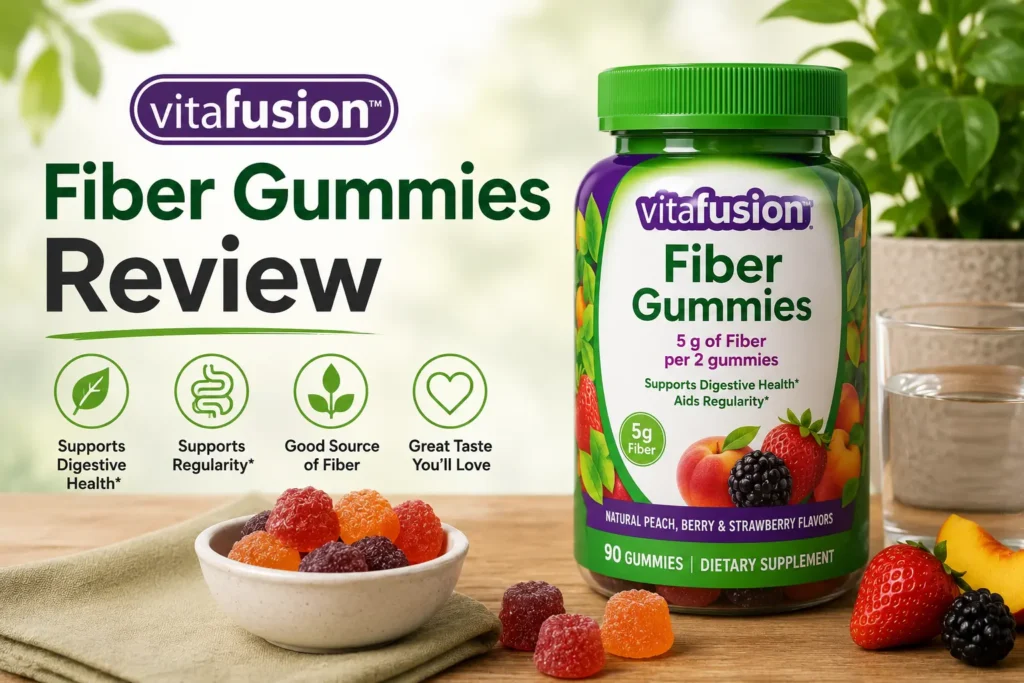
Vitafusion’s Fiber Well line delivers 3–5 grams of prebiotic fiber per serving in a chewable gummy, using either chicory root fiber (inulin) or polydextrose depending on which version you buy. They’re genuinely easy to take and taste better than most powders or capsules, but the dose is meaningfully smaller than a typical psyllium or acacia serving, and a recurring complaint across thousands of reviews is that the gummies can be hard, sticky, or tough to chew. They’re a reasonable entry point for fiber beginners, not a replacement for a full-strength daily fiber supplement.
If you searched “Vitafusion Fiber Gummies review,” you’re probably trying to figure out one of three things: does 3–5 grams of gummy fiber actually do anything, what’s the difference between the sugar-containing and sugar-free versions, and is the chewy texture as bad as some reviews make it sound. This review answers all three using the label data, ingredient breakdowns, and a wide sample of verified buyer feedback — including the recurring texture complaints most competitor pages don’t mention.
Table of Contents
What Is Vitafusion Fiber Well?
Vitafusion is a gummy vitamin brand made by Church & Dwight, the same company behind Arm & Hammer and OxiClean. Fiber Well is their fiber-specific line, sold in a few different formulations that are easy to mix up if you’re shopping quickly:
- Fiber Well (Sugar Free) — 5g fiber per serving, fiber source is polydextrose
- Fiber Well + Probiotics — 3g fiber per serving from chicory root fiber (inulin), plus 800 million CFU of probiotics, contains added sugar
- Fiber Well Fit — 4-5g fiber per serving with added B vitamins, sugar-free, marketed toward weight and energy support
Because the fiber source and dose genuinely differ between these three, this review focuses primarily on the standard Fiber Well Sugar Free gummy — the version most commonly searched and sold — with direct comparisons to the other two throughout.
What’s Actually in Vitafusion Fiber Gummies
The Sugar Free version’s other ingredients are: polydextrose, water, gelatin, sorbitol, and a small blend (under 2%) of coconut and/or palm oil, beeswax and/or carnauba wax, natural colors, malic acid, natural flavors, and sucralose.
The Fiber Well + Probiotics version instead uses chicory root fiber (inulin) as its fiber source, along with sugar, water, and gelatin as the main base ingredients.
Supplement Facts Comparison
| Product | Fiber Per Serving | Fiber Source | Serving Size | Sugar? |
| Fiber Well (Sugar Free) | 5g | Polydextrose | 2 gummies | No — sweetened with sorbitol/sucralose |
| Fiber Well + Probiotics | 3g | Chicory root fiber (inulin) | 2 gummies | Yes |
| Fiber Well Fit | 4–5g | Polydextrose (plus B vitamins) | 2 gummies | No |
This distinction matters more than most reviews let on. Polydextrose and inulin are both soluble, fermentable fibers, but they don’t behave identically in the gut — inulin tends to ferment faster and is more commonly associated with gas and bloating at higher intakes, while polydextrose ferments more slowly and is generally considered gentler for sensitive digestive systems. If you’ve had a rough experience with inulin-based products before, the Sugar Free polydextrose version may be the more comfortable starting point.
How Much Fiber Are You Actually Getting?
This is the honest math competitors tend to gloss over. At 5g per serving, two Fiber Well gummies provide roughly 20% of the FDA’s daily recommended fiber intake of 25 grams. Compare that to a single tablespoon of psyllium husk powder, which delivers 4.5–6g of concentrated soluble fiber, or a scoop of a whole-food fiber blend that can run closer to 9g. Gummies aren’t a lesser product by definition, but the serving size is smaller than most people assume when picking a fiber supplement based on convenience rather than gram counts.
That doesn’t mean the effect is negligible — fermentable fibers like polydextrose and inulin do feed beneficial gut bacteria and can meaningfully support regularity at these doses, especially for someone whose baseline fiber intake is very low. It just means gummies are better understood as a fiber top-up than a full daily fiber solution, particularly for anyone using fiber specifically to manage constipation or cholesterol.
Benefits
- Genuinely easy to take. No mixing, no gritty texture, no drinking a full glass of water within two minutes — the single biggest reason people switch to gummies in the first place.
- Sugar-free options available. The Sugar Free and Fit lines avoid added sugar, using sorbitol and sucralose instead.
- No high fructose corn syrup, synthetic dyes, gluten, or dairy across the line.
- Reasonably good taste, with peach, strawberry, and berry flavors that consistently get positive mentions in reviews, unlike unflavored powders.
- Fiber Well Fit adds B vitamins, useful for people who want a small multivitamin boost alongside fiber, though this shouldn’t be the primary reason to choose it.
Drawbacks
- Lower fiber dose per serving than most powder or capsule fiber supplements — you’d need several servings to match a single scoop of psyllium or a whole-food fiber blend.
- Chewiness and texture complaints are frequent and specific. Multiple reviewers describe the gummies as unusually hard, sticky, or tough to chew through, not just firm — this shows up across several product variants, not as an isolated batch issue.
- Contains sugar in the +Probiotics version, which matters if you’re managing blood sugar or simply prefer to avoid added sugar in a health supplement.
- Contains coconut (tree nut) and is processed in a facility with egg, fish, shellfish, soy, and tree nuts — a real consideration for anyone with those allergies.
- Sugar alcohols (sorbitol) in the sugar-free versions can themselves cause gas or a laxative effect in sensitive individuals, on top of the fiber’s own effect — worth knowing if you’re troubleshooting side effects.
Pros & Cons at a Glance
| Pros | Cons |
| Easy to take — no mixing, no water requirement | Fiber per serving is lower than powders or capsules |
| Sugar-free options with no HFCS or synthetic dyes | Recurring reviewer complaints about hard, chewy texture |
| Pleasant fruit flavors (peach, strawberry, berry) | Contains coconut and is made in a facility with major allergens |
| Multiple formulations for different needs (Fit, +Probiotics) | Sugar alcohols in sugar-free versions can add their own GI effects |
| No gritty texture or mixing required | +Probiotics version contains added sugar |
Vitafusion Fiber Well vs. Fiber Well + Probiotics vs. Fiber Well Fit
Since the product line causes real confusion at the shelf, here’s a direct comparison of what actually separates them.
| Feature | Fiber Well (Sugar Free) | Fiber Well + Probiotics | Fiber Well Fit |
| Fiber source | Polydextrose | Chicory root fiber (inulin) | Polydextrose |
| Fiber per serving | 5g | 3g | 4–5g |
| Added sugar | No | Yes | No |
| Extra ingredients | None beyond base gummy | 800 million CFU probiotics | B vitamins |
| Best for | Straightforward daily fiber, sugar-conscious buyers | People wanting a fiber + probiotic combo, less concerned about sugar | People wanting fiber plus a small B-vitamin boost |
| Gas/bloating tendency | Lower (slower-fermenting polydextrose) | Higher at first (faster-fermenting inulin) | Lower (polydextrose-based) |
In practice: the Sugar Free version is the most straightforward choice for most people, since it delivers the highest fiber dose in the line without added sugar. The +Probiotics version is worth considering only if you specifically want a fiber-probiotic combination and don’t mind the sugar and lower fiber gram count; otherwise, pairing a plain fiber gummy with a separate prebiotic fiber supplement or probiotic and fiber supplement may give you more control over each dose.
What Real Users Say
The pattern across hundreds of Walmart and Sam’s Club reviews is consistent: taste is almost universally praised, effectiveness gets mixed-to-positive marks, and texture is the recurring sticking point — sometimes literally. Multiple reviewers independently describe the gummies as hard, chewy, or sticky enough that people with dental work or a weaker jaw specifically flag it as a dealbreaker. Vitafusion’s customer service team has responded directly to several of these texture complaints, which suggests it’s a known and ongoing issue rather than a one-off batch problem.
On effectiveness, most reviewers report noticeable improvement in regularity within the first one to two weeks, with a subset mentioning mild gas, bloating, or stronger-smelling stool in the first several days — consistent with how fermentable fibers like inulin and polydextrose typically behave as gut bacteria adjust. Several long-term users specifically compare it favorably to Metamucil on convenience while acknowledging it doesn’t feel as “strong” as a full psyllium dose.
Who Vitafusion Fiber Gummies Are a Good Fit For
- People who struggle to take fiber powders or capsules consistently and need something they’ll actually remember to take
- Anyone looking for a modest daily fiber top-up rather than a therapeutic dose for constipation or cholesterol management
- People who want a sugar-free option with reasonably clean ingredients and decent flavor
- Beginners easing into fiber supplementation who want a gentler starting dose
Who Should Consider a Different Option
- Anyone targeting a specific therapeutic goal, like managing constipation or LDL cholesterol, where a full-dose product like psyllium husk or acacia fiber will deliver a more clinically meaningful amount of fiber per serving
- People with dental sensitivity or jaw issues, given the recurring chewiness complaints — a fiber powder or fiber capsule avoids the chewing question entirely
- Anyone managing blood sugar closely who might want to specifically choose the sugar-free version over the +Probiotics variant, or avoid sugar alcohols altogether
- People with a coconut or tree nut allergy, who should check the label carefully before choosing this brand
How to Use It
The label directs adults to take two gummies once daily, chewed thoroughly before swallowing, with a recommendation to increase water intake to help the fiber work comfortably. As with capsules or powders, the label also notes that the serving should be reduced if minor gas or bloating occurs — a sign that even at this lower gummy dose, a gradual approach still matters. Since these are fermentable, prebiotic-style fibers, some brands suggest taking them with meals to further reduce the odds of stomach discomfort.
Common Mistakes People Make With This Product
- Assuming gummy fiber matches a full powder or capsule dose. At 3–5g per serving, it’s a smaller amount than most other fiber formats, and expecting equivalent results can lead to disappointment.
- Grabbing the wrong variant off the shelf. The +Probiotics, Sugar Free, and Fit versions have different fiber sources, doses, and sugar content — checking the label matters here more than with most single-ingredient fiber products.
- Increasing the dose too quickly if results feel slow. Jumping straight to extra servings, rather than giving the current dose one to two weeks to work, is a common source of unnecessary gas and bloating.
- Not accounting for the sugar alcohols in sugar-free versions. Sorbitol itself has a mild laxative effect in some people, separate from the fiber — worth knowing if you’re trying to isolate the cause of loose stool.
- Expecting a therapeutic effect for constipation or cholesterol from a supplement dose designed primarily as a convenient daily top-up.
Frequently Asked Questions
Do Vitafusion Fiber Gummies actually work? For general digestive regularity and closing a fiber gap in the diet, most reviewers report a noticeable improvement within one to two weeks. For more targeted goals like managing constipation or cholesterol, the fiber dose (3–5g per serving) is lower than what’s typically used in clinical research on psyllium or acacia, so results may be more modest.
Why are Vitafusion Fiber Gummies so hard to chew? This is a frequently reported issue across multiple product variants and appears related to the gummy’s gelatin-based formulation rather than an isolated defect. If texture is a dealbreaker for you, a fiber capsule or powder avoids the chewing question entirely.
What’s the difference between Fiber Well and Fiber Well + Probiotics? Fiber Well (Sugar Free) uses polydextrose as its fiber source and delivers 5g of fiber per serving with no added sugar. Fiber Well + Probiotics uses chicory root fiber (inulin), delivers 3g of fiber per serving, contains added sugar, and includes 800 million CFU of probiotics.
Can Vitafusion Fiber Gummies cause bloating? Yes, especially in the first several days, which is typical of fermentable fibers like inulin and polydextrose as gut bacteria adjust. Taking the recommended dose with meals and not exceeding it can help minimize this.
Are Vitafusion Fiber Gummies safe for people with diabetes? The Sugar Free and Fit versions don’t contain added sugar and use soluble fiber, which doesn’t spike blood sugar the way simple sugars do. That said, anyone managing diabetes should check with their doctor before adding any new supplement, including which specific Fiber Well variant is appropriate.
How do Vitafusion Fiber Gummies compare to fiber powder? Gummies are more convenient and better-tasting but deliver a smaller fiber dose per serving than most powders. If convenience is your priority and you don’t need a therapeutic dose, gummies work well; if you’re managing a specific digestive or cholesterol goal, a powder like psyllium husk powder will typically deliver more fiber per serving. See our full fiber gummies vs. fiber powder comparison for more detail.
Final Verdict
Vitafusion Fiber Well gummies do exactly what a gummy fiber supplement is supposed to do: make taking fiber genuinely easy and reasonably pleasant, with sugar-free options and a clean-enough ingredient list. The trade-off is a smaller fiber dose than most powders or capsules, and a real, recurring complaint about how hard and chewy the gummies can be — something worth taking seriously if you have any dental sensitivity.
For someone who simply wants a low-effort way to close a modest fiber gap, especially as a starting point before working up to a stronger supplement, this is a reasonable, well-formulated choice — the Sugar Free version in particular, given its higher fiber content and lack of added sugar. For anyone with a specific therapeutic target like constipation relief or cholesterol management, it’s worth pairing this with, or switching to, a full-strength option; our best fiber gummies and best psyllium husk guides can help you compare stronger alternatives.
This article is for educational purposes only and is not medical advice. Talk to your doctor before starting any new supplement, especially if you’re pregnant, nursing, on medication, managing diabetes, or have a digestive condition.