
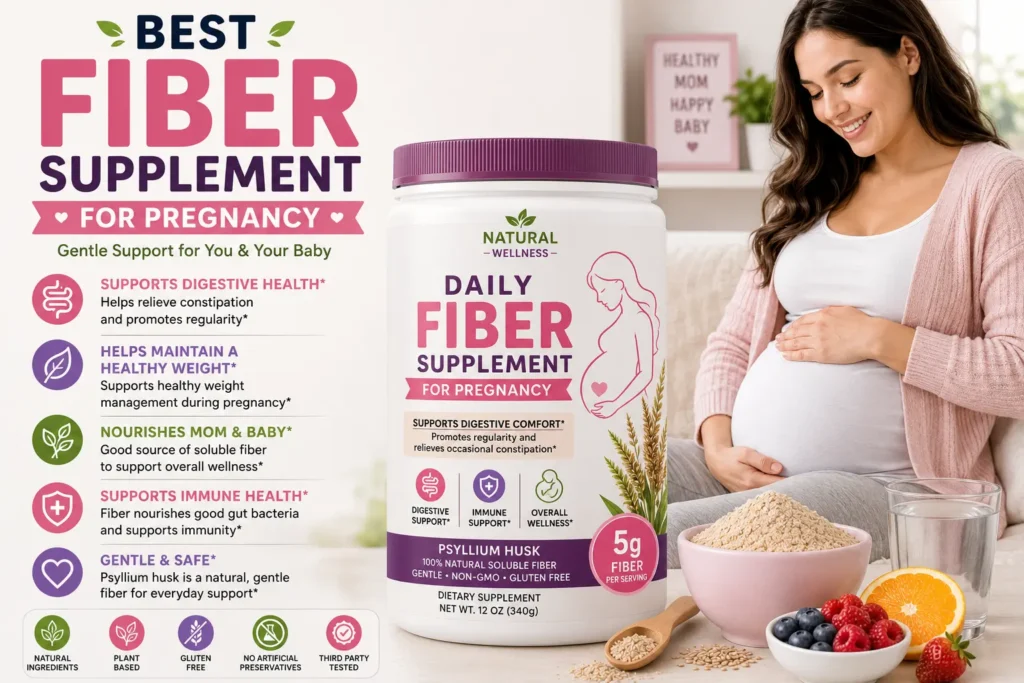
Best Fiber Supplement for Pregnancy: Pregnancy constipation is common, and it’s often one of the least talked-about parts of pregnancy. Rising progesterone slows digestion, a growing uterus puts pressure on the intestines, and iron in prenatal vitamins can make things worse. A fiber supplement can help — but not every fiber supplement is a good fit for pregnancy, and none should be chosen without your OB or midwife’s input.Pregnancy constipation is common, and it’s often one of the least talked-about parts of pregnancy. Rising progesterone slows digestion, a growing uterus puts pressure on the intestines, and iron in prenatal vitamins can make things worse. A fiber supplement can help — but not every fiber supplement is a good fit for pregnancy, and none should be chosen without your OB or midwife’s input.
Quick answer: There isn’t one single “best” fiber supplement for every pregnant person, because the right choice depends on your trimester, your current diet, and any conditions your provider is monitoring. That said, unflavored psyllium husk and plain inulin/acacia fiber are the types most commonly discussed as reasonable options during pregnancy, because they are minimally processed and don’t typically carry added stimulant laxatives, high sugar content, or unnecessary additives. Always confirm your specific choice with your healthcare provider before starting it.
This guide walks through what fiber does during pregnancy, which types are generally better suited to it, what to avoid, and how to actually choose a product — not just a list of names.
Table of Contents
Why Constipation Is So Common During Pregnancy
Three things typically happen at once:
- Hormonal changes. Progesterone relaxes smooth muscle throughout the body, including the intestinal wall, which slows the movement of food through the gut.
- Physical pressure. As the uterus grows, it can compress the intestines and rectum, making bowel movements less frequent or more difficult.
- Iron supplementation. Iron in prenatal vitamins is a well-known contributor to constipation and harder stools.
None of this means something is wrong with you. It’s a near-universal experience, but that doesn’t make it comfortable, and untreated constipation can contribute to bloating, hemorrhoids, and general discomfort.
What Fiber Supplements Actually Do
Fiber supplements aren’t a treatment or a medication — they’re a way to add what your diet may be missing. Broadly:
- Soluble fiber (like psyllium, inulin, or acacia) absorbs water and forms a gel-like substance, which softens stool and can support more regular movements.
- Insoluble fiber (like wheat bran) adds bulk to stool and can speed up transit time, though it can also cause more gas and bloating for some people.
For a deeper breakdown of the two categories, see our guide on soluble vs. insoluble fiber.
Most healthcare providers recommend starting with dietary fiber — fruits, vegetables, legumes, and whole grains — before adding a supplement. If you want to compare the two approaches directly, this comparison of fiber supplements vs. fiber foods is a useful next read.
Types of Fiber Supplements and How They Fit Pregnancy
| Fiber Type | What It Is | Common Pregnancy Consideration |
| Psyllium husk | Soluble fiber from plantago seeds | Widely discussed as a starting option; needs to be taken with plenty of water |
| Inulin (chicory root) | Soluble, fermentable fiber | Can cause more gas/bloating in some people; start with a small dose |
| Acacia fiber | Soluble, gentle-fermenting fiber | Often described as one of the gentler options for sensitive digestion |
| Methylcellulose | Semi-synthetic, non-fermentable fiber | Tends to cause less gas since it isn’t fermented by gut bacteria |
| Wheat dextrin | Soluble, low-viscosity fiber | Mixes easily but some formulations contain added flavoring/sweeteners |
| Wheat bran | Insoluble fiber | Can be more likely to cause bloating; less commonly recommended as a first option |
This table is a starting point for a conversation with your provider — not a ranking of “best to worst.” What works well for one person’s gut can be uncomfortable for another, especially in the second and third trimesters when bloating is already more common.
For more on psyllium specifically, our dedicated guide covers psyllium husk in depth, and if you’re comparing individual products, see best psyllium husk supplements.
What to Look For on the Label
When you’re standing in front of options — whether in a store like Target or shopping online — these are the label details that matter most during pregnancy:
- Single-ingredient or near-single-ingredient formulas. Fewer additives means fewer unknowns.
- No stimulant laxatives. Ingredients like senna or cascara sagrada are stimulant laxatives, not fiber, and are generally not recommended in pregnancy without direct medical guidance.
- Low or no added sugar. Many flavored fiber powders and gummies contain added sugars or sugar alcohols, which can worsen bloating.
- No unnecessary artificial sweeteners or dyes, if you’d prefer to minimize them — this is a personal preference rather than a safety rule for most people, but worth checking with your provider if you have any concerns.
- Clear dosing instructions. Fiber needs are individual, and pregnancy is not the time to guess at a serving size.
Our general guide on how to choose a fiber supplement covers the label-reading process in more detail if you want the full framework.
Fiber Powder, Pills, or Gummies — Which Format Makes Sense in Pregnancy?
| Format | Pros | Cons | Pregnancy Notes |
| Powder | Flexible dosing, mixes into water or food | Requires mixing, some have taste/texture some find unpleasant with pregnancy nausea | Needs to be taken with enough fluid to be effective |
| Pills/capsules | No taste, easy to travel with | Often requires taking several capsules for an effective dose | Can be easier if you’re dealing with nausea or food aversions |
| Gummies | Easy to tolerate, no mixing | Typically lower fiber per serving, often contain added sugar | May not provide enough fiber on their own to make a difference |
If nausea or aversions are a factor for you, capsules are worth discussing with your provider. If you want to see how these formats stack up outside of pregnancy too, we compare them further in our guides to fiber powder, fiber pills, and fiber gummies.
How Much Fiber Do You Actually Need?
General fiber recommendations for adults are commonly cited around 25–28 grams per day, with pregnancy sometimes associated with a slightly higher target due to increased digestive slowdown — but exact numbers vary by source and individual health status. Rather than aiming for a specific gram count on your own, the more useful approach is:
- Track roughly how much fiber you’re already getting from food.
- Identify the gap between that and your provider’s recommendation for you.
- Use a supplement to help close that gap gradually — not replace it all at once.
Common mistake: Jumping straight to a full adult serving of a new fiber supplement. This is one of the most frequent causes of pregnancy bloating and gas complaints. Starting with a half dose for the first few days and increasing slowly, while drinking extra water, is a more comfortable approach for most people.
What Pregnant People Often Get Wrong About Fiber Supplements
- Assuming “natural” means “no need to check with a doctor.” Even plant-based fiber can interact with how you absorb prenatal vitamins and minerals like iron if taken at the exact same time.
- Not drinking enough water. Soluble fiber needs fluid to work properly; without it, some people experience the opposite of the intended effect.
- Choosing flavored or sweetened versions by default. These are often chosen for taste, not function, and can add sugar without added benefit.
- Expecting immediate results. Fiber supplements typically take a few days of consistent use to show a noticeable difference.
- Ignoring warning signs. Severe abdominal pain, no bowel movement for several days, or rectal bleeding are reasons to contact your provider rather than simply increasing fiber intake.
Fiber Supplements vs. Other Pregnancy Constipation Remedies
Fiber isn’t the only tool. Depending on your situation, your provider might also discuss:
- Increasing water intake
- Light, doctor-approved physical activity like walking
- Stool softeners (different from fiber and from stimulant laxatives)
- Adjusting the timing or type of iron supplement
Fiber supplements are generally considered a first-line, non-medication approach — but “generally considered” is not the same as “automatically appropriate for you.” Some pregnancy conditions and medications change what’s advisable, which is exactly why this is a conversation to have rather than a decision to make from a product label alone.
Questions Worth Asking Your OB or Midwife
- Is a fiber supplement a good fit for my specific pregnancy and any conditions being monitored?
- Is there a type of fiber (psyllium, inulin, acacia, methylcellulose) you’d recommend over another for me?
- Should I take it at a different time than my prenatal vitamin or iron supplement?
- What’s a reasonable starting dose for me, and how should I increase it?
- What symptoms would mean I should stop and call you?
Bringing a short list like this to an appointment tends to get more useful, specific answers than a general “is fiber okay in pregnancy?” question.
Frequently Asked Questions
Is it safe to take a fiber supplement every day during pregnancy? Many people use a fiber supplement daily during pregnancy under their provider’s guidance. Whether daily use is right for you depends on your diet, trimester, and any conditions your provider is tracking, so this is worth confirming individually rather than assuming.
Can fiber supplements cause miscarriage or harm the baby? Plain fiber itself (as opposed to stimulant laxatives) is not commonly associated with pregnancy risk in the way some other supplements are, but this is exactly the kind of question your OB or midwife should answer directly, since they know your full medical history.
Should I take fiber with my prenatal vitamin? Some providers recommend spacing fiber supplements and iron-containing prenatal vitamins apart by a couple of hours, since fiber can affect mineral absorption. Ask your provider what timing they’d recommend for you.
What’s the difference between a fiber supplement and a stool softener? A fiber supplement adds bulk and/or water-holding capacity to stool through dietary fiber. A stool softener works through a different mechanism to help water penetrate the stool. They’re sometimes used together, but they are not interchangeable, and a provider can advise which — if either — fits your situation.
Can I just eat more high-fiber foods instead of taking a supplement? For many people, yes — increasing fruits, vegetables, legumes, and whole grains is usually the first recommendation before adding a supplement. Our guide to high-fiber foods is a good starting point if you’d rather try that route first.
Is psyllium husk better than inulin during pregnancy? Neither is universally “better” — psyllium tends to be gentler on gas/bloating for some people, while inulin is fermented more actively by gut bacteria and can cause more gas for some. It often comes down to individual tolerance, which is part of why starting with a small dose matters.
Final Verdict
There’s no single fiber supplement that’s the right answer for every pregnancy. What the evidence and general practice point to is a pattern, not a specific product: simple, minimally processed soluble fiber (psyllium, acacia, or methylcellulose in particular) taken in a low starting dose, with plenty of water, and cleared by your OB or midwife first.
If you’re newly pregnant and just starting to research this topic, it may help to first read our broader guide on what a fiber supplement actually is, then bring your shortlist of options to your next prenatal appointment.
This article is for educational purposes only and is not a substitute for medical advice. Always talk to your doctor, OB, or midwife before starting any new supplement during pregnancy.