
Table of Contents
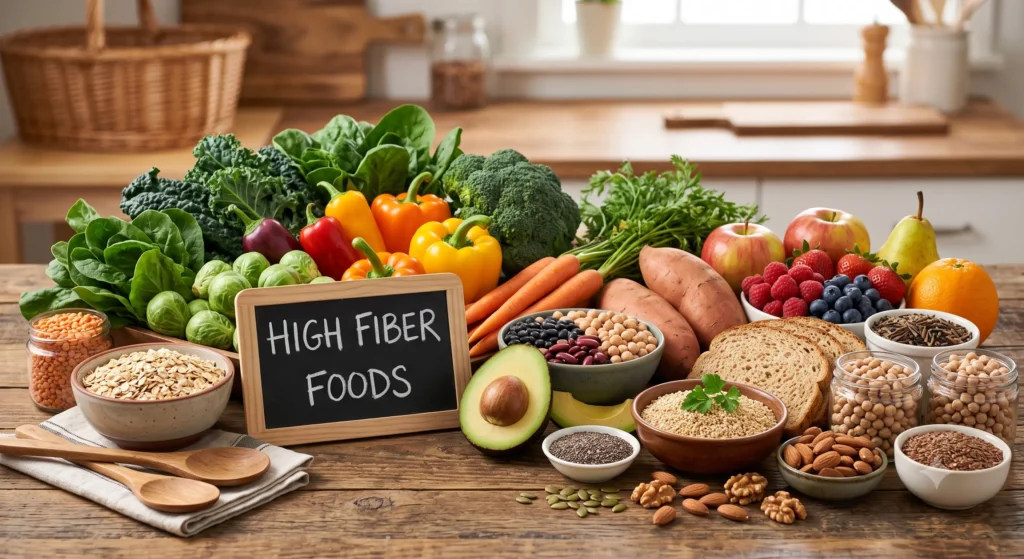
The best foods to get fiber from are legumes (split peas, lentils, black beans), vegetables (artichokes, broccoli, Brussels sprouts), fruits (raspberries, pears, avocado), whole grains (oats, barley, bran), and seeds (chia, flax). Most adults need 25–38 grams of fiber a day, but the average person only eats about 15 grams. Eating a variety of these high fiber foods across meals — rather than relying on one “super food” — is the most realistic way to close that gap.
Below you’ll find a complete, categorized list of foods high in fiber, exactly how many grams each one provides, and a practical plan for actually hitting your daily target without stomach discomfort.
What Counts as a “High Fiber” Food?
Dietary fiber is the part of plant food your body can’t fully break down. It passes through your digestive system mostly intact, and that’s exactly why it matters — it adds bulk to stool, feeds gut bacteria, and slows down how quickly sugar enters your bloodstream.
A food is generally considered “high fiber” if it provides 5 grams or more of fiber per serving, and a “good source” if it provides 2.5–4.9 grams. Almost all high fiber foods are plant-based; meat, fish, eggs, and dairy contain essentially none.
There are two types of fiber, and most high fiber foods contain a mix of both:
- Soluble fiber dissolves in water and forms a gel-like substance. It’s found in oats, beans, apples, and citrus fruit, and it’s linked to lower cholesterol and steadier blood sugar.
- Insoluble fiber doesn’t dissolve and instead adds bulk that helps food move through the gut. It’s found in whole wheat, nuts, and vegetable skins, and it’s the type most associated with regularity.
If you want a deeper breakdown of the two types, see our guides on soluble fiber, insoluble fiber, and soluble vs. insoluble fiber.
How Much Fiber Do You Actually Need?
Fiber needs are based on calorie intake, not a flat number. The general guideline is about 14 grams of fiber for every 1,000 calories consumed, which works out to:
- Women: roughly 25 grams per day
- Men: roughly 38 grams per day
- Children (1–2 years): roughly 19 grams per day
Most adults fall well short of this, averaging only 10–16 grams a day. That gap matters — fiber is one of the few nutrients most people are genuinely deficient in, even those eating what looks like a “healthy” diet.
A common mistake: assuming a food is high fiber because it looks healthy. A serving of white rice, most breakfast cereals, and skinless potatoes all contain surprisingly little fiber. Reading the “Dietary Fiber” line under Total Carbohydrate on a nutrition label is the only reliable way to know.
The Complete High Fiber Foods List
Legumes: The Highest-Fiber Food Category
Legumes consistently top every fiber chart, and for good reason — a single cup of cooked beans or lentils can provide close to half of your daily target in one serving.
| Food (cooked, 1 cup unless noted) | Fiber (grams) |
| Split peas | 16.3 |
| Lentils | 15.6 |
| Black beans | 15.0 |
| Navy beans | 19.1 |
| Pinto beans | 15.4 |
| Chickpeas (garbanzo beans) | 12.5 |
| Kidney beans | 11.3 |
| Edamame (shelled, 1 cup) | 8.0 |
Because legumes are so concentrated, they’re also the easiest way to overshoot your comfort level. Start with a half-cup serving (roughly 6–8 grams of fiber) before working up to a full cup.
Vegetables High in Fiber
| Food | Serving | Fiber (grams) |
| Artichoke, boiled | 1 medium | 10.3 |
| Green peas, boiled | 1 cup | 8.8 |
| Acorn squash, cooked | 1 cup | 9.0 |
| Broccoli, boiled | 1 cup | 5.1 |
| Turnip greens, boiled | 1 cup | 5.0 |
| Brussels sprouts, boiled | 1 cup | 4.1 |
| Sweet corn, boiled | 1 cup | 3.6 |
| Potato, with skin, baked | 1 small | 2.9–3.0 |
| Carrot, raw | 1 medium | 1.7 |
Keeping the skin on potatoes, sweet potatoes, and other root vegetables is a simple way to add fiber without changing your meal at all — most of it sits in the skin.
Fruits High in Fiber
| Food | Serving | Fiber (grams) |
| Raspberries | 1 cup | 8.0 |
| Pear, with skin | 1 medium | 5.5 |
| Avocado | 1 medium | 10.0 |
| Apple, with skin | 1 medium | 4.5 |
| Banana | 1 medium | 3.1 |
| Orange | 1 medium | 3.1 |
| Strawberries, sliced | 1 cup | 3.0 |
Fruit fiber is concentrated in the skin and edible seeds, so peeling fruit — or juicing it — strips out most of the benefit.
Whole Grains and Cereals
| Food | Serving | Fiber (grams) |
| Bran flakes cereal | 1 cup | 7.0 |
| Oat bran, raw | ½ cup | 6.5 |
| Barley, cooked | 1 cup | 6.0 |
| Oatmeal, cooked | 1 cup | 4.0 |
| Popcorn, air-popped | 3 cups | 3.5 |
| Whole wheat pasta, cooked | 1 cup | 3.2 |
| Brown rice, cooked | 1 cup | 3.5 |
When shopping for cereal or bread, look for “100% whole grain” as the first ingredient — “wheat flour” alone usually means refined flour with the fiber-rich bran removed.
Nuts and Seeds High in Fiber
| Food | Serving | Fiber (grams) |
| Chia seeds | 1 oz (2 tbsp) | 10.0 |
| Ground flaxseed | 2 tbsp | 4.0 |
| Almonds | 1 oz (23 nuts) | 3.5 |
| Pistachios | 1 oz | 3.0 |
| Sunflower seeds | 1 oz | 3.0 |
Chia and flax are the most concentrated fiber sources by weight in this entire list. Stirring a tablespoon into oatmeal, yogurt, or a smoothie adds roughly 4–5 grams of fiber without noticeably changing the taste or texture.
Best Foods to Get Fiber From — Ranked by Practicality
Highest fiber-per-gram doesn’t always mean the most practical choice. Here’s how the categories compare when you weigh fiber content against how easy each one is to actually eat every day.
| Category | Fiber Density | Ease of Daily Use | Best For |
| Legumes | Highest | Moderate (needs cooking/planning) | Hitting your target fast |
| Seeds (chia, flax) | Very high | Very easy (add to anything) | Small, consistent boosts |
| Vegetables | Moderate | Easy | Spreading fiber across meals |
| Fruits | Moderate | Very easy | Snacking and breakfast |
| Whole grains | Moderate | Easy | Replacing refined carbs |
| Nuts | Moderate | Easy, but calorie-dense | Portable snacking |
If you’re only going to change one habit, adding legumes to two or three meals a week and a tablespoon of chia or flax to breakfast daily will do more for your fiber intake than almost any other single change.
How to Reach Your Fiber Goal Without Digestive Discomfort
Increasing fiber intake too quickly is the single most common reason people give up on it. A sudden jump can cause gas, bloating, and cramping — not because fiber is harmful, but because your gut bacteria need time to adjust.
- Increase gradually. Add 5 grams a day for a week or two rather than jumping from 15 to 35 grams overnight.
- Drink more water. Fiber — especially soluble fiber — needs fluid to do its job properly. Without enough water, added fiber can actually worsen constipation instead of relieving it.
- Spread it across meals. Three smaller fiber boosts (breakfast, lunch, dinner) are easier on digestion than one very high-fiber meal.
- Mix soluble and insoluble sources. Relying only on wheat bran (insoluble) without any oats or beans (soluble) is a common reason people feel worse instead of better.
- Check labels, not assumptions. “Multigrain” and “made with whole grains” don’t guarantee a high fiber count — check the actual grams on the label.
Sample High Fiber Day (Roughly 30 Grams)
| Meal | Food | Fiber (grams) |
| Breakfast | Oatmeal (1 cup) + chia seeds (1 tbsp) + raspberries (½ cup) | ~10 |
| Lunch | Lentil soup (1 cup) + whole grain bread (1 slice) | ~10 |
| Snack | Apple with skin + 10 almonds | ~6 |
| Dinner | Roasted broccoli (1 cup) + brown rice (½ cup) | ~7 |
This isn’t a strict meal plan — it’s proof that hitting 25–38 grams doesn’t require unusual or unpleasant food. It just requires fiber showing up at every meal instead of one.
When Food Alone Isn’t Enough
Whole foods should always be the first choice for fiber, since they also deliver vitamins, minerals, and water that isolated fiber doesn’t. But for people who are traveling, have a restricted diet, or genuinely struggle to eat enough plants, a supplement can help close the gap.
If that applies to you, these guides can help you choose the right option:
- Best fiber supplement overall
- Best fiber supplement for women
- Best fiber supplement for constipation
- Best fiber supplement for weight loss
- Best fiber powder
- Best fiber pills
- Best fiber gummies
- Best psyllium husk supplement
Frequently Asked Questions
What is the single highest fiber food? By concentration, chia seeds, avocado, and artichoke are tied at roughly 10 grams per serving. By total volume across a typical diet, legumes like split peas and lentils contribute the most fiber per meal.
What are the best foods to get fiber from if I don’t like vegetables? Beans and lentils blended into soups or sauces, oatmeal with chia seeds, and whole fruit (not juice) are the easiest entry points. Fiber doesn’t have to come from salads — legumes and whole grains often provide more per serving than vegetables do.
Can you get too much fiber? Yes, though it’s uncommon on a whole-food diet. Very high intakes without enough water can cause bloating or interfere with mineral absorption. For most people, the bigger risk is eating too little fiber, not too much.
Do cooked vegetables have less fiber than raw ones? Fiber content changes very little with cooking. In some cases, cooking softens plant cell walls and makes fiber slightly easier for your gut to use, though raw and cooked versions are both good sources.
Is fiber in fruit lost when you make juice? Yes, mostly. Juicing removes the pulp and skin, which is where most of the fiber lives. Whole or blended fruit (like a smoothie) keeps the fiber intact.
How quickly will more fiber affect digestion? Some people notice more regular bowel movements within a few days, but full gut adaptation — including reduced bloating from the fiber itself — can take two to three weeks.
The Bottom Line
There’s no single “best” high fiber food — the best foods to get fiber from are the ones you’ll actually eat consistently. Legumes offer the biggest fiber payoff per serving, seeds like chia and flax are the easiest to add to anything, and vegetables and fruit make it simple to spread fiber across the whole day. Focus on variety, increase your intake gradually, and pair it with enough water, and reaching 25–38 grams of fiber a day becomes a realistic habit rather than a one-off effort.
This article is for educational purposes and isn’t a substitute for personalized medical or nutritional advice. If you have a digestive condition or are changing your diet significantly, talk to a doctor or registered dietitian first.