
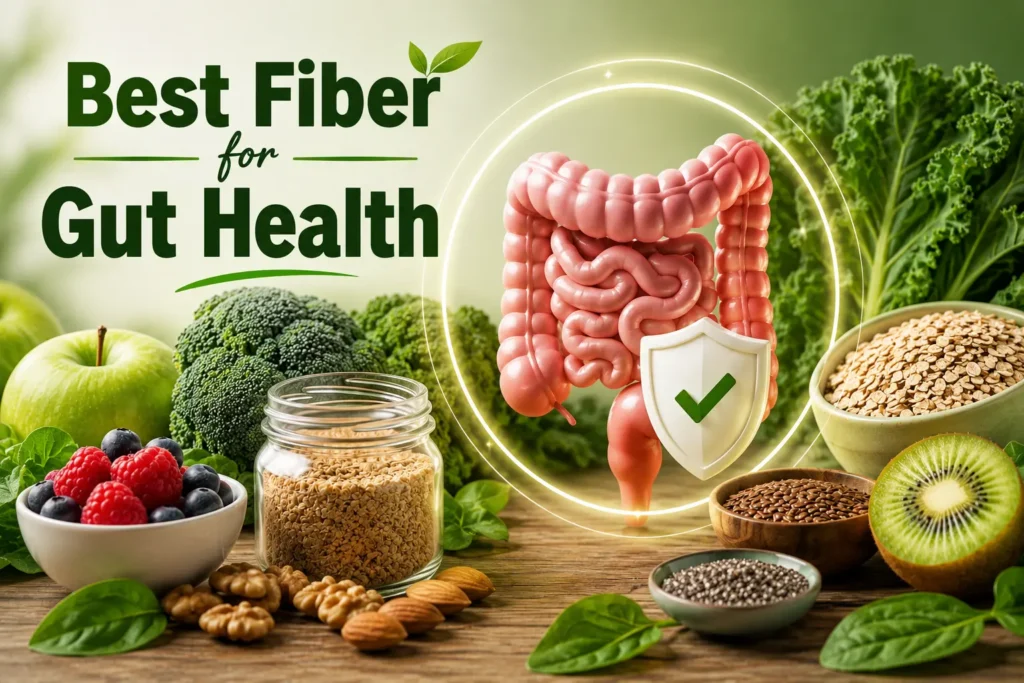
There isn’t one single “best” fiber for gut health — different fibers feed different bacteria and solve different problems. For overall microbiome support, inulin, partially hydrolyzed guar gum (PHGG), acacia fiber, and resistant starch rank among the most effective because they’re highly fermentable and feed beneficial bacteria like Bifidobacterium. For regularity alongside gut support, psyllium husk is the most well-researched all-rounder. The real answer, backed by microbiome research, is that a mix of fiber types — not one isolated source — produces the best results.
Why “Best Fiber” Isn’t a Single Ingredient
Most articles on this topic pick one fiber and call it the winner. That’s not how your gut actually works.
Your colon hosts hundreds of different bacterial species, and each one prefers different food. <cite index=”15-1″>Since each fiber type feeds different bacterial populations, the diversity of prebiotic sources matters more than the quantity of any single one</cite>. A supplement built around one isolated fiber — even a good one — only feeds a narrow slice of your gut’s microbial community.
So this guide isn’t ranking brands. It’s ranking fiber types by how well the evidence supports their effect on gut bacteria, then showing you how to combine or choose between them based on your actual goal.
If you’re new to the basic vocabulary — soluble vs. insoluble, what a “fiber supplement” even is — start with our what is a fiber supplement and soluble vs. insoluble fiber guides first. This article builds on that foundation.
Table of Contents
How Fiber Actually Supports Gut Health
Not all fiber helps your gut bacteria the same way. Here’s the mechanism in plain terms:
- Fermentable fibers reach your colon undigested and are broken down by gut bacteria.
- Bacteria ferment these fibers into short-chain fatty acids (SCFAs) — mainly acetate, propionate, and butyrate.
- SCFAs, especially butyrate, are the primary fuel source for the cells lining your colon, and they help maintain the gut barrier.
- Fermentation also encourages the growth of beneficial species, particularly Bifidobacterium and Lactobacillus.
- Non-fermentable fibers (like methylcellulose) skip this process entirely — they add bulk to stool but don’t feed bacteria.
This is the key distinction most competitor content blurs: a fiber can be great for regularity without doing much for your microbiome, and vice versa. Knowing which one you’re taking — and why — is what actually matters.
The Best Fiber Types for Gut Health, Ranked
| Rank | Fiber Type | Source | Fermentability | Best For |
| 1 | Inulin / FOS | Chicory root, Jerusalem artichoke, agave | Very high | Feeding Bifidobacterium; strongest research base |
| 2 | Partially hydrolyzed guar gum (PHGG) | Guar beans, processed for tolerability | High, but gentler | Gut support with less bloating than inulin |
| 3 | Acacia fiber (gum arabic) | Acacia tree sap | High | Sensitive stomachs; comparable prebiotic effect to inulin |
| 4 | Resistant starch | Green bananas, cooked-and-cooled potatoes/rice, supplements | High | Butyrate production, metabolic support |
| 5 | Galactooligosaccharides (GOS) | Legumes, dairy-derived supplements | High | Targeted Bifidobacterium growth |
| 6 | Psyllium husk | Plantago ovata seed husk | Moderate (mostly bulking) | Regularity plus modest microbiome benefit |
| 7 | Methylcellulose | Plant cellulose, synthetic | None (non-fermentable) | Bulking only — not a gut-bacteria fiber |
How to read this table: rank 1–5 are the strongest choices if your specific goal is feeding gut bacteria. Psyllium and methylcellulose are included because they’re common “gut health” purchases, but they work through a different mechanism — mostly mechanical bulking rather than fermentation.
What the Research Actually Shows
A few points worth being direct about, since supplement marketing often overstates this:
- <cite index=”17-1″>A systematic review found that healthy adults with increased fiber intake had a higher abundance of Bifidobacterium and Lactobacillus, along with higher fecal butyrate levels, compared with people eating less fiber</cite> — but this effect was strongest for recognized prebiotic fibers specifically, not fiber in general.
- <cite index=”17-1″>The same review found that fiber intake did not meaningfully change the abundance of several other important bacteria, including Faecalibacterium prausnitzii and Roseburia species</cite> — meaning fiber supplements boost some beneficial bacteria more than others, not your entire microbiome uniformly.
- <cite index=”15-1″>Whole foods remain more effective than isolated prebiotic supplements, because the fiber in food is embedded in a “food matrix” alongside other fibers, polyphenols, vitamins, and minerals that work together</cite> — an isolated extract can’t fully replicate that.
- <cite index=”16-1″>Acacia gum has shown prebiotic efficacy comparable to inulin</cite> in research, which makes it a solid alternative for people who find inulin too gassy.
Fermentable vs. Non-Fermentable Fiber: The Comparison Competitors Skip
Most “best fiber” articles never explain this distinction clearly, even though it’s the single most useful thing to understand before buying anything.
| Fermentable (Gut-Feeding) Fiber | Non-Fermentable (Bulking) Fiber | |
| Examples | Inulin, PHGG, acacia, resistant starch, GOS | Methylcellulose, wheat bran (partially), cellulose |
| Feeds gut bacteria | Yes | No |
| Produces SCFAs | Yes | No |
| Main benefit | Microbiome diversity, butyrate production | Stool bulk, regularity, less gas |
| Bloating risk | Higher, especially at high doses | Lower |
| Best if your goal is… | Improving gut bacteria balance | Constipation without extra gas |
If constipation is your main issue rather than microbiome support specifically, our best fiber supplement for constipation guide is more directly relevant than a gut-health-focused pick.
How Much Prebiotic Fiber Do You Actually Need?
<cite index=”13-1″>Research suggests that consuming 5 to 10 grams of prebiotic fiber daily can meaningfully improve gut bacteria diversity</cite>. That’s a smaller number than the 25–38 grams recommended for total daily fiber — prebiotic fiber is typically layered on top of, not instead of, your broader fiber intake.
A practical starting approach:
- Week 1–2: Start with 2–3 grams of a fermentable fiber (inulin, PHGG, or acacia) once daily.
- Week 3–4: Increase gradually toward 5–10 grams daily if well tolerated.
- Ongoing: Rotate or combine fiber sources rather than relying on one type indefinitely — this better reflects how a varied, plant-rich diet naturally works.
<cite index=”12-1″>For prebiotic-specific benefits, like measurable shifts in gut bacteria populations, most research points to at least four to six weeks of consistent use before meaningful changes show up</cite> — noticeably longer than the few days it takes for a bulking fiber to affect regularity.
Common Mistakes When Choosing a Fiber for Gut Health
- Picking based on marketing, not mechanism. “Gut health” appears on packaging for products that are purely bulking fibers with no fermentation benefit at all.
- Jumping straight to 10+ grams of inulin. This is the single most common cause of the bloating and gas that makes people quit fiber supplements altogether.
- Relying on one fiber source long-term. <cite index=”15-1″>A narrow scope of one or two fiber types only feeds a limited portion of your gut’s microbial community</cite>, since a genuinely diverse microbiome needs a wide variety of prebiotic compounds.
- Ignoring hidden inulin in packaged foods. <cite index=”14-1″>Inulin is one of the most common isolated fibers added to processed foods, and it’s easy to consume more than intended when it’s hidden in products like “high fiber” bars or prebiotic sodas</cite>.
- Expecting fast results. Regularity changes quickly; microbiome shifts take weeks, not days.
Pros and Cons of Prioritizing Gut-Focused Fiber Supplements
| Pros | Cons |
| Directly feeds beneficial bacteria (Bifidobacterium, Lactobacillus) | Effects vary significantly by fiber type and individual gut composition |
| Produces SCFAs that support the gut lining | Highly fermentable fibers often cause more gas/bloating than bulking fibers |
| Can complement probiotics for a more complete approach | Isolated supplements don’t match the benefit of whole-food fiber diversity |
| Available in gentler forms (PHGG, acacia) for sensitive guts | Takes weeks, not days, to see microbiome-level changes |
Decision Framework: Which Fiber Type Fits Your Situation?
1. Is your main goal feeding gut bacteria, or relieving constipation?
- Gut bacteria/microbiome → inulin, PHGG, acacia, resistant starch, GOS
- Constipation specifically → psyllium husk or methylcellulose (see our soluble fiber and insoluble fiber guides)
2. How sensitive is your gut to gas and bloating?
- Very sensitive → start with acacia or PHGG, both known for being gentler than inulin
- Tolerant → inulin/FOS has the strongest research base if you can handle it
3. Do you want a natural or highly processed source?
- Prefer minimally processed → acacia gum, resistant starch from food (green bananas, cooled potatoes)
- Comfortable with a refined supplement → PHGG or inulin powder
4. Are you also taking probiotics?
- <cite index=”12-1″>Prebiotic fiber and probiotics complement each other, and there’s no need to time them separately — taking them together or apart both work fine</cite>.
For product comparisons by category, see our guides to the best soluble fiber supplement, best natural fiber supplement, and best daily fiber supplement. If psyllium is on your shortlist, our dedicated psyllium husk and best psyllium husk guides go deeper.
Food First: The Best Whole-Food Sources for Each Fiber Type
Supplements are convenient, but whole foods still provide the strongest evidence base and the widest variety of fiber types in one place.
| Fiber Type | Best Food Sources |
| Inulin | Chicory root, Jerusalem artichoke, garlic, onions, leeks |
| Resistant starch | Green (unripe) bananas, cooked-and-cooled potatoes, rice, and pasta, oats |
| GOS | Lentils, chickpeas, black beans, kidney beans |
| Acacia-type gums | Less common in whole foods; mostly supplement-derived |
| Psyllium-like bulking fiber | Whole grains, flaxseed, chia seeds |
For a broader list, our high-fiber foods guide covers sources across every fiber category, not just the gut-focused ones.
Is It Safe to Take Gut-Focused Fiber Every Day?
For most healthy adults, yes — fermentable fibers like inulin, PHGG, and acacia are generally well tolerated in the 5–10 gram daily range once you’ve built up to it gradually. That said, evidence on ideal long-term dosing for microbiome outcomes specifically is still developing, so treating these as a steady daily habit rather than a “more is better” approach is the more evidence-aligned choice.
People who should talk to a doctor before adding a prebiotic fiber supplement include those with:
- IBS, especially if FODMAP-sensitive (inulin and GOS are both high-FODMAP and can trigger symptoms)
- Inflammatory bowel disease during active flares
- A history of SIBO (small intestinal bacterial overgrowth)
- Any planned medication that requires consistent absorption timing
Frequently Asked Questions
What is the single best fiber for gut bacteria? Inulin has the strongest and longest research history for feeding beneficial bacteria like Bifidobacterium, but it isn’t automatically “best” for everyone — acacia and PHGG offer similar prebiotic benefits with less bloating for sensitive stomachs.
Is psyllium husk good for gut health, or just for constipation? <cite index=”12-1″>Psyllium is predominantly soluble but largely non-fermentable, meaning it helps with regularity by bulking stool rather than feeding bacteria directly</cite>. It’s still valuable for digestive health overall, just through a different mechanism than prebiotic fibers.
Can I combine multiple types of gut-health fiber? Yes, and it’s often more effective than relying on one source, since different fibers feed different bacterial species. Start with small amounts of each and increase gradually to avoid excess gas.
How long before I notice gut health improvements from fiber? Regularity changes can appear within days. Measurable shifts in gut bacteria composition typically take four to six weeks of consistent intake.
Do fiber supplements work as well as prebiotic-rich foods? Not quite. Whole foods deliver prebiotic fiber alongside other nutrients and fiber types that isolated supplements can’t replicate, so supplements are best used to fill gaps, not replace a plant-diverse diet.
Can too much prebiotic fiber be bad for gut health? Excess fermentable fiber, taken too quickly, commonly causes gas, bloating, and cramping — and in people with IBS or SIBO, it can worsen symptoms. Gradual increases and adequate hydration reduce this risk significantly.
Final Verdict
If you want one fiber to start with for gut health, inulin or PHGG offer the strongest combination of research support and practical availability — with acacia as the better option for a sensitive stomach. But the honest, evidence-based answer is that no single fiber type does everything: pairing a fermentable, gut-feeding fiber with a diverse, plant-rich diet — and adjusting for your own tolerance — consistently outperforms chasing one “best” ingredient.
To go further, explore our complete best fiber supplement guide, or narrow your search with our best fiber supplement for women and best fiber supplement for weight loss picks.
This article is for educational purposes only and is not a substitute for professional medical advice. Talk to a doctor or registered dietitian before starting a new fiber supplement, especially if you have a digestive condition or take medication.