
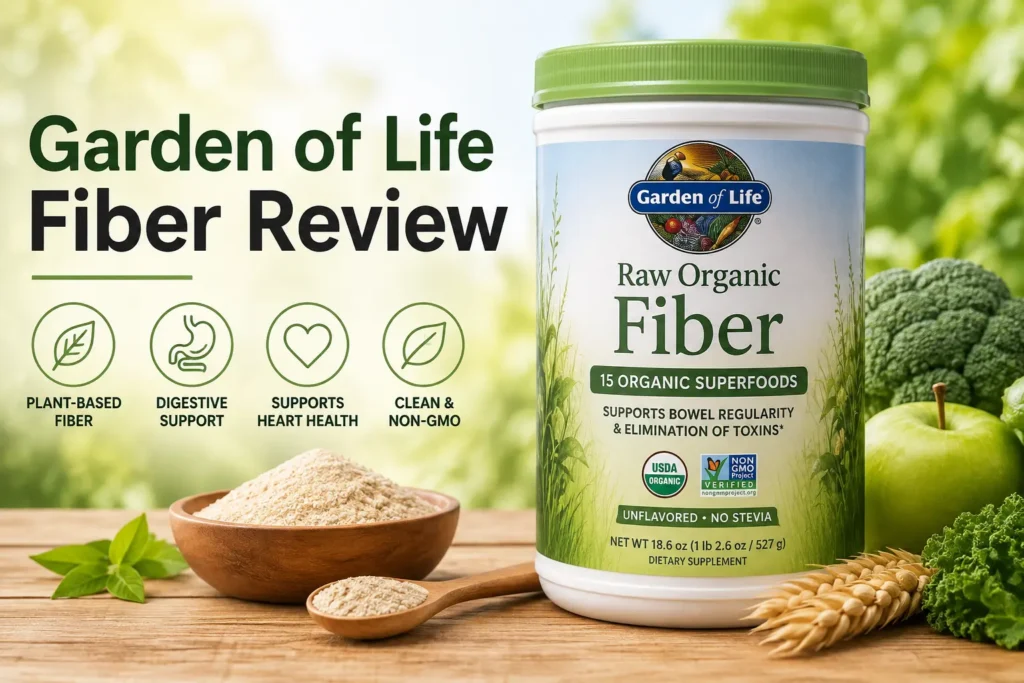
Garden of Life Fiber Review: Garden of Life Raw Organic Fiber is a plant-based powder built from 15 sprouted organic seeds, grains, and legumes rather than a single fiber source like psyllium or acacia.. Each scoop delivers 9 grams of fiber (4g soluble, 5g insoluble), a small dose of omega-3s, and a probiotic strain. It’s a solid choice for people who want a whole-food fiber blend and want to avoid psyllium, but it’s thicker, pricier, and less predictable in texture than single-ingredient options like acacia fiber or psyllium husk.
If you’ve been comparing fiber supplements, you’ve probably noticed that most reviews just repeat the marketing copy off the label. This one digs into what’s actually in the tub, how it behaves in real use, who it works well for, and where it falls short — including an honest look at how it stacks up against Heather’s Tummy Fiber, a pure acacia product that gets compared to it constantly despite being a very different type of supplement.
Table of Contents
What Is Garden of Life Raw Organic Fiber?
Garden of Life Raw Organic Fiber (sold in the “RAW” line) is a certified organic, unflavored fiber powder made from a blend of sprouted seeds, grains, and legumes rather than an isolated fiber like psyllium husk, inulin, or acacia gum. The idea behind it is different from most fiber supplements on the market: instead of concentrating one fiber source, Garden of Life sprouts a mix of whole foods and grinds them into a fine powder, so you’re getting fiber alongside small amounts of protein, healthy fats, and plant compounds that come along for the ride.
This matters for search intent, because a lot of people typing “Garden of Life fiber review” are really asking one of three things: does it work, does it taste okay, and is it worth the price compared to something simpler like a best fiber powder or best psyllium husk product. We’ll answer all three.
What’s Actually Inside It
The label is more crowded than a typical fiber supplement, which is the whole point of the product. Here’s the breakdown of the core blend:
Raw Organic Sprout & Fiber Blend — organic flax seed (meal and sprout), amaranth sprout, quinoa sprout, chia (seed and sprout), millet sprout, buckwheat sprout, garbanzo bean sprout, lentil sprout, adzuki bean sprout, sunflower seed sprout, pumpkin seed sprout, sesame seed sprout, and coconut flour, along with a small amount of the probiotic strain Bacillus coagulans.
The only other ingredient is organic stevia leaf extract — a small amount used to soften the flavor slightly, since the blend of legume and seed sprouts on its own can taste earthy and slightly bitter.
Supplement Facts (per 1 scoop / ~20g serving)
| Nutrient | Amount | % Daily Value |
| Calories | 120 | — |
| Total Fat | 4g | 5% |
| Total Carbohydrate | 16g | 6% |
| Dietary Fiber | 9g | 32% |
| — Soluble Fiber | 4g | — |
| — Insoluble Fiber | 5g | — |
| Total Sugars | 1g | — |
| Protein | 7g | 14% |
| Omega-3 (ALA) | 1g | — |
A few things stand out here that most competitor reviews skip over. First, this is one of the only fiber supplements on the market that also delivers a meaningful amount of protein (7g) and omega-3 fatty acids (1g ALA from flax and chia) in the same scoop — most fiber products, including acacia fiber and wheat dextrin, contribute close to zero protein or fat. Second, the fiber is genuinely mixed — a near 50/50 soluble-to-insoluble ratio — which is relatively balanced compared to, say, straight psyllium husk, which leans much more soluble.
How It Works in the Gut
The soluble fiber (from flax, chia, and legume sprouts) dissolves in water to form a gel-like substance in the digestive tract. This slows digestion, helps you feel fuller, and can support healthy blood sugar and cholesterol levels already within a normal range — the same general mechanism you’d get from oat fiber or beta-glucan fiber.
The insoluble fiber (largely from the grain and bean sprouts and coconut flour) adds bulk to stool and helps move material through the intestines more efficiently, which is the main driver of the “regularity” effect people report.
The added Bacillus coagulans is a spore-forming probiotic strain that’s shelf-stable at room temperature, unlike many refrigerated probiotics. It’s included at a modest dose, so think of it as a small bonus rather than a primary reason to buy this product — if gut flora support is your main goal, you’d get a more targeted effect from a dedicated prebiotic fiber supplement or a probiotic and fiber supplement.
Benefits
- Whole-food fiber source. Instead of one isolated fiber, you’re getting fiber from 13 different plant sources, which mimics the diversity you’d get from eating a varied high-fiber diet.
- Psyllium-free. A real advantage for the subset of people who find psyllium husk gritty, mucilage-heavy, or irritating to a sensitive gut.
- Balanced soluble/insoluble ratio. Useful for general digestive support rather than solving one specific problem.
- Added nutrients. Small but real amounts of plant protein and omega-3 ALA that most single-ingredient fiber powders don’t offer.
- Certified organic, non-GMO, gluten-free, and vegan, which matters if those certifications are non-negotiable for you.
Drawbacks
- Thickens quickly. Multiple users note the powder gels and thickens fast, especially if you let it sit in liquid for more than a minute or two before drinking.
- Texture is polarizing. It works well blended into a smoothie or yogurt; mixed into plain water, several reviewers describe it as gritty or “funky” tasting once you use a full scoop.
- Contains tree nuts (coconut) and sesame, and is made in a facility that also processes egg, milk, soy, wheat, and fish — a real consideration for anyone with food allergies.
- Pricier per serving than single-ingredient fiber powders like acacia or psyllium.
- Not ideal for acute constipation relief. Because the fiber is spread across many plant sources rather than concentrated, the effect tends to be gentler and slower than a therapeutic dose of psyllium or a stimulant-free option built for constipation.
Pros & Cons at a Glance
| Pros | Cons |
| 15-ingredient whole-food fiber blend | Thickens fast, can turn gritty in plain water |
| No psyllium — gentler for sensitive colons | Contains coconut and sesame allergens |
| Balanced soluble and insoluble fiber (4g / 5g) | Higher cost per serving than single-ingredient fibers |
| Bonus protein (7g) and omega-3 ALA (1g) per scoop | Effect is gradual, not built for fast constipation relief |
| USDA Organic, Non-GMO, gluten-free, vegan | Some users report mild bloating in the first week |
What Real Users Say
Across retailer reviews, a pattern shows up consistently. People who blend it into smoothies, oatmeal, or Greek yogurt tend to report a pleasant, mildly nutty taste and no digestive discomfort. People who mix a full scoop into plain water more often describe the texture as thick or “funky,” and a handful specifically call out the stevia aftertaste as a dealbreaker.
On the effectiveness side, most reviewers report improved regularity within the first one to two weeks, and a common theme is that it doesn’t cause the sudden bloating some people experience with concentrated psyllium or inulin products — though a small number of users do report initial bloating, which is typical of any fiber increase and usually settles once your gut adjusts.
Garden of Life Raw Organic Fiber vs. Heather’s Tummy Fiber (Acacia)
This is where most competitor articles fall short — they either don’t compare the two at all, or they treat them as interchangeable. They’re not. This is genuinely one of the more useful comparisons for anyone choosing between the two, because the products solve different problems.
| Feature | Garden of Life Raw Organic Fiber | Heather’s Tummy Fiber (100% Acacia) |
| Fiber source | 13 sprouted seeds, grains & legumes | Pure organic acacia senegal gum |
| Fiber per serving | 9g (4g soluble / 5g insoluble) | ~4-5g, almost entirely soluble |
| Texture in water | Thickens, can turn gritty | Dissolves clear, virtually no texture |
| Taste | Mild, nutty, lightly sweetened with stevia | Essentially tasteless |
| Best suited for | General fiber gap-filling, whole-food approach | IBS, SIBO-friendly diets, sensitive guts, low-FODMAP needs |
| Extras | Protein, omega-3 ALA, a probiotic strain | None — single ingredient by design |
| Gas/bloating risk | Low to moderate | Very low when dosed gradually |
The short version: if you have a sensitive gut, IBS, or you’re following a low-FODMAP protocol, acacia fiber — including Heather’s Tummy Fiber specifically — is usually the gentler, more predictable choice because it’s a single, well-studied soluble fiber with a long track record in IBS research. If you want a broader whole-food fiber source with some added nutritional extras and you don’t have a sensitive-gut diagnosis, Garden of Life’s blend is the more nutrient-dense option. Read our full tummy fiber acacia breakdown if that’s your main concern.
It’s also worth noting these aren’t the only two paths. If you’re weighing fiber type more broadly, our guide to soluble vs. insoluble fiber and inulin vs. acacia fiber can help you narrow things down further.
Who This Is a Good Fit For
- People who want a fiber supplement that reads more like a whole-food product than an isolated ingredient
- Anyone specifically avoiding psyllium due to past irritation
- People who already use smoothies, oatmeal, or yogurt daily and want an easy way to fold fiber in
- Those who want a small nutritional bonus (protein, omega-3, probiotics) alongside their fiber
Who Should Consider a Different Option
- Anyone with a coconut, sesame, or tree nut allergy
- People with diagnosed IBS or SIBO, who typically do better with a single, well-tolerated fiber like acacia — see our best fiber supplement for IBS guide
- Anyone who mainly drinks fiber in plain water and wants a smooth, gritless mix — a best soluble fiber supplement will usually dissolve more cleanly
- People looking for fast relief from occasional constipation, where a more concentrated fiber source may act more predictably — compare options in our best fiber supplement for constipation guide
How to Use It
The label directs adults to mix one scoop (about 20g) with 10–12 ounces of water, once or more per day, and children four and up to use half a scoop under supervision. In practice, most reviewers get better results blending it into a smoothie or stirring it into yogurt or oatmeal rather than drinking it straight in water, since that’s where the gritty texture is least noticeable.
As with any fiber supplement, a gradual start matters more than the product itself. Jumping straight to a full scoop can cause temporary bloating or gas regardless of which fiber you choose — starting with a half scoop for the first few days and increasing water intake alongside it is the more comfortable approach. If you’re new to fiber supplementation generally, our guide on when should I take fiber supplements and do I need a fiber supplement covers the basics.
Price and Value
Garden of Life Raw Organic Fiber sits at the higher end of the fiber supplement price range, reflecting its organic certification and 15-ingredient sprouted blend rather than a single bulk-produced fiber source. Pricing varies by retailer and container size, so it’s worth checking current pricing directly on iHerb, Walmart, or the Garden of Life site before buying, since supplement pricing shifts frequently. Per gram of fiber, it costs noticeably more than a comparable serving of plain acacia or psyllium powder — the trade-off is the added protein, omega-3s, and ingredient diversity you’re paying for.
Common Mistakes People Make With This Product
- Drinking it immediately without stirring long enough, which leaves clumps at the bottom of the glass.
- Letting it sit too long before drinking, which causes the gel-forming fibers to thicken past the point of being pleasant to drink.
- Starting with a full scoop on day one, which increases the odds of bloating that a slower ramp-up would have avoided.
- Assuming it’s interchangeable with acacia or psyllium for IBS management, when it’s a fundamentally different, more complex fiber blend.
Frequently Asked Questions
Does Garden of Life Raw Organic Fiber cause bloating? Some users report mild, temporary bloating in the first week, which is common with any fiber increase. It tends to resolve as your gut adjusts, especially if you start with a half scoop and increase water intake.
Is Garden of Life Raw Organic Fiber the same as Heather’s Tummy Fiber? No. Garden of Life’s product is a blend of 13 sprouted seeds, grains, and legumes with a mixed soluble/insoluble profile, while Heather’s Tummy Fiber is a single-ingredient, nearly pure soluble acacia fiber designed specifically for sensitive digestive systems like IBS.
Can I take Garden of Life Fiber every day? Yes, the label is designed for daily use, one or more scoops per day mixed with water, smoothies, or food. As with any fiber supplement, pairing it with adequate water intake matters for comfort and effectiveness.
Does it contain psyllium? No. It’s specifically formulated without psyllium husk, which the brand markets as gentler for people with sensitive colons who find psyllium’s mucilage texture irritating.
Is it keto-friendly? The product is certified Keto, though it does contain 16g of total carbohydrate per serving, most of which comes from fiber rather than net digestible carbs.
What does it taste like? Reviewers consistently describe it as mildly nutty and lightly sweetened by the small amount of stevia, with the strongest opinions split between people who find it pleasant in smoothies and those who find plain water mixes too thick or slightly off-tasting.
Final Verdict
Garden of Life Raw Organic Fiber earns its place as one of the more nutrient-dense fiber powders on the market — it’s not just fiber, it’s a whole-food blend with added protein, omega-3s, and a probiotic strain, all psyllium-free and organic. It’s a strong option if you want a broad-spectrum fiber source to round out your diet and you don’t mind a thicker texture or a higher price tag.
It’s not the right choice if you have a diagnosed sensitive-gut condition like IBS, need predictable and fast relief from constipation, or want a fiber powder that dissolves cleanly in a glass of water. In those cases, a single-ingredient fiber like acacia or a best psyllium husk product will likely serve you better. For most healthy adults just trying to close a fiber gap in their diet, though, this is a well-formulated, clean-label option worth the higher price.
If you’re still deciding between fiber types generally, our how to choose a fiber supplement guide walks through the full decision framework, and our best fiber powder roundup compares this product directly against its closest competitors.
This article is for educational purposes only and is not medical advice. Talk to your doctor before starting any new supplement, especially if you’re pregnant, nursing, on medication, or managing a digestive condition.