
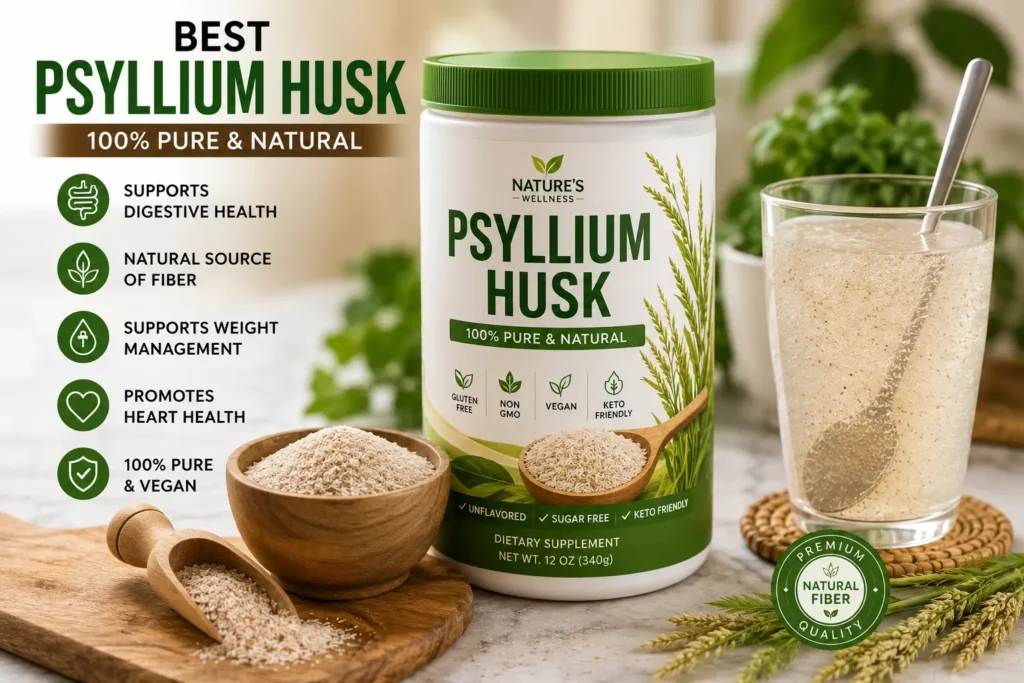
Quick answer: The best psyllium husk for most people is a pure, unflavored, 100% psyllium husk powder or fine powder capsule with no added sugar, artificial sweeteners, or fillers. Powder gives you more control over dosage and mixes into a stronger gel, which makes it slightly more effective for constipation and cholesterol support. Capsules are more convenient and easier to tolerate for people who dislike the texture of psyllium in water. Whichever form you choose, look for a product that lists psyllium husk (not psyllium seed alone) as the only active ingredient, and always take it with a full glass of water.
Psyllium husk has gone from a pharmacy-shelf laxative to one of the most talked-about fiber supplements online, partly thanks to renewed media coverage of the research behind it. But “best” doesn’t mean the same thing for everyone. Someone taking psyllium for occasional constipation has different needs than someone using it to support cholesterol, blood sugar, or a low-fiber diet. This guide breaks down exactly what to look for, how the different forms compare, and how to avoid the mistakes that make people quit psyllium before it has a chance to work.
Table of Contents
What Is Psyllium Husk?
Psyllium husk is the outer coating of the seed from Plantago ovata, a plant grown mainly in India and Pakistan. The husk is dried and ground into a powder that is almost entirely soluble fiber.
When psyllium meets water, it doesn’t dissolve like sugar — it swells into a thick, viscous gel. That gel is the whole point. As it travels through your digestive tract, it:
- Softens and adds bulk to stool, making it easier to pass
- Slows down digestion, which can blunt post-meal blood sugar spikes
- Binds to bile acids in the gut, which the liver then has to replace using cholesterol from the bloodstream — one reason psyllium is linked to modest LDL reductions
Psyllium is the main ingredient in well-known laxative brands like Metamucil, but it’s also sold as a standalone supplement in plain powder, flavored powder, and capsule form.
Related reading: For a broader comparison of fiber types, see our guide to the best fiber supplement overall, or jump straight to our dedicated psyllium husk overview if you want the full ingredient deep-dive.
What the Research Actually Supports
It’s worth being upfront: psyllium is one of the better-studied fiber supplements, but its benefits vary in strength. Recent reporting, including coverage in The New York Times citing gastroenterologist William Chey, MD, of Michigan Medicine, has renewed attention on psyllium — but the underlying evidence isn’t new, and it doesn’t support every claim circulating online.
| Benefit | Strength of Evidence | What the Research Shows |
| Constipation relief | Strong | FDA-recognized bulk-forming laxative; one of the most consistently effective fibers for regularity |
| LDL (“bad”) cholesterol | Moderate | Around 10 g/day is linked to modest LDL reductions in multiple trials |
| Blood sugar management | Moderate | May modestly improve post-meal glucose response, particularly when taken with meals, in people with type 2 diabetes or prediabetes |
| Diarrhea / IBS symptoms | Moderate | Its gel-forming action can firm up loose stools and ease IBS-related irregularity |
| Weight loss | Weak | Reviews have found little to no effect on body weight, BMI, or waist circumference compared with placebo |
| Blood pressure | Limited | Some studies show a small effect, but evidence is less consistent than for cholesterol |
Psyllium is sometimes nicknamed “nature’s Ozempic” online. That comparison overstates the evidence — psyllium can support digestion, cholesterol, and blood sugar to a modest degree, but it isn’t a substitute for medication, and it works best alongside a diet already rich in whole grains, legumes, vegetables, and fruit rather than in place of one.
If you’re specifically comparing psyllium to other soluble fibers for these purposes, our guide to the best soluble fiber supplement covers how it stacks up against options like glucomannan and beta-glucan.
Psyllium Husk Powder vs. Capsules: Which Is Better?
This is the most common decision buyers face, and there’s no universally “best” answer — it depends on your goal and your tolerance for the texture.
| Factor | Psyllium Husk Powder | Psyllium Husk Capsules |
| Dosage control | Very precise (measure by gram or scoop) | Fixed per capsule; may need several capsules to hit an effective dose |
| Speed of gel formation | Fast — forms a gel within seconds, must be drunk quickly | Gel forms in the stomach after swallowing |
| Convenience | Requires mixing with water each time | Grab-and-go, easy to travel with |
| Taste/texture | Some find the gritty, mucilaginous texture unpleasant | No taste, no texture issue |
| Cost per effective dose | Usually cheaper per gram of fiber | Usually more expensive per gram of fiber |
| Best for | Constipation, cholesterol support, higher daily fiber goals | People who dislike mixing powders or are sensitive to the texture |
Practical tip: A typical effective dose is 5–10 grams of psyllium per day, and most capsule products only deliver 0.5–1 gram of fiber per capsule. That means reaching a therapeutic dose with capsules can mean swallowing 8–15 capsules a day — worth checking before you buy, since some people underdose without realizing it.
If capsules are your preference for convenience, see our dedicated best fiber pills guide for how psyllium capsules compare to other pill-based fiber options. If you’d rather stick with powder, our best fiber powder guide covers non-psyllium alternatives as well.
How to Choose the Best Psyllium Husk Brand
Most psyllium husk products look similar at a glance, but quality varies more than people expect. Here’s what actually separates a good brand from a mediocre one.
1. Check the ingredient list first
The best psyllium husk products contain only psyllium husk — nothing else. Avoid products where psyllium husk powder is padded with fillers, maltodextrin, or excessive flow agents. A short ingredient list is usually a good sign.
2. Watch for added sugar and artificial sweeteners
Many mainstream psyllium products (especially orange-flavored ones) contain added sugar or aspartame to mask the taste. If you’re using psyllium for blood sugar or weight-related goals, an unflavored version defeats the purpose of adding sugar back in.
3. Look for husk, not whole seed or seed powder
“Psyllium husk” and “psyllium seed” are not interchangeable. The husk is almost pure soluble fiber; whole seed contains more insoluble fiber and starch, and behaves differently in the gut. Products labeled simply “psyllium powder” should specify husk content.
4. Prioritize fine or superfine grind for capsules
Coarse psyllium husk can be harder to compress into capsules efficiently, often requiring more capsules per dose. Fine or “husk powder” grinds tend to pack more fiber per capsule.
5. Third-party testing and certifications
Because psyllium is grown and processed largely in South Asia, contamination with pesticide residue or heavy metals is a real quality concern in the supplement industry generally. Look for brands that state independent lab testing, USDA Organic certification, or Non-GMO Project Verification — these aren’t proof of purity on their own, but they add a layer of accountability.
6. Check the fiber content per serving, not just the price
A cheaper product with a lower percentage of active psyllium husk (bulked up with fillers) can end up costing more per effective gram than a pricier, purer product. Always compare cost per gram of actual fiber, not cost per container.
Common Mistakes People Make With Psyllium Husk
Most negative experiences with psyllium come down to a handful of avoidable mistakes rather than the ingredient itself.
- Not drinking enough water. Psyllium needs at least 8 ounces (about 240 ml) of water per dose. Without enough liquid, the gel can form in the throat or gut and cause choking or blockage risk — this is a genuine safety issue, not just a comfort one.
- Starting at too high a dose. Jumping straight to 10 g/day often causes bloating and gas. Start with 3–5 g/day and increase gradually over one to two weeks.
- Taking it at the wrong time for the goal. For blood sugar support, psyllium works best taken with or just before meals. For general regularity, timing matters less, as long as it’s consistent daily.
- Taking it too close to medications. Psyllium’s gel-forming action can slow the absorption of some oral medications. A general rule is to separate psyllium from other medications by at least two hours, but check with a pharmacist or doctor for anything with a narrow safety margin.
- Expecting fast weight loss results. As covered above, the evidence for psyllium and weight loss specifically is weak. Expecting dramatic results here tends to lead people to quit a supplement that’s actually working for its stronger uses (regularity, cholesterol).
- Quitting after a few days. Psyllium’s cholesterol and blood sugar effects build over weeks of consistent use, not days. Short-term trials aren’t a fair test of those particular benefits.
Who Should Be Cautious With Psyllium Husk
Psyllium is generally well tolerated, but it isn’t right for everyone. Speak with a healthcare provider before starting psyllium if you:
- Have a diagnosed bowel obstruction, difficulty swallowing, or esophageal narrowing
- Take medications with a narrow therapeutic window (certain diabetes, thyroid, or heart medications)
- Have a known allergy to psyllium — allergic reactions, while uncommon, have been reported, particularly with inhaled psyllium dust in occupational settings
- Are pregnant or breastfeeding and want guidance on appropriate dosing
This article is educational and is not a substitute for personalized medical advice.
Psyllium Husk for Specific Goals
For constipation: Powder is generally the more reliable choice because it delivers a full, controllable dose and forms a stronger gel. This is the use case with the strongest research support. See our best fiber supplement for constipation guide for a deeper comparison of options.
For weight management support: Psyllium may help with satiety as part of a broader calorie-conscious diet, but shouldn’t be relied on as a standalone weight-loss tool. Our best fiber supplement for weight loss guide explains what fiber can realistically do here.
For women’s digestive and hormonal-cycle-related regularity: Fiber needs can shift with hormonal changes. See our best fiber supplement for women guide for more on that.
For daily maintenance fiber intake: If you’re simply trying to close a daily fiber gap rather than treat a specific issue, a lower, consistent daily dose works well — our best daily fiber supplement and best natural fiber supplement guides cover gentler, everyday options alongside psyllium.
Frequently Asked Questions
Is psyllium husk powder better than capsules? Neither is objectively “better” — powder gives more precise dosing and a stronger gel effect, which tends to work better for constipation and cholesterol goals. Capsules are more convenient and better for people who dislike the texture, but usually require several capsules to match an effective powder dose.
How much psyllium husk should I take per day? Most research uses doses in the 5–10 gram per day range, typically split across one to three doses. It’s best to start around 3–5 grams per day and increase gradually to avoid bloating.
Can I take psyllium husk every day long-term? Yes, psyllium is generally considered safe for regular daily use, and its cholesterol and blood-sugar benefits specifically depend on consistent, ongoing use rather than occasional use.
Does psyllium husk cause bloating? It can, especially if you start at too high a dose or don’t drink enough water. Bloating is more common in the first week or two and often improves as your gut adjusts and you increase intake gradually.
Is psyllium husk the same as Metamucil? Metamucil is a brand name product whose main active ingredient is psyllium husk, often combined with sweeteners or flavoring. Plain psyllium husk powder or capsules contain the same core fiber without those additions.
What’s the difference between psyllium husk and psyllium husk powder? “Psyllium husk” typically refers to the coarser, flaky form, while “psyllium husk powder” is ground finer. Powder mixes more smoothly and is generally preferred for daily use; the coarser husk form is less common in consumer products.
Can psyllium husk help with cholesterol? Modest reductions in LDL cholesterol have been observed in studies using around 10 grams of psyllium daily over several weeks, typically alongside a heart-healthy diet — not as a replacement for one.
Final Verdict
The best psyllium husk isn’t the flashiest or most expensive option — it’s the one with the shortest ingredient list, an appropriate husk-to-filler ratio, and a form (powder or capsule) that actually fits into your routine consistently. For most people focused on regularity or cholesterol support, an unflavored, pure psyllium husk powder offers the most control and the strongest evidence-backed effect. For convenience-first users, a fine-ground capsule with a clearly labeled fiber content per serving is a reasonable alternative — just be realistic about how many capsules it takes to reach an effective dose.
Whichever you choose, the two habits that matter most are drinking enough water with every dose and increasing your intake gradually. Those two factors, more than any specific brand, determine whether psyllium husk works well for you.