
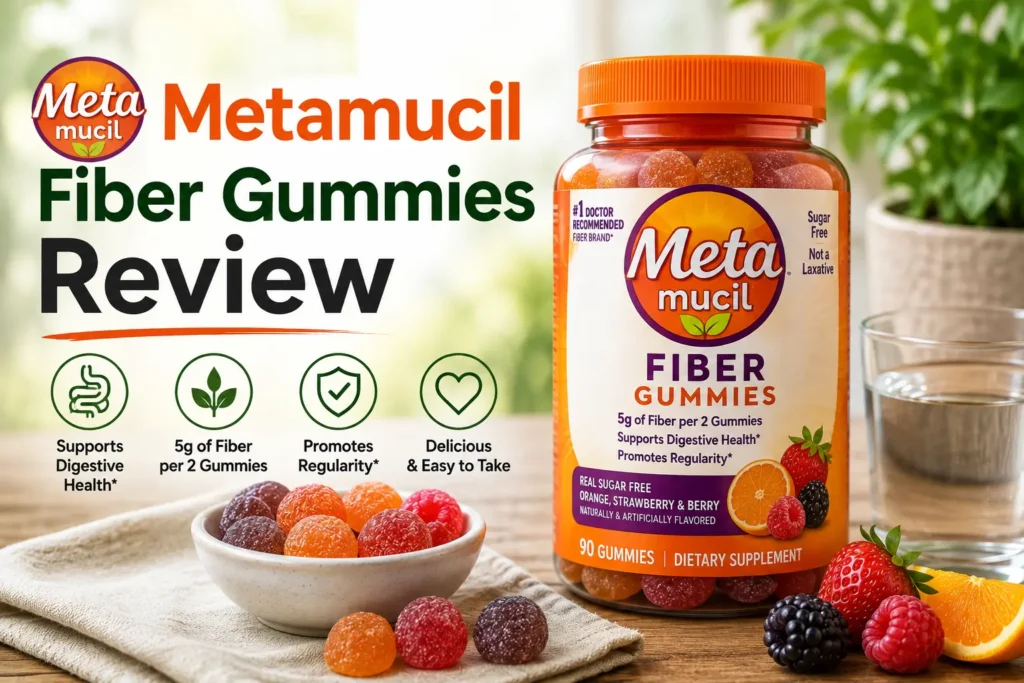
: Metamucil Fiber Gummies deliver 5 grams of plant-based fiber per three-gummy serving from a blend of inulin and Fibersol (soluble corn fiber) — not psyllium husk, which is the ingredient that makes Metamucil’s powder and capsules famous for heart-health and regularity support. The gummies taste good and are genuinely easy to take, but they’re a different product with a different evidence base, not a gummy version of the same formula. If you’re choosing between the two, this distinction matters more than almost anything else in this review.
If you searched “Metamucil Fiber Gummies review,” you’re likely trying to answer one specific question that most articles bury or skip entirely: are these actually the same thing as Metamucil powder, just in gummy form? They’re not, and understanding why is the key to deciding whether they’re right for you. This review breaks down the ingredients, the real difference between gummies and powder, side effects, and what actual buyers report — including a detail from a colorectal specialist that surprised more than one reviewer.
Table of Contents
What Are Metamucil Fiber Gummies?
Metamucil is Procter & Gamble’s fiber supplement brand, historically built around psyllium husk powder and capsules. The Fiber Gummies line is a newer addition that uses a completely different fiber source: a blend of inulin (chicory root fiber) and Fibersol, a soluble corn fiber. The line has expanded into several variants:
- Metamucil Fiber Gummies — the base version, 5g fiber per 3-gummy serving, no added sugar
- Metamucil Fiber Plus Vitamins Gummies — same fiber blend plus Vitamins C, D, and B12
- Metamucil Fiber Plus Probiotics Gummies — 5g fiber plus 1 billion CFU probiotics, marketed for occasional bloating relief
- Metamucil Kids Fiber Gummies — a lower-dose, no-added-sugar version for children
Every version in this line shares the same core fiber source: inulin and Fibersol. None of them contain psyllium husk.
The Most Important Thing to Know: Gummies Don’t Contain Psyllium
This is the single biggest gap in most competitor reviews, and it directly answers the “Metamucil gummies vs. powder” question people are actually searching for.
Metamucil’s classic powders and capsules are built on psyllium husk, a fiber with decades of clinical research behind it for supporting regularity, softening stool, and helping maintain healthy cholesterol levels already within a normal range — the basis of the FDA-recognized heart health claim printed on Metamucil’s psyllium products. The Fiber Gummies line uses a different fiber entirely: inulin and Fibersol, both legitimate prebiotic fibers with their own research base for feeding gut bacteria, but neither carries the same specific, decades-deep evidence tied to psyllium’s cardiovascular and bulk-forming effects.
This isn’t a hidden fact — it’s stated directly on Metamucil’s own product pages and confirmed in the brand’s healthcare professional FAQ. But it’s the kind of detail that gets lost between the marketing (same brand name, same “trusted for 90 years” messaging) and the actual formula. One verified buyer review makes the point sharply: after trying the gummies on a nurse practitioner’s recommendation, a colorectal surgeon told them the gummies weren’t “the right kind of fiber,” specifically noting that anything containing psyllium husk would be the better choice.
That doesn’t mean the gummies don’t work — inulin and Fibersol are real, functional fibers that support digestion and feed beneficial gut bacteria. It means they work differently, and if you specifically chose Metamucil because of its psyllium-based reputation, the gummies won’t deliver that same specific effect.
What’s Actually in the Ingredient List
The standard Metamucil Fiber Gummies (No Sugar Added, Orange) ingredient list: inulin, soluble corn fiber (Fibersol), water, xylitol; less than 2% of pectin, citric acid, sodium citrate, natural orange flavor, coconut oil with carnauba wax, and annatto for color.
Supplement Facts Comparison
| Product | Fiber Per Serving | Fiber Source | Serving Size | Contains Psyllium? |
| Metamucil Fiber Gummies | 5g | Inulin + Fibersol (soluble corn fiber) | 3 gummies | No |
| Metamucil Fiber Plus Probiotics | 5g | Inulin + Fibersol + 1 billion CFU probiotics | 3 gummies | No |
| Metamucil Powder (original) | ~2.4g soluble fiber | Psyllium husk | 1 rounded tbsp | Yes |
| Metamucil Capsules | ~1.8g soluble fiber | Psyllium husk | Varies (multiple caps) | Yes |
Interestingly, the gummies actually deliver more total fiber grams per labeled serving than a single dose of Metamucil’s own psyllium powder or capsules — but total fiber grams and clinically studied soluble fiber grams aren’t measured the same way across fiber types, so this isn’t a straightforward “gummies have more fiber” win. It reflects a different fiber source with a different research profile, not a simple upgrade.
How Inulin and Fibersol Work
Inulin is a fermentable prebiotic fiber found naturally in chicory root, and Fibersol is a manufactured soluble corn fiber designed to resist digestion and reach the colon largely intact. Both are fermented by gut bacteria, producing short-chain fatty acids that are thought to support gut health and feed beneficial bacterial populations. This fermentation process is also the mechanism behind the gas and bloating some people experience, particularly with inulin at higher doses.
Unlike psyllium, which works primarily through bulk-forming and gel-formation in the intestines, inulin and Fibersol are more purely fermentable, prebiotic-style fibers. They can support regularity, but the mechanism — and the amount of clinical research specifically behind that effect — differs meaningfully from psyllium’s decades of cardiovascular and bulk-forming study data.
Benefits
- Genuinely convenient. No mixing, no water requirement, no grainy texture — the core appeal of any gummy fiber format.
- No added sugar across the standard adult lines, sweetened instead with xylitol.
- 5g of fiber per serving, a meaningful dose for a gummy format.
- Multiple formulation options — plain, plus vitamins, or plus probiotics — depending on what else you’re trying to get from a daily supplement.
- Pleasant, well-reviewed flavors, with orange and citrus berry consistently getting positive mentions.
Drawbacks
- Doesn’t contain psyllium husk, so it doesn’t carry Metamucil’s flagship heart-health and bulk-forming claims tied to the brand’s original powders and capsules.
- Gummies clump together in the bottle. This is one of the most frequently repeated complaints across reviews — several buyers specifically mention storing the bottle upside down to keep the gummies from sticking into a solid mass.
- Sticks to teeth and dental work. Multiple reviewers, including denture wearers, report the gummies sticking uncomfortably to teeth or dental appliances.
- Serving size can feel small relative to the price for people used to a single scoop of psyllium powder — some reviewers report needing more than the recommended 3-gummy serving to feel the same effect they got from powder.
- Contains coconut oil, worth noting for anyone with a coconut or tree nut sensitivity.
Pros & Cons at a Glance
| Pros | Cons |
| No mixing, no water requirement, easy to take on the go | Does not contain psyllium husk — different fiber profile than classic Metamucil |
| 5g fiber per serving, no added sugar | Gummies clump together in the bottle |
| Pleasant, well-liked citrus flavors | Can stick to teeth, dentures, or dental work |
| Available plain, with vitamins, or with probiotics | Some users need more than the recommended serving to feel the same effect as powder |
| Familiar, trusted brand name | Contains coconut oil |
Metamucil Gummies vs. Metamucil Powder: The Real Comparison
This is the comparison most competitor articles either skip or handle superficially. Here’s the direct breakdown.
| Feature | Metamucil Fiber Gummies | Metamucil Psyllium Powder |
| Fiber source | Inulin + Fibersol (soluble corn fiber) | Psyllium husk |
| Fiber type mechanism | Fermentable, prebiotic | Bulk-forming, gel-forming, prebiotic |
| Heart health claim | Not applicable to this fiber type | FDA-recognized soluble fiber cholesterol claim |
| Convenience | High — chew and go | Lower — must mix with liquid and drink |
| Taste/texture | Fruit-flavored, chewable | Unflavored or flavored, gritty/thick texture |
| Best evidence base for | General prebiotic/gut microbiome support | Regularity, cholesterol support, established clinical research |
| Best for | Convenience-focused daily fiber top-up | Anyone specifically wanting psyllium’s studied effects |
The bottom line: if you chose Metamucil because of its reputation for cholesterol support and psyllium’s clinical track record, the gummies won’t replicate that specific benefit — you’d need the powder or capsules for that. If you simply want an easy, pleasant way to add some prebiotic fiber to your day and aren’t targeting a specific clinical outcome, the gummies are a reasonable, functional option. For a deeper look at how psyllium performs on its own, see our psyllium husk benefits guide, and for the format question more broadly, our fiber gummies vs. fiber powder comparison.
What Real Users Say
Feedback on taste is overwhelmingly positive — the orange and citrus berry flavors get repeated praise, and several reviewers specifically say they prefer the gummies to Metamucil’s powder or capsules purely on ease of use. The clumping issue shows up often enough across multiple product listings that it reads as a known packaging quirk rather than a rare defect; the workaround multiple reviewers mention independently is storing the bottle upside down.
On effectiveness, most users report the gummies help with regularity, and the Fiber Plus Probiotics version gets specific praise for easing occasional bloating. A smaller number of reviewers, particularly those switching from the psyllium-based powder, report needing to exceed the recommended serving to get a comparable effect — consistent with the fact that these are a different fiber type at a different functional dose than psyllium.
Who Metamucil Fiber Gummies Are a Good Fit For
- People who want a convenient, chewable way to add prebiotic fiber to their daily routine without mixing anything
- Anyone who dislikes the texture of psyllium powder but still wants to stay within a trusted, established brand
- People interested in a fiber-plus-probiotic combination specifically for occasional bloating
- Those looking for a no-added-sugar gummy option with a pleasant, well-reviewed flavor
Who Should Consider a Different Option
- Anyone specifically seeking psyllium’s cholesterol-support or bulk-forming benefits — Metamucil’s own psyllium powder or capsules, or a straightforward option like NOW Foods psyllium, will be the better fit
- People with dentures or dental work concerned about sticky textures — a fiber powder avoids this entirely
- Anyone who’s sensitive to inulin specifically and prone to gas or bloating from fermentable fibers — a gentler option like acacia fiber may be more comfortable
- Budget-conscious buyers, since gummy formats generally cost more per gram of fiber than psyllium powder
How to Use It
The label allows a range: one gummy for a light dose, two for a moderate amount, or three gummies as one full serving providing 5g of fiber, up to two servings per day. Gummies should be chewed thoroughly before swallowing, and the label specifically warns against exceeding the recommended dose, since doing so can cause gastrointestinal discomfort like bloating, gas, or diarrhea — the same caution that applies to any fermentable fiber taken in excess.
Common Mistakes People Make With This Product
- Assuming the gummies are a direct substitute for Metamucil’s psyllium powder. They’re a different fiber type with a different research base — not an interchangeable format of the same formula.
- Storing the bottle upright and getting frustrated when the gummies clump. Storing it on its side or upside down, as many reviewers suggest, helps keep them from fusing together.
- Jumping straight to the maximum daily dose. Increasing gradually reduces the odds of the bloating and gas that come with any sudden increase in fermentable fiber.
- Not accounting for dental sensitivity. If you have dentures, bridges, or other dental work, the sticky texture is worth testing cautiously before committing to a full bottle.
- Expecting the same heart-health effect as the psyllium products based on brand name alone, without checking which specific fiber source is in the product they bought.
Frequently Asked Questions
Do Metamucil Fiber Gummies contain psyllium husk? No. The gummies use a blend of inulin (chicory root fiber) and Fibersol (soluble corn fiber). Only Metamucil’s powders, capsules, and Fiber Thins contain psyllium husk.
Are Metamucil Gummies as effective as Metamucil powder? For general prebiotic fiber intake and regularity support, many users find them effective. For psyllium-specific benefits like cholesterol support, the gummies are not equivalent, since they don’t contain psyllium — the powder or capsules are the appropriate choice for that specific goal.
Why do Metamucil Gummies clump together? This is a frequently reported issue related to the gummy formulation and storage conditions rather than a product defect. Storing the bottle on its side or upside down is the most common fix reported by buyers.
Can Metamucil Fiber Gummies cause bloating? Yes, especially if taken in excess of the recommended serving. Inulin and Fibersol are both fermentable fibers, and fermentation by gut bacteria is a normal process that can cause temporary gas or bloating, particularly when starting out or increasing the dose too quickly.
How many Metamucil Gummies should I take per day? The label allows up to two full servings (6 gummies total, providing about 10g of fiber) per day for adults, but starting with a smaller amount and increasing gradually is the safer approach for avoiding digestive discomfort.
Is it better to take Metamucil gummies or powder? It depends on your goal. If convenience and taste are your priority and you’re not targeting a specific clinical benefit, the gummies are a reasonable option. If you specifically want psyllium’s studied cholesterol and regularity benefits, the powder or capsules are the better-supported choice. See our full Metamucil review for a deeper look at the psyllium-based product line.
Final Verdict
Metamucil Fiber Gummies are a genuinely convenient, pleasant-tasting way to add prebiotic fiber to your day, and for people who simply want an easier alternative to mixing a powder, they do the job well. What they are not is a gummy version of Metamucil’s classic psyllium formula — the fiber source, mechanism, and evidence base are meaningfully different, and that distinction should drive your decision more than the shared brand name does.
If cholesterol support or psyllium’s specific bulk-forming benefits are why you’re shopping the Metamucil name in the first place, stick with the powder or capsules. If you just want a manageable, low-effort way to close a fiber gap and don’t mind a smaller, differently-sourced dose, the gummies are a solid, well-reviewed choice — just store the bottle on its side, and go easy on the serving size while your gut adjusts.
For more on choosing between fiber formats generally, see our guides on fiber gummies vs. fiber pills and best fiber gummies.
This article is for educational purposes only and is not medical advice. Talk to your doctor before starting any new supplement, especially if you’re pregnant, nursing, on medication, or managing a digestive or cholesterol-related condition.