
Quick Answer
Fiber capsules are a convenient, no-mess way to add extra fiber to your diet when food alone doesn’t cover your daily needs. They typically contain psyllium husk, inulin, or methylcellulose, and work best for people who want steady digestive support without measuring powders or mixing drinks. They’re not automatically better than fiber powder — capsules just trade a bit of fiber-per-dose for portability and convenience.
If you’re dealing with a specific issue like constipation, bloating, or cholesterol management, the right fiber type matters more than the format. We’ll walk through both below.
Table of Contents
What Are Fiber Capsules?
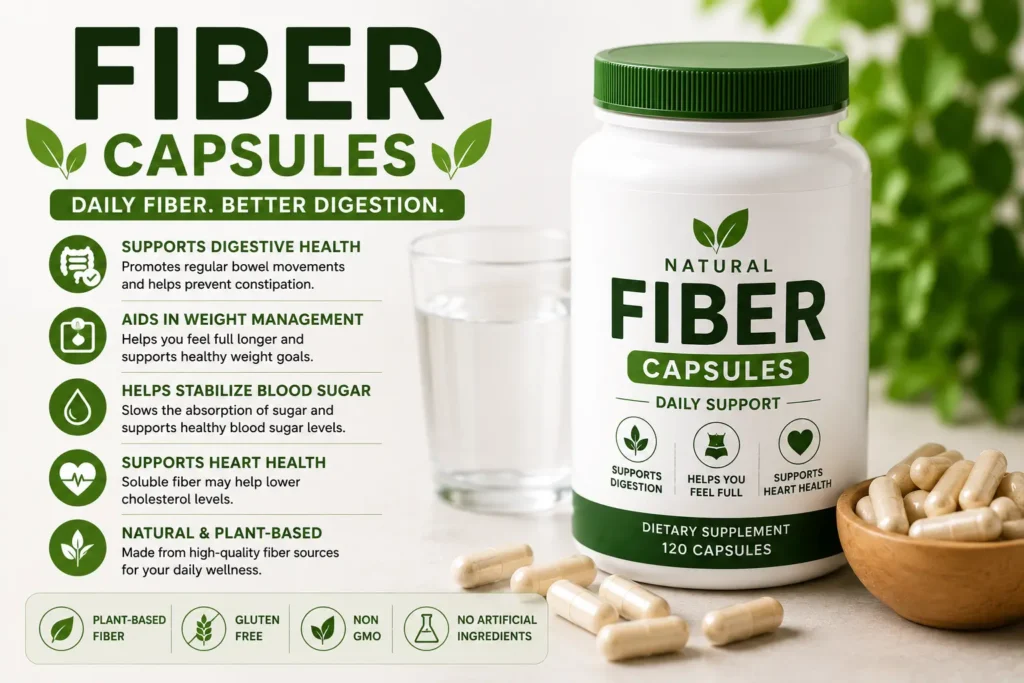
Fiber capsules are dietary supplements that deliver concentrated fiber in pill form instead of powder, gummy, or drink form. Each capsule contains a small, compressed amount of a fiber source — most commonly psyllium husk, inulin, methylcellulose, or wheat dextrin.
Because capsules are compact, you generally need several of them (often 5 or more per serving) to match the fiber content of a single scoop of fiber powder. That’s the main trade-off: convenience versus dose-per-serving efficiency.
Fiber capsules fall under the broader category of fiber supplements, alongside fiber powder, fiber gummies, and chewable fiber pills.
How Fiber Capsules Work in the Body
Once swallowed, the capsule shell dissolves in the stomach and releases the fiber, which then travels largely undigested into the intestines. What happens next depends on the fiber type:
- Soluble fiber (like psyllium) absorbs water and forms a gel. This softens stool, slows digestion slightly, and can help regulate blood sugar and cholesterol.
- Insoluble fiber (like some wheat dextrin or cellulose sources) adds bulk to stool and speeds up transit time through the gut.
Most commercial fiber capsules use soluble fiber because it’s gentler and has more research behind it for regularity and gut health. For a deeper breakdown of the two categories, see our guide on soluble vs. insoluble fiber.
Common Types of Fiber Used in Capsules
| Fiber Type | Source | Best Known For | Notes |
| Psyllium husk | Plantago ovata seed husk | Regularity, cholesterol support | Most researched fiber capsule ingredient |
| Inulin | Chicory root | Prebiotic/gut bacteria support | Can cause more gas in sensitive people |
| Methylcellulose | Plant cellulose | Gentle bulking, less gas | Doesn’t ferment in the gut |
| Wheat dextrin | Wheat starch | Mild, “invisible” fiber boost | Contains trace gluten unless labeled gluten-free |
If gas and bloating are a concern, methylcellulose-based capsules or a fiber supplement that doesn’t cause gas may be worth comparing.
Benefits of Fiber Capsules
- Convenience — no mixing, no chalky texture, easy to carry or take at work
- Discreet dosing — useful for people who dislike the taste or texture of fiber powders
- Supports regularity — particularly soluble-fiber capsules, which soften stool
- May support healthy cholesterol levels when psyllium is the main ingredient
- Can help you reach daily fiber targets most adults fall short of through food alone
For fiber’s broader role in the body, our guide on what a fiber supplement does covers this in more depth.
Fiber Capsules vs. Fiber Powder vs. Fiber Gummies
| Format | Fiber per Serving | Convenience | Taste/Texture Issue | Best For |
| Capsules | Low–moderate (needs several pills) | High | None | Travel, work, taste-sensitive users |
| Powder | High | Moderate (needs mixing) | Can feel gritty | Higher daily fiber needs |
| Gummies | Low | High | Tastes like candy | Fiber-averse users, added sugar concern |
If your main goal is hitting a specific daily fiber gram target, fiber powder is usually more efficient. If convenience and consistency matter more than raw fiber-per-dose, capsules are a reasonable trade-off. You can compare all formats in our guide on choosing a fiber supplement.
Pros and Cons of Fiber Capsules
Pros
- Easy to take anywhere, no water-mixing required
- No gritty texture or strong taste
- Simple to build into a daily routine
- Widely available in pharmacies and online
Cons
- Need multiple capsules to match one dose of powder
- Can be harder to swallow for some people
- Generally costs more per gram of fiber than powder
- Requires adequate water intake to avoid choking or bloating
Who Might Benefit From Fiber Capsules
- People who travel often or don’t have access to water/mixing tools during the day
- Those who dislike the taste or texture of fiber drinks
- People managing occasional constipation who want a simple daily habit
- Anyone trying to close the gap between their actual fiber intake and the recommended daily amount
Specific groups — including women, men, seniors, and people managing IBS — may have different fiber needs worth reviewing separately.
How to Take Fiber Capsules Correctly
- Start low. Begin with the lowest labeled dose to see how your body reacts.
- Increase gradually. Sudden high fiber intake is the most common cause of bloating and gas.
- Drink plenty of water. Soluble fiber absorbs water — without enough fluid, it can worsen constipation instead of relieving it.
- Be consistent with timing. Many people find it easier to remember a capsule dose with a meal. Our guide on the best time to take a fiber supplement covers this in detail.
- Space out from medications. Fiber can affect how some medications are absorbed — take capsules a couple of hours apart from prescription drugs unless your doctor advises otherwise.
Common Mistakes People Make With Fiber Capsules
- Not drinking enough water — this is the single biggest cause of capsules making constipation worse, not better
- Increasing the dose too quickly — leads to gas, cramping, and bloating
- Expecting instant results — regularity from fiber typically improves over several days to a couple of weeks of consistent use
- Ignoring the fiber type — someone with IBS may react differently to inulin (fermentable) versus psyllium or methylcellulose
Possible Side Effects
Fiber capsules are generally considered safe for most healthy adults when taken as directed. That said, side effects can include:
- Bloating or gas, especially when starting out or increasing dose too fast
- Stomach cramping
- Rare risk of choking if not taken with enough water
- Reduced absorption of certain medications if taken too close together
People with a history of bowel obstruction, difficulty swallowing, or certain digestive conditions should speak with a doctor before starting any fiber supplement. This article is educational and not a substitute for personalized medical advice.
Fiber Capsules and Daily Fiber Needs
Most adults don’t reach the fiber intake generally recommended by nutrition guidelines, largely because of low intake of fruits, vegetables, and whole grains. Capsules can help close part of that gap, but they work best as a supplement to a fiber-containing diet, not a replacement for it. Whole foods also provide additional nutrients that isolated fiber supplements don’t. For more on this distinction, see fiber supplements vs. fiber foods and our list of high-fiber foods.
Frequently Asked Questions
Do fiber capsules work as well as fiber powder? They can support similar benefits, but you typically need more capsules to match the fiber content of one serving of powder. For people prioritizing a high fiber dose, powder is usually more efficient.
How many fiber capsules should I take per day? This depends on the brand and fiber concentration per capsule — always follow the label’s serving size, and start at the lower end.
Can fiber capsules help with bloating? It depends on the fiber source. Fermentable fibers like inulin can cause more gas in sensitive individuals, while methylcellulose tends to cause less. Our guide on fiber supplements for bloating goes into more detail.
Are fiber capsules safe to take every day? For most healthy adults, daily use within the labeled dose is considered safe. Anyone with an existing digestive condition or who takes regular medication should check with a healthcare provider first.
Do fiber capsules help with weight management? Some soluble fibers may support feelings of fullness, which can support a broader weight management plan. See our guide on fiber supplements for weight loss for a fuller picture.
What’s the difference between a fiber capsule and a fiber pill? The terms are often used interchangeably, though “fiber pill” sometimes refers to compressed tablets rather than gel capsules. Functionally, both aim to deliver concentrated fiber in solid form — see our fiber pills guide for specifics.
Final Verdict
Fiber capsules are a solid choice if convenience, taste, and portability matter more to you than getting the most fiber per dose. They’re not inherently “better” or “worse” than powders or gummies — they simply serve a different use case. If your main goal is a high daily fiber dose in the fewest servings, powder is usually the more efficient option. If you want something you can take at your desk, in your bag, or on a trip with zero prep, capsules are a practical, well-tolerated way to support your daily fiber intake.
Before choosing a specific product, it’s worth reviewing your personal goal — regularity, cholesterol support, gut health, or general fiber intake — since the ideal fiber type varies by goal. Our complete guide to choosing a fiber supplement can help you narrow it down.