
Quick Answer
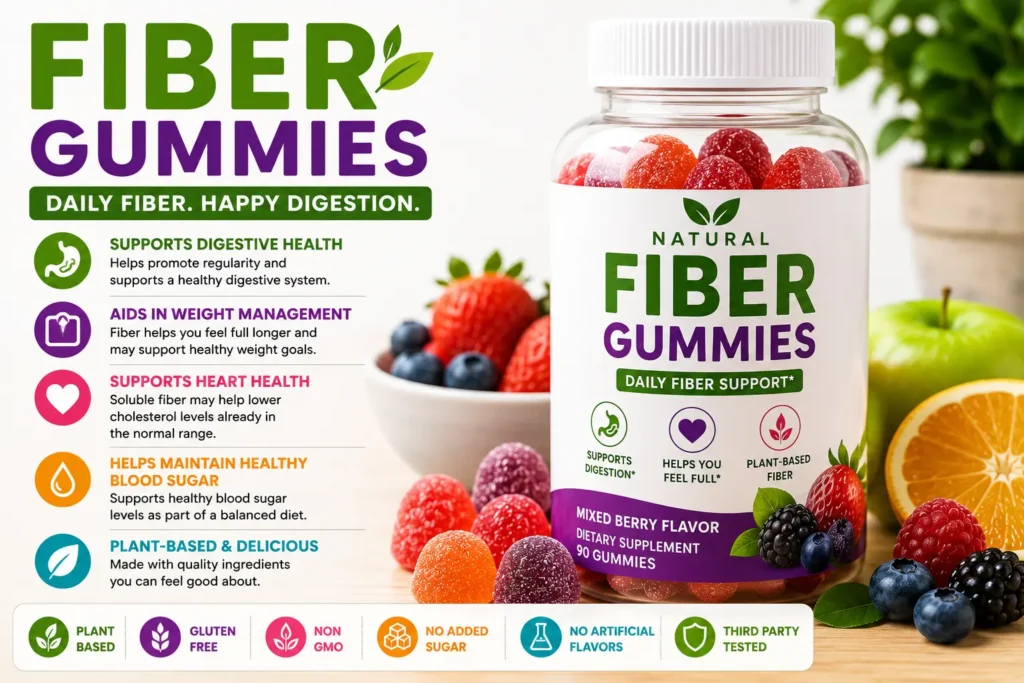
Fiber gummies are chewable supplements that deliver a small dose of fiber — usually 2 to 5 grams per serving — in a candy-like format. They’re easier to take than fiber powder or capsules, but most fiber gummies provide far less fiber per serving than a scoop of fiber powder or a glass of psyllium husk. They can help you inch closer to your daily fiber goal, but on their own they rarely close a large fiber gap. If you’re dealing with constipation, cholesterol, or blood sugar concerns, gummies are usually a supporting player, not the main solution.
Table of Contents
What Are Fiber Gummies, Exactly?
Fiber gummies are dietary fiber packed into a chewy, flavored gummy base — similar in texture to a vitamin gummy. Most use one or two fiber sources, most commonly:
- Chicory root fiber (inulin) — a prebiotic fiber that feeds beneficial gut bacteria
- Soluble corn fiber — a mild, well-tolerated fiber often used in Benefiber-style products
- Psyllium husk — the fiber found in Metamucil, though it’s harder to gummify because of how much it thickens with water
Unlike a fiber powder that you mix into liquid, a gummy is meant to be chewed and swallowed with little water. That convenience is the entire selling point — and also the source of the format’s biggest limitation, which we’ll get to.
How Fiber Gummies Compare to Other Fiber Formats
| Format | Typical Fiber per Serving | Convenience | Best For |
| Fiber Gummies | 2–5g | Highest | Small, consistent top-ups; people who dislike swallowing pills or mixing powder |
| Fiber Powder | 5–15g per scoop | Moderate (needs mixing) | Larger fiber gaps, flexible dosing |
| Fiber Capsules | 1–3g per capsule (several needed) | Moderate (multiple pills) | People who want a fiber source without taste or texture |
| Psyllium Husk | 3–5g per tablespoon | Low (needs full glass of water) | Constipation and cholesterol support |
The pattern is consistent across the market: gummies trade fiber quantity for ease of use. That’s a reasonable trade-off for some people and a poor one for others, depending on why you’re taking fiber in the first place.
Why the Serving Size Matters More Than the Marketing
Most fiber gummy labels list an appealing gram number, but the real question is how many grams you’d need to eat to match one scoop of powder or one dose of psyllium. Because gummies rely on sugar alcohols, gelatin, or pectin as a base, manufacturers can only pack so much fiber into a single gummy before the texture becomes unworkable or the sugar-alcohol load causes gas and bloating.
This is the detail most competitor pages gloss over: to get 5 grams of fiber from gummies, you may need to eat 2–4 gummies, and each additional gummy usually adds sugar alcohols (like sorbitol or maltitol), which have their own digestive side effects at higher amounts.
Benefits of Fiber Gummies
- Easier adherence. People who forget to take capsules or dislike mixing powder are more likely to actually take a gummy daily.
- No grainy texture or aftertaste, which is a common complaint with powdered fiber.
- Portable — no water or mixing required, useful for travel or on-the-go schedules.
- A reasonable entry point for someone who eats very little fiber and wants to build the habit before committing to a stronger daily regimen. If you’re just getting started, do I need a fiber supplement can help you figure out if gummies alone are enough or if you need something more.
Downsides of Fiber Gummies
- Lower fiber density. You typically need several gummies to match a single serving of powder or psyllium.
- Added sugars or sugar alcohols. Even “low sugar” gummies often rely on sorbitol or maltitol, which can cause bloating or a laxative effect at higher intakes — separate from the fiber’s own effect.
- Limited fiber types. Most gummies use one soluble fiber source; they don’t offer the mix of soluble and insoluble fiber you’d get from whole foods or a blended fiber powder. See soluble vs insoluble fiber for why that mix matters.
- Not ideal for significant constipation. If you need meaningful stool-bulking effects, 2–5 grams a day usually isn’t enough. Compare options at best fiber supplement for constipation.
- Cost per gram of fiber is high relative to powders, since you’re paying for flavoring, gelling agents, and packaging along with the fiber itself.
Who Fiber Gummies Are a Good Fit For
- Adults who already eat a reasonably fiber-rich diet and just want a small daily top-up
- People who have tried powders or capsules and stopped because of taste, texture, or pill fatigue
- Anyone building a new daily supplement habit who values consistency over maximum dose
- People without a diagnosed digestive condition who mainly want general gut-health support alongside food sources — see high fiber foods for what a fiber-rich diet actually looks like
Who Should Look at a Different Format
- Anyone managing constipation that hasn’t responded to diet changes
- People targeting a specific gram amount for cholesterol or blood sugar goals, where dose matters
- Anyone sensitive to sugar alcohols, since several gummies a day can add up
- People who want a mix of soluble and insoluble fiber rather than a single fiber source
In these cases, a fiber powder or psyllium husk supplement is usually more effective per dose. Our guide on how to choose a fiber supplement walks through matching the format to your goal.
Common Mistakes People Make With Fiber Gummies
- Assuming the label’s gram count is a full daily fiber source. Most gummies are a supplement to your existing diet, not a replacement for fiber-rich food.
- Eating extra gummies to “catch up” quickly. This often backfires because of the sugar alcohols, causing bloating or loose stools rather than better regularity.
- Not drinking enough water. Fiber of any kind works better — and is more comfortable — with adequate fluid intake, even though gummies don’t require mixing.
- Expecting fast results. Fiber, in any format, tends to show its full effect on regularity over one to two weeks of consistent daily use, not a single dose.
- Ignoring total daily sugar or sugar-alcohol intake if taking multiple gummies to hit a higher fiber target.
What to Check on a Fiber Gummy Label
- Grams of fiber per serving — and how many gummies make up that serving
- Type of fiber — inulin/chicory root, soluble corn fiber, or another source
- Added sugars and sugar alcohols — check both the amount and the specific ingredient
- Third-party testing or certification, which supports quality and label accuracy
- Serving size realism — if reaching a “full” daily amount requires 6+ gummies, factor that into cost and sugar alcohol intake
Fiber Gummies vs. Whole-Food Fiber Sources
Gummies can’t fully substitute for the fiber, water, and nutrients found in whole foods. A single cup of raspberries or a serving of black beans can provide more fiber than several fiber gummies, along with vitamins, minerals, and antioxidants gummies don’t offer. Fiber gummies are best thought of as a bridge — useful when whole-food intake falls short on a given day — rather than a primary fiber strategy. For a deeper look at this trade-off, see fiber supplements vs fiber foods.
Frequently Asked Questions
Do fiber gummies actually work? They can modestly support daily fiber intake and gut health, especially for people who otherwise get very little fiber. But because most provide only 2–5 grams per serving, they’re unlikely to resolve constipation or meaningfully lower cholesterol on their own.
How many fiber gummies should I take per day? Follow the product’s label directions. Increasing fiber gradually — rather than jumping to the maximum serving right away — reduces the chance of bloating or gas.
Can fiber gummies cause bloating or gas? Yes, particularly gummies containing inulin/chicory root fiber or sugar alcohols. This is common with most fiber sources when intake increases quickly and tends to settle as your gut adjusts.
Are fiber gummies as good as fiber powder? Generally no, gram for gram. Fiber powders typically deliver 2–3 times more fiber per serving and often include a broader mix of fiber types. Gummies win on convenience, not on dose.
Can I take fiber gummies every day? Most are formulated for daily use, similar to a daily multivitamin. As with any supplement, check with a healthcare provider if you have a digestive condition or take other medications.
Do fiber gummies help with weight loss? Fiber in general can support satiety, but at 2–5 grams per serving, gummies alone are unlikely to meaningfully affect weight. Fiber supplements aimed specifically at this goal, covered in best fiber supplement for weight loss, typically use higher doses.
Final Verdict
Fiber gummies solve a real problem: they make taking a fiber supplement easier for people who dislike powders or pills. That convenience has value, especially for building a consistent daily habit. But the format has a ceiling — most gummies simply can’t deliver as much fiber per serving as a powder, capsule, or psyllium dose, and pushing intake higher by eating more gummies brings added sugar and sugar-alcohol side effects into play.
If your goal is a light, sustainable top-up to an already reasonable diet, fiber gummies for adults are a sensible, low-friction choice. If you’re addressing a specific issue like constipation, cholesterol, or a significant fiber gap, it’s worth pairing gummies with a more concentrated format, or choosing one of those directly. Our best fiber gummies roundup can help you compare specific products if you decide the format is right for you.