
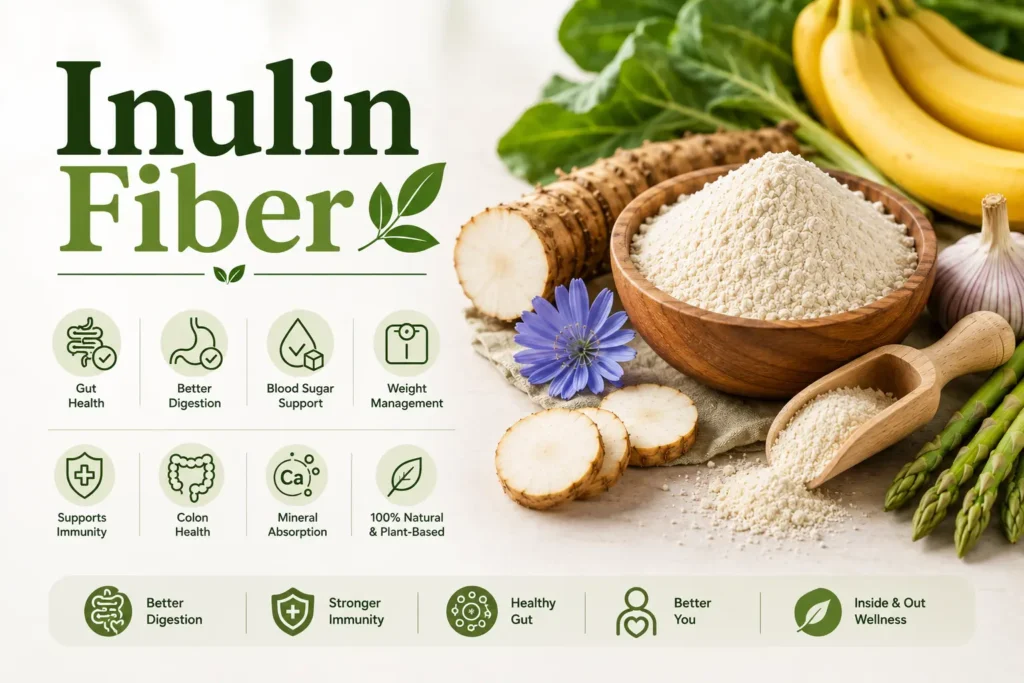
Inulin fiber is a type of soluble, fermentable fiber found naturally in plants like chicory root, Jerusalem artichoke, garlic, and onions. It acts as a prebiotic, meaning it feeds the beneficial bacteria in your gut. Most people tolerate 5–10 grams per day well, though starting with smaller amounts (2–3 grams) helps avoid bloating and gas as your gut adjusts. It’s added to many fiber supplements and processed foods to boost fiber content and support regularity.
Table of Contents
What Is Inulin Fiber?
Inulin is a naturally occurring carbohydrate that belongs to a group of compounds called fructans. Unlike sugars and starches, your body can’t break inulin down in the small intestine. Instead, it travels intact to the large intestine, where gut bacteria ferment it.
This is what makes inulin a soluble fiber — it dissolves in water and forms a gel-like substance during digestion, rather than adding bulk the way insoluble fiber does. If you’re trying to understand the difference between fiber types before choosing a supplement, this guide on soluble vs insoluble fiber breaks it down further.
Inulin is found in over 36,000 plant species, but only a handful are used commercially:
- Chicory root — the most common commercial source, containing the highest concentration of inulin of any cultivated plant
- Jerusalem artichoke
- Garlic and onions (smaller amounts)
- Asparagus, leeks, and bananas (small amounts)
- Agave
Chicory Root Inulin: Why It’s the Industry Standard
When you see “inulin” listed on a supplement or food label, it almost always means chicory root inulin. Chicory root contains roughly 15–20% inulin by weight, far more than most other plant sources, which is why manufacturers extract it commercially rather than using other crops.
The extraction process is relatively simple: chicory roots are washed, sliced, and soaked in hot water to pull out the inulin, which is then purified and dried into a powder. No harsh chemical processing is required, which is one reason inulin is often marketed as a “natural” fiber additive.
Chicory root inulin comes in different chain lengths, which actually matters for how it behaves in your body:
- Long-chain inulin ferments more slowly, further down the colon, and tends to cause less gas
- Short-chain inulin (oligofructose) ferments faster and closer to the start of the colon, which can trigger more noticeable bloating in sensitive people
Some products blend both chain lengths for a more balanced fermentation pattern — worth checking if you’ve had trouble with gas from fiber supplements in the past.
How Inulin Works in the Body
Inulin’s function comes down to one core mechanism: fermentation, not digestion.
- You consume inulin (through food or a supplement)
- It passes through your stomach and small intestine unchanged
- Gut bacteria in your colon ferment it
- This fermentation produces short-chain fatty acids (SCFAs) — including butyrate, propionate, and acetate
- SCFAs nourish colon cells, support a healthy gut lining, and may influence metabolism and inflammation
This fermentation process is also why inulin is classified as a prebiotic — it’s not the bacteria itself (that would be a probiotic), it’s the food source that helps beneficial bacteria, particularly Bifidobacteria, multiply.
This distinction matters if you’re comparing products, since fiber and probiotics serve different roles. If you’re weighing whether to combine both, this comparison of prebiotic fiber supplements versus probiotic and fiber combinations covers that decision in more depth.
Inulin as a Prebiotic Fiber
Not all fiber is prebiotic. Prebiotic fiber specifically means it survives digestion and selectively feeds beneficial bacteria strains. Inulin is one of the most well-studied prebiotic fibers, alongside fructooligosaccharides (FOS) and galactooligosaccharides (GOS).
Research on inulin’s prebiotic effect has consistently shown it increases populations of Bifidobacterium in the gut. This shift in gut bacteria composition is associated with several potential downstream benefits, though it’s worth being clear that research quality varies — some effects are well established, others are still preliminary.
Potential Benefits of Inulin Fiber
Supports Regularity
Because inulin adds soluble bulk and draws water into stool, it can help with softer, more regular bowel movements. It’s often included in supplements aimed at supporting gut health for this reason.
Feeds Beneficial Gut Bacteria
As covered above, inulin’s main function is nourishing bacteria like Bifidobacteria. A more diverse, balanced gut microbiome has been linked to better digestion and, in some studies, improved immune signaling — though this research is still developing.
May Help With Blood Sugar Management
Some studies suggest inulin can modestly slow the rate of gastric emptying and blunt post-meal blood sugar spikes, likely due to its gel-forming property in the gut. It should not be considered a treatment for diabetes or a substitute for medical management of blood sugar.
May Support Mineral Absorption
Interestingly, several studies have found that inulin fermentation can enhance calcium and, to a lesser extent, magnesium absorption in the colon. This is one of the more novel benefits that’s often underreported compared to inulin’s digestive effects.
Adds Fiber Without Major Taste or Texture Change
Inulin is mildly sweet, dissolves easily, and doesn’t add grit — unlike some other soluble fibers. This is why it’s popular in protein bars, yogurts, and “high fiber” processed foods, not just supplements.
May Support Weight Management Indirectly
Inulin can increase feelings of fullness by slowing gastric emptying, which may help some people manage appetite. It is not a weight-loss ingredient on its own, and results vary significantly between individuals. If weight management is your primary goal, this guide to fiber supplements for weight loss puts inulin’s role in proper context alongside other strategies.
Inulin vs Other Common Fibers
| Fiber Type | Source | Solubility | Fermentation Speed | Common Effect |
| Inulin (chicory root) | Chicory, Jerusalem artichoke | Soluble | Fast to moderate | Prebiotic, can cause gas in high doses |
| Psyllium husk | Plantago seed husk | Mostly soluble | Slow / minimal | Bulks stool, gentler on gas, good for regularity — see psyllium husk |
| Methylcellulose | Synthetic (plant cellulose derived) | Soluble | None (not fermented) | Bulks stool, minimal gas |
| Wheat dextrin | Wheat starch | Soluble | Moderate | Mild prebiotic effect |
| Cellulose | Plant cell walls | Insoluble | Minimal | Adds bulk, speeds transit — see insoluble fiber |
This table matters because people often choose inulin expecting the same effect as psyllium, then are surprised by gas or bloating. Inulin and psyllium solve different problems — inulin feeds bacteria, psyllium primarily adds bulk and moisture.
Pros and Cons of Inulin Fiber
| Pros | Cons |
| Strong prebiotic effect, well-researched | Can cause gas, bloating, or cramping, especially at higher doses |
| Mild taste, dissolves easily in food and drinks | Fermentation happens quickly, which increases gas production compared to slower fibers |
| May support mineral absorption | Not ideal for people with IBS or FODMAP sensitivity |
| Widely available and inexpensive | Effects on blood sugar and weight are modest, not dramatic |
| Naturally occurring in common foods | Chain length and purity vary between products |
Who Should Be Cautious With Inulin
Inulin is a FODMAP — specifically, a fructan. This means it can trigger symptoms in people with IBS or fructan sensitivity. If you have a diagnosed digestive condition, it’s worth discussing fiber choices with a healthcare provider before adding inulin. Those managing IBS specifically may want to review this guide on fiber supplements for IBS, which covers gentler alternatives.
People who are new to fiber supplementation in general, or unsure whether they need one at all, may find it useful to start with the basics in do I need a fiber supplement before choosing a specific type like inulin.
How Much Inulin Should You Take?
There’s no single official recommended dose, but general guidance based on available research and product labeling looks like this:
- Starting dose: 2–3 grams per day
- Common maintenance dose: 5–10 grams per day
- Upper range seen in studies: up to 20 grams per day, though this is more likely to cause digestive discomfort
The key practical advice missed by many sources: increase gradually over 1–2 weeks rather than jumping straight to a full dose. This gives your gut bacteria time to adapt to the new fermentation load, which significantly reduces gas and bloating.
Timing also matters less than consistency. Taking inulin with meals, rather than on an empty stomach, tends to reduce digestive discomfort for most people. For general guidance on timing across fiber types, see best time to take a fiber supplement.
Common Mistakes People Make With Inulin
- Starting with too high a dose. This is the single biggest cause of complaints about inulin causing gas.
- Not drinking enough water. Soluble fiber needs adequate fluid intake to work as intended.
- Assuming all inulin products are the same. Chain length, purity, and source (chicory vs synthetic) vary by brand.
- Using inulin as a fix for a diagnosed digestive disorder without medical guidance. It can worsen symptoms in some IBS cases rather than help.
- Expecting dramatic weight-loss or blood-sugar results. The evidence supports modest effects, not major transformations.
Inulin Supplement Forms
Inulin is sold in a few common formats, each with different practical trade-offs:
- Powder — the most common and versatile form, easily mixed into drinks, smoothies, or food. Compare options in this guide to fiber powders.
- Capsules/pills — convenient for travel or those who dislike the taste or texture of powder, covered in fiber pills.
- Gummies — easier to tolerate for some, though typically lower in fiber per serving; see fiber gummies.
If you’re still deciding between fiber formats generally, how to choose a fiber supplement walks through the decision process in more detail.
Frequently Asked Questions
Is inulin fiber the same as chicory root fiber? Yes, in almost all commercial products. Chicory root is the primary source used to extract inulin, so the terms are often used interchangeably on labels.
Does inulin cause gas and bloating? It can, especially at higher doses or when introduced too quickly. This happens because gut bacteria rapidly ferment inulin, producing gas as a byproduct. Starting low and increasing gradually reduces this significantly.
Is inulin fiber good for weight loss? It may support modest appetite regulation by increasing fullness, but it isn’t a proven standalone weight-loss solution. It works best as part of an overall balanced diet.
Can I get enough inulin from food alone? Yes, foods like garlic, onions, leeks, asparagus, and Jerusalem artichoke contain natural inulin. However, supplements provide a more concentrated and consistent dose if you’re targeting a specific intake level.
Is inulin safe for daily use? For most healthy adults, yes, when introduced gradually and taken within typical dosage ranges. People with IBS, fructan sensitivity, or other digestive conditions should be more cautious.
What’s the difference between inulin and FOS (fructooligosaccharides)? Both are prebiotic fructans. FOS has shorter chains and ferments faster, often causing more noticeable gas. Inulin includes longer chains that ferment more slowly and gradually.
Can children or pregnant women take inulin? Small amounts from food sources are generally considered fine, but supplemental doses should be discussed with a doctor first, since research on optimal dosing in these groups is more limited. Related guidance is available in fiber supplements for kids and fiber supplements for pregnancy.
Final Verdict
Inulin fiber is one of the most researched and widely used prebiotic fibers available, with solid evidence supporting its role in feeding beneficial gut bacteria and modest support for regularity, mineral absorption, and blood sugar balance. It isn’t the right choice for everyone — particularly those with IBS or fructan sensitivity — and its biggest drawback is the digestive discomfort that comes from starting too high, too fast.
Used thoughtfully, starting low and increasing gradually, inulin fiber can be a genuinely useful addition to a fiber routine, especially for anyone specifically looking to support gut bacteria diversity rather than just add bulk. If you’re comparing it against other soluble fiber options, this overview of soluble fiber supplements is a useful next step.
This article is for educational purposes only and does not constitute medical advice. Consult a healthcare provider before starting any new supplement, particularly if you have a digestive condition or are pregnant.