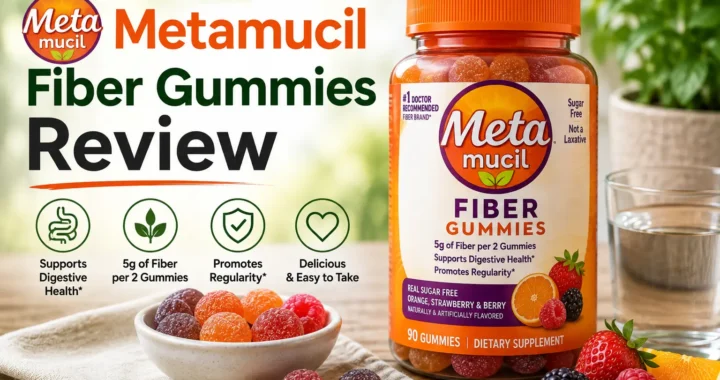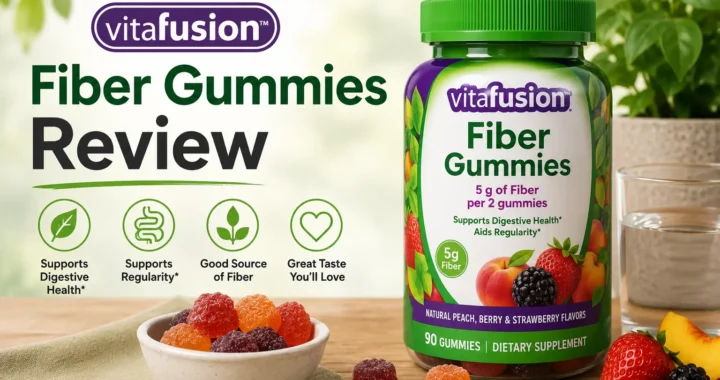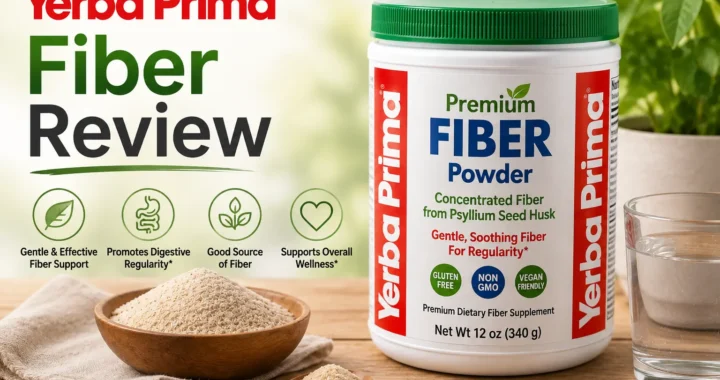

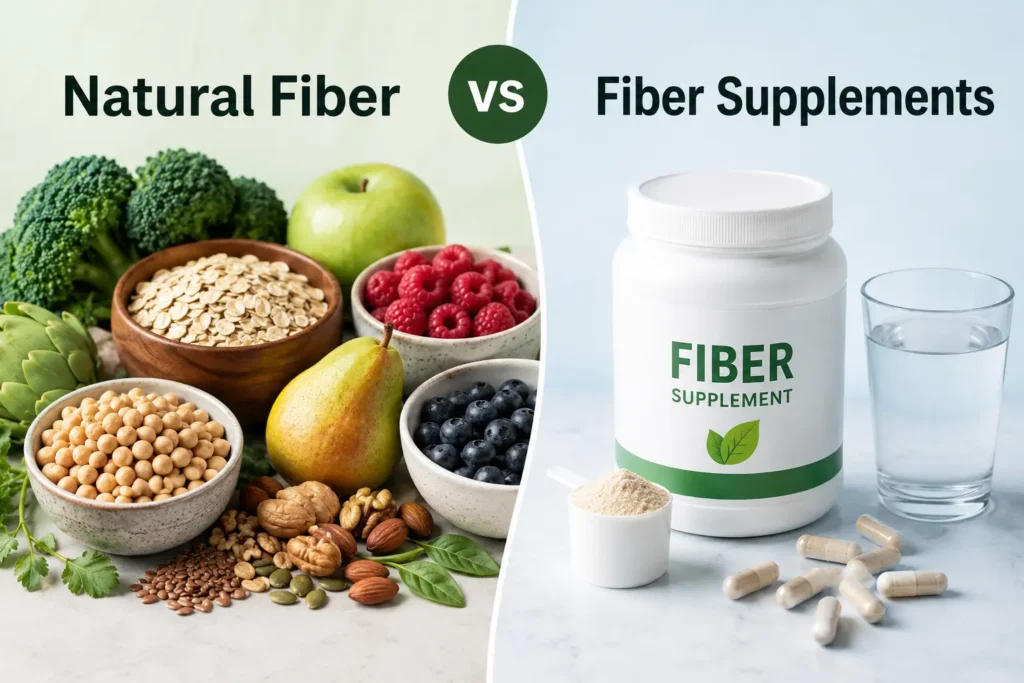
Natural Fiber vs Fiber Supplements: Natural fiber—the fiber in whole foods like fruits, vegetables, legumes, and whole grains—comes packaged with vitamins, minerals, antioxidants, and a natural mix of different fiber types that work together. Fiber supplements isolate a single fiber (like psyllium, inulin, or wheat dextrin) without those extra nutrients, but they’re far more convenient and let you hit a precise, consistent dose.
Nearly every major health authority agrees on the same hierarchy: whole foods are the better long-term source of fiber, and supplements are a useful backup, not a replacement. The honest, evidence-based answer isn’t “pick one” — it’s that most people should try to close their fiber gap with food first and use a supplement to fill in what’s genuinely missing.
Table of Contents
Natural Fiber vs Fiber Supplements: The Fast Comparison
| Feature | Natural Fiber (Food) | Fiber Supplements |
| Fiber types included | A natural mix of soluble and insoluble fiber | Usually one isolated fiber type |
| Additional nutrients | Vitamins, minerals, antioxidants, phytonutrients | None — just the fiber (and sometimes flavoring/sweeteners) |
| Dose consistency | Varies by food and serving | Precise, consistent, easy to measure |
| Convenience | Requires meal planning and preparation | Fast — mix, swallow, or chew |
| Long-term health evidence | Strong — linked to lower rates of heart disease, diabetes, some cancers | Evidence exists for specific fibers and specific outcomes, but weaker overall |
| Best for | Long-term general health, disease risk reduction | Closing a specific fiber gap, targeted digestive relief |
| Typical fiber per serving | Varies widely (2–8+ g per serving depending on food) | Often 1–5 g per labeled serving — check the panel |
This table reflects what nutrition researchers and dietitians consistently emphasize: it’s not really “versus” — it’s “which one is doing which job.”
What Counts as Natural Fiber?
Natural fiber is the fiber your body gets from whole plant foods — fruits, vegetables, whole grains, legumes, nuts, and seeds. Because fiber occurs within the natural structure of these foods, it arrives bundled with a wide range of other nutrients: vitamins, minerals, healthy fats, and plant compounds called phytonutrients.
Whole foods also typically provide a mix of different fiber types in the same meal, rather than one isolated kind. That variety matters for feeding a diverse gut microbiome, which is part of why researchers consistently find stronger long-term health associations with food-based fiber than with supplement-based fiber alone.
For a full list of high-fiber foods and how much they provide, see high fiber foods and fiber rich foods.
What Are Fiber Supplements?
Fiber supplements isolate a single fiber ingredient — psyllium husk, wheat dextrin, methylcellulose, inulin, acacia, and others — and deliver it in a concentrated, standardized dose through powder, capsules, or gummies. This makes it easy to know exactly how many grams of fiber you’re getting, which is much harder to calculate precisely from a plate of food.
What supplements don’t provide is the surrounding nutrition. You get the isolated fiber and, in some cases, added flavoring or sweeteners, but not the vitamins, minerals, or phytonutrients that come packaged with fiber in whole foods.
For an overview of what a supplement actually does in your body, see what does a fiber supplement do.
The Core Difference: Isolated Fiber vs Fiber-in-Context
This is the point most comparison articles gesture at but don’t fully explain. Fiber in food doesn’t act alone — it’s embedded in a matrix of other compounds that interact with it and with each other. That interaction is part of why researchers can’t fully replicate a whole food’s health benefits by extracting just the fiber and putting it in a capsule.
Fiber supplements, by contrast, remove that context entirely. You get a concentrated, purified dose of one fiber type, which is genuinely useful for hitting a specific target (like a clinical cholesterol-lowering dose of psyllium), but it isn’t nutritionally equivalent to eating the food that fiber came from.
Neither format is “wrong.” They’re simply built for different purposes: food-based fiber for broad, long-term nutrition, and supplement fiber for precision and convenience. For the deeper structural distinction, see fiber supplements vs fiber foods.
Effectiveness for Long-Term Health
Multiple studies and meta-analyses associate higher intake of fiber from whole foods with reduced risk of cardiovascular disease, type 2 diabetes, and certain cancers. Because these studies typically track people’s overall diets rather than isolated supplement use, much of this evidence is specifically tied to food-based fiber intake patterns, not supplements alone.
Fiber supplements do have real, targeted evidence of their own. Psyllium, for example, has an FDA-recognized claim for helping lower LDL cholesterol, and gel-forming fiber supplements have shown benefits for post-meal blood sugar control in some studies, though not everyone responds the same way.
Practical takeaway: if your goal is broad, long-term disease risk reduction, food-based fiber has the stronger overall evidence base. If your goal is a specific, measurable outcome — like meeting a clinical fiber target for cholesterol — a well-chosen supplement can help you get there reliably.
For supplement options tied to specific goals, see best fiber supplement for cholesterol and best fiber for gut health.
Why Whole Foods Have an Edge Nutritionally
Whole foods provide something a supplement bottle physically can’t: a naturally occurring package of nutrients working together. An apple, for instance, contains fiber alongside vitamin C, potassium, and various plant antioxidants. Oats bring fiber together with B vitamins and minerals like magnesium.
This “package effect” is one reason major health organizations, including the Mayo Clinic, consistently note that whole foods are generally preferable to fiber supplements when the goal is overall health, not just meeting a fiber gram count. Supplements simply aren’t designed to replicate that broader nutrient profile — they’re built to deliver fiber, and only fiber, efficiently.
When a Fiber Supplement Genuinely Makes Sense
Supplements aren’t a lesser option across the board — they solve real problems that food alone often can’t:
- Closing a persistent fiber gap. Most adults fall well short of daily fiber recommendations, and a supplement can help bridge that gap on days when food intake isn’t enough.
- Targeted digestive relief. Conditions like constipation, diarrhea, or IBS symptoms sometimes respond better to a specific, concentrated fiber type — such as psyllium’s gel-forming action — than to trying to eat your way to the same effect.
- Medical or dietary restrictions. People with limited food variety, digestive sensitivities, or conditions that make eating large volumes of high-fiber food difficult may rely more heavily on supplements as a practical necessity.
- Precision dosing. If a doctor recommends a specific daily fiber target for a health condition, a supplement makes it far easier to hit that number consistently than estimating from meals.
For more on matching a supplement to a specific need, see do i need a fiber supplement.
A Better Decision Framework Than “Just Pick One”
Instead of treating this as an either/or choice, run through these questions:
1. Are you trying to improve overall long-term health, or solve a specific problem right now?
- Overall long-term health → Prioritize whole foods first.
- A specific issue like constipation or a cholesterol target → A targeted supplement may be more effective and efficient.
2. Is your diet already reasonably high in fiber-rich foods?
- Yes, but you’re still short of your daily target → A supplement can close the remaining gap.
- No, your diet is generally low in fruits, vegetables, and whole grains → Focus on food first; a supplement alone won’t replace the missing nutrients.
3. Do you need a precise, measurable dose for a health reason?
- Yes (e.g., a doctor-recommended fiber target) → Supplements make hitting that number far easier.
- No, you just want general wellness → Food-based fiber is the more complete option.
4. Do you have trouble tolerating high-fiber foods?
- Yes → A supplement may be a more practical starting point, ideally alongside gradual dietary changes.
- No → There’s no strong reason to replace food-based fiber with a supplement.
Common Mistakes People Make With Either Approach
- Assuming a supplement replaces a healthy diet. No fiber supplement contains the vitamins, minerals, and antioxidants that come packaged with whole foods; it’s an addition, not a substitute.
- Not checking how much fiber is actually in a supplement serving. Some supplements provide only a gram or less per serving, similar to or even less than a single piece of fruit.
- Overcorrecting with food and skipping water. High-fiber diets and fiber supplements both require adequate hydration to work properly; increasing fiber without more water often backfires.
- Ignoring fiber variety. Relying on one isolated supplement fiber long-term misses the diversity of fiber types your gut bacteria benefit from when fiber comes from many different foods.
- Increasing intake too quickly. Whether from food or supplements, a sudden jump in fiber intake is the most common cause of gas and bloating; gradual increases are better tolerated.
Frequently Asked Questions
Is fiber from food better than fiber supplements? For overall, long-term health, yes — whole foods provide a natural mix of fiber types along with vitamins, minerals, and antioxidants that supplements don’t include. Supplements are still useful for closing a specific fiber gap or addressing a targeted digestive issue.
Can a fiber supplement replace fruits and vegetables? No. A fiber supplement delivers isolated fiber, not the broader nutrition — vitamins, minerals, and phytonutrients — found in whole fruits, vegetables, whole grains, and legumes.
How much fiber do I actually need per day? General guidance for adults is around 25 grams per day for women and 38 grams per day for men, though needs vary by age and other factors. Most adults in the US fall well short of these targets.
Are fiber supplements safe to take every day? Generally, yes, when used as directed and with adequate water. As with any supplement, check with a doctor if you have a diagnosed digestive condition or take regular medications.
Should I use both food and a fiber supplement? For many people, yes — using whole foods as the main source of fiber and a supplement to fill in the remaining gap is a practical, evidence-supported approach, rather than choosing one exclusively.
Do fiber supplements cause more gas than fiber from food? It depends on the fiber type more than the format. Fast-fermenting fibers, whether from food (like beans) or supplements (like inulin), can cause more gas than slower-fermenting options like psyllium, regardless of the source.
Final Verdict
Natural fiber and fiber supplements aren’t direct competitors — they’re tools built for different jobs. Whole foods deliver fiber alongside a package of vitamins, minerals, and antioxidants that no supplement can fully replicate, which is why they remain the stronger choice for broad, long-term health. Fiber supplements isolate a single fiber type in a precise, convenient dose, making them genuinely useful for closing a persistent fiber gap or addressing a specific digestive goal.
The most evidence-based approach for most people is to prioritize fiber-rich foods first and use a supplement strategically to fill in what your diet is still missing — not to replace one with the other. For more on how these fit together, see fiber supplements vs fiber foods or how to choose a fiber supplement.
This article is for educational purposes only and does not replace personalized medical advice. Talk to a healthcare provider before making significant changes to your diet or starting a new supplement, especially if you have a diagnosed digestive condition or take regular medication.