
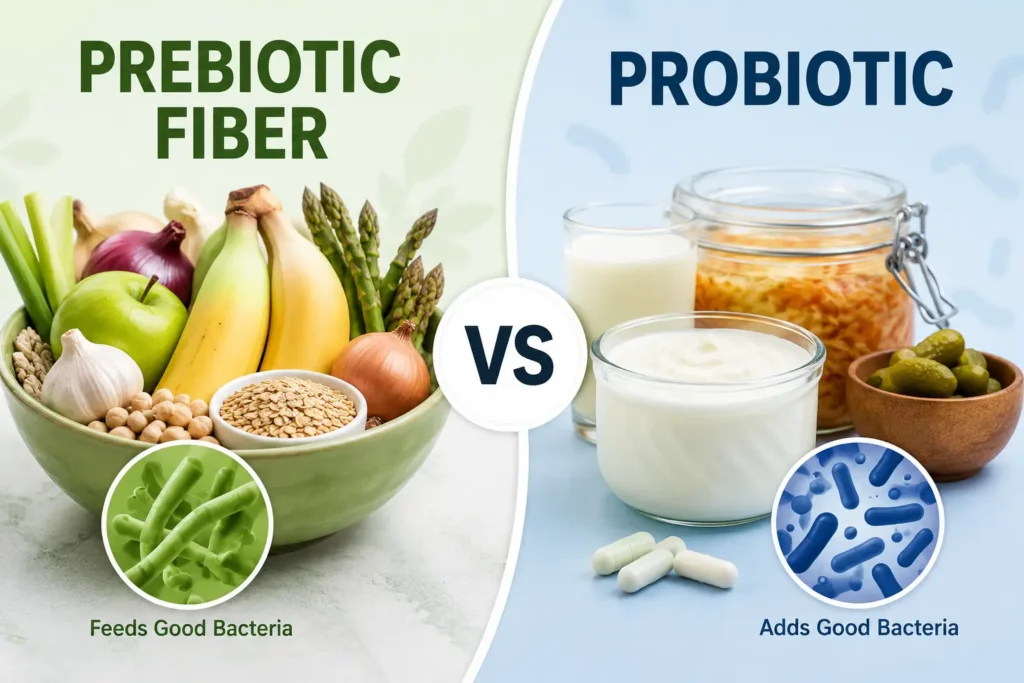
Prebiotic fiber and probiotics aren’t competing products — they do two completely different jobs. Prebiotic fiber is a type of fiber your body can’t digest that travels to the colon and feeds the beneficial bacteria already living there. Probiotics are live bacteria themselves, introduced through fermented foods or supplements, meant to add to or support your existing gut bacterial community.
Think of it this way: probiotics are the bacteria, and prebiotic fiber is what feeds them. Neither one replaces the other, and most gut-health guidance from major medical institutions points toward using both together rather than picking one over the other, ideally through a varied diet first and supplements only where the diet falls short.
Table of Contents
Prebiotic Fiber vs Probiotic: The Fast Comparison
| Feature | Prebiotic Fiber | Probiotic |
| What it is | A non-digestible fiber (e.g., inulin) | Live beneficial bacteria (e.g., Lactobacillus, Bifidobacterium) |
| Function | Feeds existing gut bacteria | Adds live bacteria to the gut community |
| Common sources | Chicory root, garlic, onions, oats, legumes | Yogurt, kefir, sauerkraut, kimchi, supplements |
| Stability | Stable; resistant to heat and stomach acid | Sensitive to heat, acid, and processing |
| Digestibility | Passes through undigested until fermented in the colon | Bacteria must survive digestion to reach the colon alive |
| Supplement form | Powder, capsules, gummies (often inulin-based) | Capsules or powders with specific bacterial strains and CFU counts |
| Best-known role | Feeding and supporting existing bacteria (like Bifidobacteria) | Introducing or reinforcing specific bacterial populations |
| Common side effect | Gas or bloating from fermentation, especially at high doses | Generally mild; occasional temporary bloating |
This table addresses the core confusion behind this search: people often assume “prebiotic” and “probiotic” are just two names for the same category of gut-health product, when they’re structurally different things entirely.
What Is Prebiotic Fiber?
Prebiotic fiber is a specific category of fiber — usually a type of carbohydrate your body can’t digest on its own — that reaches the colon largely intact. Once there, gut bacteria ferment it, using it as fuel to grow and produce beneficial byproducts like short-chain fatty acids.
Not all fiber qualifies as prebiotic. The defining feature is that it must be selectively used by your existing gut microorganisms as food. Common prebiotic fibers include inulin (often sourced from chicory root), fructooligosaccharides (FOS), and to varying degrees, other fermentable fibers like acacia.
Prebiotic fiber is naturally found in foods like garlic, onions, asparagus, oats, and legumes, and it’s also sold as a standalone supplement, most commonly in the form of inulin or chicory root fiber gummies and powders.
For more on this specific ingredient, see inulin fiber and chicory root fiber.
What Are Probiotics?
Probiotics are live microorganisms — mainly specific strains of bacteria and sometimes yeasts — that, when consumed in adequate amounts, provide a health benefit by supporting your gut’s bacterial community. Common probiotic strains include various species of Lactobacillus and Bifidobacterium.
Probiotics occur naturally in fermented foods like yogurt, kefir, sauerkraut, and kimchi, as long as those foods retain live, active cultures through processing (some fermented foods lose their live bacteria during manufacturing). Probiotics are also sold as dietary supplements, usually labeled with the specific bacterial strain and a CFU (colony-forming unit) count.
Unlike prebiotic fiber, probiotics are living organisms that need to survive your digestive system’s acid and enzymes to reach the colon and have an effect — which is part of why they’re more sensitive to heat, processing, and storage conditions.
The Core Difference: Feeding Bacteria vs Being the Bacteria
The clearest way to understand this distinction: probiotics are the seeds, and prebiotic fiber is the fertilizer.
- Probiotics introduce live bacteria directly into your gut ecosystem, aiming to add to or reinforce specific bacterial populations.
- Prebiotic fiber doesn’t introduce any bacteria at all. Instead, it feeds the bacteria that are already living in your colon, helping them grow and function better.
This is why prebiotic fiber and probiotics aren’t interchangeable, and why one can’t simply replace the other. A probiotic supplement without any prebiotic fiber in your diet is a bit like planting seeds in soil with no nutrients; a prebiotic-rich diet without any probiotic bacteria present has less to “feed” in terms of newly introduced strains, though your existing gut bacteria still benefit.
For the broader picture of how fiber fits into gut health generally, see best fiber for gut health.
How They Work Together
Prebiotics and probiotics function best as a team rather than as competing options. When probiotic bacteria — either from food or a supplement — reach your gut, prebiotic fiber gives them something to consume and multiply on. This relationship is part of why some products combine both intentionally, often labeled as “synbiotic.”
Research consistently shows that prebiotics support the growth of beneficial bacteria already present in the gut, including strains commonly introduced through probiotics, like Bifidobacterium species. This complementary relationship is one of the more well-established points of agreement across major health institutions covering this topic.
If you’re specifically looking for a combined approach, see best probiotic and fiber supplement or best prebiotic fiber supplement.
Do You Need a Supplement, or Can Food Cover This?
This is a point competitors often gloss over: most major health institutions emphasize getting prebiotics and probiotics from a varied diet before reaching for supplements.
For prebiotic fiber: foods like garlic, onions, leeks, asparagus, oats, and legumes provide meaningful prebiotic fiber. If your diet regularly includes these, you may already be getting a reasonable prebiotic intake without a dedicated supplement.
For probiotics: fermented foods with live, active cultures — yogurt, kefir, sauerkraut, and kimchi — are a practical way to introduce beneficial bacteria. It’s worth noting that not all fermented foods retain live cultures through processing, so checking labels for phrases like “live and active cultures” matters.
When supplements make more sense: if your diet doesn’t reliably include these foods, or you’re managing a specific digestive concern under a doctor’s guidance, a targeted prebiotic fiber or probiotic supplement can help close that gap. Health care providers are generally in the best position to recommend specific strains or fiber types for individual situations.
A Better Decision Framework Than “Just Pick One”
Instead of choosing between prebiotic fiber and probiotics, run through these questions:
1. Does your current diet include fermented foods with live cultures?
- Rarely or never → A probiotic supplement, or adding fermented foods, may help introduce beneficial bacteria.
- Regularly (yogurt, kefir, etc.) → You may already be getting meaningful probiotic exposure through food.
2. Does your diet include prebiotic-rich foods like garlic, onions, oats, or legumes?
- Rarely → A prebiotic fiber supplement can help feed your existing gut bacteria.
- Regularly → Your existing gut bacteria are likely already getting fuel from your diet.
3. Are you managing a specific digestive condition?
- Yes → Talk to a healthcare provider about which specific fiber type or bacterial strain fits your situation, since needs vary by condition.
- No, just general gut health → A balanced diet with variety in both categories is usually the most practical starting point.
4. Do you want to support newly introduced bacteria more effectively?
- Yes → Combining a probiotic with prebiotic fiber (a synbiotic approach) gives introduced bacteria something to feed on.
- Not a specific concern → Either category can be added independently based on where your diet is lacking.
Common Mistakes People Make With Either Category
- Assuming “prebiotic” and “probiotic” are interchangeable marketing terms. They describe two structurally different things — a fiber and a living organism — not two brand names for the same category.
- Taking a probiotic supplement without any prebiotic intake. Introduced bacteria have less to feed on if your diet lacks fermentable fiber, which may limit how well they establish.
- Buying “probiotic” fermented foods without checking for live cultures. Some processed fermented foods no longer contain live bacteria; the label should specify “live and active cultures” if that matters to you.
- Starting a high dose of prebiotic fiber too quickly. Fast-fermenting prebiotic fibers like inulin can cause gas and bloating if introduced suddenly; building up gradually is generally better tolerated.
- Expecting fast, dramatic results from either category. Gut microbiome changes generally happen gradually with consistent use, not overnight.
Frequently Asked Questions
Is prebiotic fiber the same as probiotics? No. Prebiotic fiber is a non-digestible fiber that feeds existing gut bacteria. Probiotics are live bacteria themselves, introduced through food or supplements. They work together but aren’t the same thing.
Do I need both prebiotics and probiotics? Most gut-health guidance suggests including both in your diet, since prebiotic fiber helps support and feed the bacteria that probiotics introduce or that are already present in your gut. You don’t necessarily need dedicated supplements for both if your diet already includes fermented and fiber-rich foods.
Can I take a prebiotic and probiotic supplement together? Yes. Products combining both are often called synbiotics, and there’s no inherent conflict in taking a prebiotic fiber alongside a probiotic supplement.
Which is better for constipation, prebiotic fiber or probiotics? Prebiotic fiber, and fiber in general, has more direct evidence for supporting regular bowel movements through its bulk-forming and fermentation effects. Probiotics may support overall gut balance, but they aren’t typically the first-line recommendation specifically for constipation.
Do prebiotic fiber supplements cause gas? They can, especially fast-fermenting types like inulin, particularly at higher doses or when started too quickly. Slower-fermenting options tend to cause less gas; building up gradually helps regardless of which prebiotic fiber you choose.
Can I get enough prebiotics and probiotics from food alone? Often, yes. A diet that regularly includes fermented foods with live cultures and prebiotic-rich foods like garlic, onions, oats, and legumes can meaningfully cover both categories without a dedicated supplement, though individual needs vary.
Final Verdict
Prebiotic fiber and probiotics aren’t rival products — they’re two different tools that support your gut in different ways. Prebiotic fiber feeds the bacteria already living in your colon, while probiotics introduce live bacteria directly. The strongest, most consistent guidance from health institutions is to include both, ideally through a varied diet of fermented and fiber-rich foods first, with supplements as a targeted addition where diet alone isn’t enough.
If you’re trying to decide where to start, look at what your current diet is already missing — fermented foods for probiotics, or prebiotic-rich foods like garlic, onions, and oats for prebiotic fiber — and build from there. For more on how fiber supports gut bacteria specifically, see best prebiotic fiber supplement or what does a fiber supplement do.
This article is for educational purposes only and does not replace personalized medical advice. Talk to a healthcare provider before starting any new supplement, especially if you have a diagnosed digestive condition or take regular medication.