
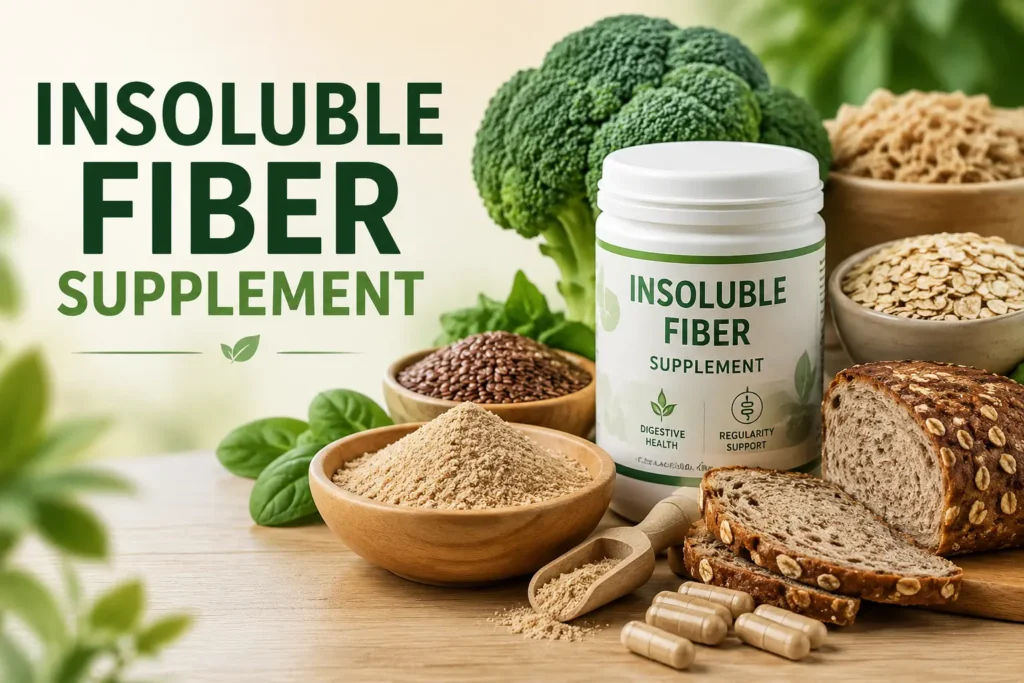
An insoluble fiber supplement is a concentrated source of fiber that does not dissolve in water. Instead, it adds bulk to stool and speeds up how quickly food moves through the digestive tract. It’s most often used for constipation, irregularity, and sluggish digestion. Common forms include wheat bran, cellulose, and psyllium husk (which is actually a mixed fiber with both soluble and insoluble properties). Unlike soluble fiber, it does not form a gel, so it’s less commonly used for blood sugar or cholesterol management.
If you’re dealing with hard, infrequent stools, an insoluble fiber powder can help. If your main goal is heart health or blood sugar control, a soluble fiber supplement is usually the better fit.
Table of Contents
What Is Insoluble Fiber?
Fiber is the part of plant food your body can’t fully break down. It comes in two main types: soluble and insoluble. Both matter, but they behave very differently once they reach your gut.
Insoluble fiber does not mix with water. It passes through the digestive system largely intact, absorbing water along the way and adding physical bulk to stool. Think of it as a natural broom for the intestines — it doesn’t dissolve, it just moves through and pushes things along.
This is different from soluble fiber, which dissolves in water and forms a thick, gel-like substance. That gel slows digestion, helps regulate blood sugar spikes, and can lower cholesterol. Insoluble fiber skips that gel-forming step entirely, which is why it plays a different role in the body.
If you want a deeper side-by-side breakdown, our guide on soluble vs insoluble fiber covers the mechanisms in more detail. For a general overview of what fiber supplements do as a category, see what is a fiber supplement.
Where Insoluble Fiber Naturally Comes From
- Wheat bran
- Whole grains (brown rice, whole wheat)
- Vegetable skins (potatoes, cucumbers)
- Nuts and seeds
- The skins of fruits like apples and pears
Most people get some insoluble fiber from high fiber foods, but modern diets built around refined grains and processed foods often fall short. That gap is where a supplement can help.
How an Insoluble Fiber Supplement Works
Understanding the mechanism helps explain why insoluble fiber works for some problems and not others.
- It absorbs water without dissolving. As it travels through the intestines, it swells slightly and adds physical bulk.
- It stimulates the intestinal walls. The added bulk mechanically presses against the colon lining, which stimulates peristalsis — the wave-like muscle contractions that move waste along.
- It shortens transit time. Because stool moves faster and with more bulk, it typically becomes softer and easier to pass.
- It doesn’t ferment as much. Compared to soluble fiber, insoluble fiber is fermented more slowly by gut bacteria, which is why it tends to cause less gas and bloating for some people — though this varies by individual and by fiber source.
This is a mechanical effect, not a chemical one. That distinction matters: insoluble fiber is generally not the right tool for lowering cholesterol or stabilizing blood sugar, because it doesn’t form the viscous gel responsible for those effects.
Who Benefits Most From an Insoluble Fiber Supplement
Insoluble fiber tends to help most with:
- Occasional or chronic constipation — added bulk and faster transit time can make stools easier to pass
- Diverticulosis maintenance (under a doctor’s guidance) — some clinicians recommend fiber to support colon health, though individual recommendations vary
- General regularity — for people who eat a low-fiber, low-residue diet
- Hemorrhoid prevention — softer, bulkier stool means less straining
It is generally less suited for:
- Blood sugar management
- Cholesterol reduction
- IBS-related diarrhea (in some cases, insoluble fiber can worsen symptoms — see the caution section below)
If constipation relief is your main goal, our dedicated guide on the best fiber supplement for constipation compares specific products. If your priority is gut microbiome support rather than bulk, check best fiber supplement for gut health.
Types of Insoluble Fiber Supplements
Not all insoluble fiber supplements are the same. Here’s how the common types compare.
| Type | Source | Texture When Mixed | Typical Use | Notes |
| Wheat bran | Wheat kernel outer layer | Gritty, coarse | Constipation, regularity | Contains gluten — not suitable for celiac disease or gluten sensitivity |
| Cellulose | Plant cell walls (often purified) | Fine, low-gel | Bulk-forming supplements | Often used in fiber pills and functional foods |
| Methylcellulose | Semi-synthetic cellulose derivative | Mixes clear, low fermentation | Constipation, minimal gas | Sold under brands like Citrucel; doesn’t ferment in the colon, which means less gas for sensitive users |
| Psyllium husk | Plantago ovata seed husk | Gel-forming when hydrated | Mixed regularity + cholesterol support | Technically a mixed fiber (soluble + insoluble); one of the most researched fiber supplements available |
| Bamboo fiber | Bamboo plant | Very fine, low taste | General fiber boost | Popular in “invisible” fiber powders added to baked goods or drinks |
Psyllium husk deserves a special note here: it’s frequently marketed under the insoluble fiber umbrella, but it actually contains a meaningful soluble fraction too. If you want a supplement that leans purely toward the mechanical, bulk-forming side, methylcellulose or wheat bran are more clearly insoluble. For a closer look at psyllium specifically, see our psyllium husk guide or best psyllium husk supplements.
Insoluble Fiber Powder vs Capsules vs Wafers
Insoluble fiber supplements come in a few delivery formats, and the format affects both convenience and dose.
| Format | Pros | Cons |
| Powder | Easy to adjust dose, mixes into drinks/food, usually cheaper per gram | Requires mixing, some have a gritty texture |
| Capsules/Pills | Convenient, no taste, portable | Need several capsules to match one scoop of powder |
| Chewable wafers | Tasty, easy for people who dislike mixing powders | Often contain added sugar; lower fiber per serving |
If you prefer capsules over powder, our best fiber pills guide breaks down the top options. For powder-specific comparisons, see best fiber powder.
How to Use an Insoluble Fiber Supplement
A few practical rules make insoluble fiber more effective and more comfortable:
- Start low, go slow. Begin with a small dose (around 3–5 grams) and increase gradually over 1–2 weeks. Jumping straight to a full serving is the most common cause of bloating and gas.
- Drink enough water. Insoluble fiber needs water to do its job properly. Taking it without adequate fluid can worsen constipation instead of relieving it.
- Be consistent. Fiber works cumulatively. Daily use matters more than any single dose.
- Take it apart from medications. Fiber can interfere with the absorption of certain oral medications. A general rule is to separate fiber supplements from medications by at least 1–2 hours, but check with a pharmacist for specific drugs.
Common Mistakes People Make
- Increasing the dose too fast. This is the number one cause of bloating, cramping, and gas with any fiber supplement.
- Not drinking enough water. Insoluble fiber without fluid can make stool harder, not softer.
- Using it for the wrong goal. Choosing an insoluble fiber supplement to lower cholesterol or manage blood sugar generally won’t produce the results a soluble fiber supplement would.
- Assuming all fibers are interchangeable. Psyllium, wheat bran, and methylcellulose behave differently in the gut — the “best” one depends on your specific goal.
- Ignoring IBS flare patterns. Some people with IBS, particularly IBS-D or IBS with visceral sensitivity, find that insoluble fiber worsens cramping and diarrhea. Soluble fiber is often better tolerated in these cases.
Insoluble Fiber vs Soluble Fiber: Quick Comparison
| Feature | Insoluble Fiber | Soluble Fiber |
| Dissolves in water | No | Yes |
| Main action | Adds bulk, speeds transit | Forms gel, slows digestion |
| Best for | Constipation, regularity | Cholesterol, blood sugar control |
| Fermentation by gut bacteria | Slower | Faster |
| Common sources | Wheat bran, cellulose, vegetable skins | Psyllium, oat bran, inulin |
| Gas/bloating risk | Moderate (dose-dependent) | Can be higher when fermentation is fast |
Most people don’t need to choose exclusively one or the other. A natural fiber supplement or a daily fiber supplement that blends both types often provides the most balanced benefit, since soluble and insoluble fiber support different parts of digestive health.
Pros and Cons of Insoluble Fiber Supplements
Pros
- Effective for relieving constipation and promoting regularity
- Generally low fermentation, meaning less gas for sensitive users (methylcellulose especially)
- Widely available and inexpensive
- Simple mechanism that’s easy to understand and use correctly
Cons
- Not effective for cholesterol or blood sugar management
- Can worsen symptoms for some people with IBS or inflammatory bowel conditions
- Requires adequate water intake to work properly
- Wheat bran sources are unsuitable for people avoiding gluten
Who Should Be Cautious
People with certain digestive conditions — including inflammatory bowel disease (IBD), bowel strictures, or a history of bowel obstruction — should talk to a doctor before adding a bulk-forming insoluble fiber supplement, since added bulk can be problematic in a narrowed or inflamed digestive tract. Anyone with celiac disease or gluten sensitivity should avoid wheat bran-based products and choose a gluten-free source like methylcellulose or purified cellulose instead.
This article is educational and does not replace personalized medical advice. If you have a diagnosed digestive condition, check with a healthcare provider before starting any new fiber supplement.
How to Choose the Right Insoluble Fiber Supplement
Use this simple framework:
- Identify your main goal. If it’s regularity or constipation, insoluble fiber is a strong fit. If it’s cholesterol or blood sugar, look at soluble fiber instead.
- Check the source. Wheat bran (contains gluten), methylcellulose (semi-synthetic, low fermentation), or cellulose (neutral, fine texture) — pick based on tolerance and dietary restrictions.
- Pick your format. Powder for flexible dosing, capsules for convenience.
- Check for additives. Avoid products loaded with added sugars, artificial sweeteners, or unnecessary fillers.
- Match the dose to your needs. Most adults benefit from starting around 3–5 grams daily and building up gradually, though total fiber needs vary by age, sex, and baseline diet.
For a broader decision-making walkthrough that also covers soluble and mixed fibers, see how to choose a fiber supplement.
Frequently Asked Questions
Is insoluble fiber powder better than capsules? Neither is inherently better — powder allows more precise dosing and is usually cheaper per gram, while capsules are more convenient for travel or a no-mixing routine.
Can insoluble fiber cause bloating? Yes, especially if the dose is increased too quickly or water intake is low. Starting with a small amount and increasing gradually usually reduces this.
Is psyllium husk insoluble or soluble fiber? Psyllium husk contains both soluble and insoluble components, though it’s often grouped with soluble fibers because of its gel-forming behavior in water.
How much insoluble fiber do I need per day? General fiber recommendations (combining both soluble and insoluble) are often cited around 25–38 grams per day for adults, though individual needs vary. There isn’t a single separate official target specifically for insoluble fiber alone.
Does insoluble fiber help you lose weight? It may support satiety by adding bulk to meals, but insoluble fiber isn’t typically the primary fiber type studied for weight loss. If that’s your main goal, a fiber supplement for weight loss built around soluble or mixed fiber sources is usually a better match.
Can I take insoluble fiber every day? Yes, for most healthy adults, daily use is standard practice — that’s how bulk-forming fiber supplements are meant to be used, alongside adequate water intake.
What’s the difference between fiber supplements and fiber-rich foods? Supplements offer a concentrated, measurable dose, while whole foods provide fiber along with vitamins, minerals, and other plant compounds. Our comparison of fiber supplements vs fiber foods covers this in depth.
Final Verdict
An insoluble fiber supplement is a practical, low-cost tool for improving regularity and easing constipation. It works by adding bulk and speeding up transit time — not by forming a gel like soluble fiber does. That makes it a good match if your main concern is sluggish digestion, but not the right tool if you’re targeting cholesterol or blood sugar.
Start with a small dose, drink enough water, and choose a source (wheat bran, cellulose, or methylcellulose) that fits your dietary needs. If you’re unsure whether insoluble, soluble, or a blended fiber supplement fits your situation best, our main fiber supplement guide and insoluble fiber overview are good next steps.