
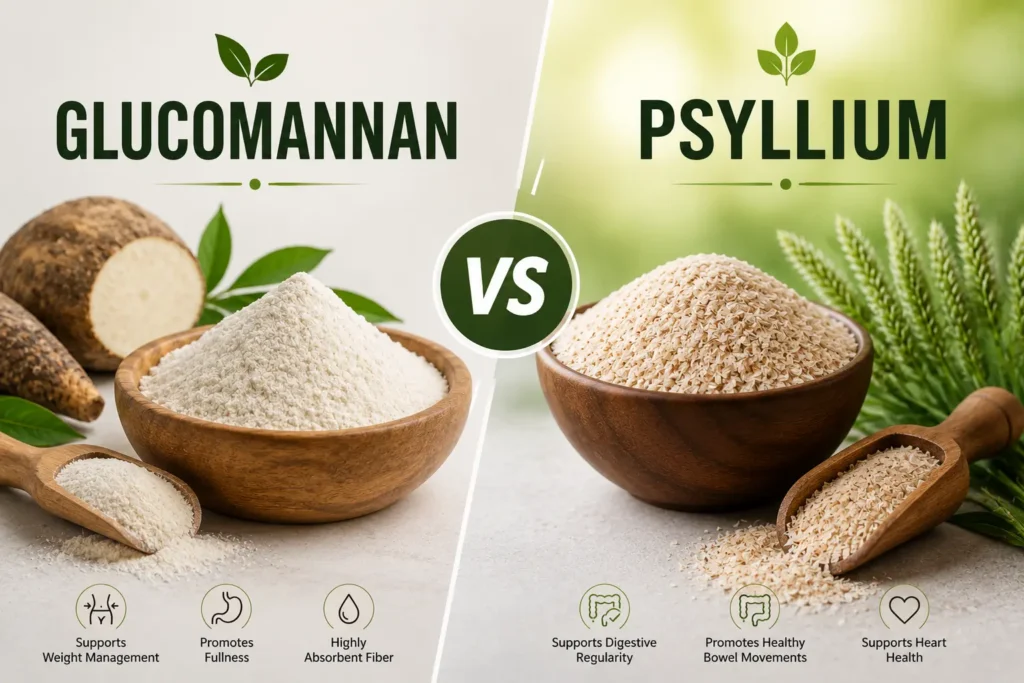
Glucomannan vs psyllium are both soluble, gel-forming fibers, but they aren’t interchangeable. Glucomannan, extracted from the root of the konjac plant, is one of the most viscous fibers known — it can absorb up to 50 times its weight in water and holds an EFSA-approved health claim specifically for weight loss when taken before meals as part of a calorie-controlled diet. Psyllium husk, from Plantago ovata seeds, forms a softer, less extreme gel but has a far broader and more consistent evidence base, including an FDA-recognized cholesterol claim and stronger long-term weight-loss data from recent large meta-analyses.
If your single goal is short-term appetite suppression before meals, glucomannan’s intense gel formation gives it a theoretical edge. If you want a well-tolerated, multi-purpose fiber for regularity, cholesterol, blood sugar, and modest weight support, psyllium is the more reliable everyday choice — and, in the largest recent trial pooling, it actually outperformed glucomannan on measured weight loss. Neither is a substitute for diet and lifestyle changes.
Table of Contents
What Is Glucomannan?
Glucomannan is a soluble fiber extracted from the root (corm) of the konjac plant (Amorphophallus konjac), traditionally used in Asian foods like shirataki noodles. Once it hits water, it swells dramatically — more than almost any other dietary fiber — forming a thick, gelatinous mass.
Key characteristics:
- Extremely high viscosity; among the most water-absorbent fibers used in supplements
- Nearly 100% soluble fiber
- Holds an EFSA-approved health claim: 3g/day of glucomannan, taken with water before meals as part of a calorie-restricted diet, contributes to weight loss
- Typically fermented by gut bacteria, which can produce more gas than less-fermentable fibers
- Common forms: capsules, powder, or as a noodle/pasta substitute (shirataki)
Because of how aggressively it expands, glucomannan is usually dosed in smaller amounts (around 1g per dose, taken two to three times daily before meals) compared to psyllium. For related konjac-based options, see our glucomannan (konjac) fiber guide.
What Is Psyllium Husk?
Psyllium husk comes from the seed coating of Plantago ovata, a plant grown mainly in India. It’s roughly 70% soluble and 30% insoluble fiber, giving it a dual bulking-and-gelling action.
Key characteristics:
- Forms a thick but comparatively softer, more mucilaginous gel than glucomannan
- Backed by an FDA-recognized heart health claim: 7g/day of psyllium soluble fiber, as part of a diet low in saturated fat and cholesterol, may reduce heart disease risk
- Moderately fermented — gentler on most digestive systems than heavily fermented fibers
- The most studied fiber supplement overall, with decades of clinical research behind it
- Available as powder, capsules, or whole husk
Psyllium is the active ingredient in most mainstream fiber supplement brands. For a full breakdown, see our psyllium husk guide and psyllium husk benefits page.
Glucomannan vs Psyllium: Side-by-Side Comparison
| Factor | Glucomannan | Psyllium Husk |
| Source | Root of the konjac plant | Husk of Plantago ovata seeds |
| Fiber type | Nearly 100% soluble | ~70% soluble, ~30% insoluble |
| Viscosity | Extremely high — swells up to 50x its weight | High, but less extreme and more mucilaginous |
| Typical dose | ~1g, 2-3x daily before meals | 5-10g daily, often split across the day |
| Water requirement | Very high — at least 1-2 full glasses per dose | High, but somewhat more forgiving |
| Fermentability | More fermentable, can increase gas | Moderately fermentable |
| Regulatory health claim | EFSA weight-loss claim (EU) | FDA cholesterol-reduction claim (US) |
| Strongest evidence for | Short-term appetite/satiety before meals | Cholesterol, regularity, broader long-term data |
| Choking/blockage risk | Documented risk if taken without enough water or in tablet form | Lower risk, but same general precaution applies |
| Availability | Capsules, powder, konjac noodles | Powder, capsules, whole husk — widely available |
How They Work in the Body
Both fibers work by absorbing water and forming a gel that occupies space in the stomach and small intestine. That gel slows gastric emptying, blunts the speed at which sugar and cholesterol-related compounds are absorbed, and adds moisture and bulk to stool.
The key difference is degree. Glucomannan’s gel is denser and expands more dramatically per gram, which is why smaller doses are used and why it’s associated with a stronger, more immediate sensation of fullness. Psyllium’s gel is thicker than most fibers but noticeably less extreme than glucomannan’s — its strength lies less in one dramatic mechanism and more in a broad, well-documented set of effects across digestion, cholesterol, and blood sugar. This mirrors the general pattern covered in our soluble vs insoluble fiber guide, where viscosity is the main driver of a soluble fiber’s physiological effect.
Benefits: What the Evidence Actually Shows
Weight Loss — The Evidence Is More Mixed Than It Looks
This is the area where marketing often runs ahead of the data. Glucomannan carries an EFSA-approved weight-loss claim, and some individual trials show meaningful reductions when it’s taken correctly (before meals, with enough water, alongside a calorie-controlled diet). However, a 2020 meta-analysis pooling 62 randomized trials and roughly 3,900 participants found that psyllium produced a modest but statistically reliable reduction in body weight, while glucomannan’s pooled effect did not reach statistical significance across trials. Individual glucomannan studies have shown stronger results, but consistency across the full body of research favors psyllium slightly. In short: glucomannan may work well for some people, but psyllium’s effect is more reproducible across studies. Neither fiber replaces a calorie deficit — see best fiber supplement for weight loss for realistic context.
Appetite and Satiety
Glucomannan’s extreme gel formation gives it a theoretical edge for pre-meal fullness, and some people report a stronger, faster satiety signal from it than from psyllium. Psyllium also supports satiety, just through a somewhat gentler mechanism.
Cholesterol Management
Psyllium is well ahead here. Its FDA-recognized claim and decades of trial data make it the better-supported option if cholesterol is a specific concern. Glucomannan has some supporting evidence for LDL reduction, but it’s less extensive and not backed by the same regulatory claim. See best fiber supplement for cholesterol for more.
Blood Sugar Support
Both slow carbohydrate absorption thanks to their gel-forming action, with reasonable evidence for each in blunting post-meal blood sugar spikes. Neither should be treated as a substitute for prescribed diabetes management.
Digestive Regularity
Psyllium’s combination of soluble and insoluble fiber makes it more versatile for regularity — helpful for both constipation and loose stool, as covered in our best fiber supplement for constipation guide. Glucomannan also softens and bulks stool but is used less often specifically for irregularity, since its main marketing focus is appetite control.
Safety Comparison: A Difference Worth Taking Seriously
Both fibers require adequate water, but glucomannan’s risk profile is more pronounced because of how dramatically it expands. This is a genuine safety point that many comparison articles gloss over.
| Glucomannan | Psyllium Husk | |
| Main risk | Esophageal or intestinal blockage if taken with too little water, especially in tablet form | Choking or worsened constipation with insufficient water |
| Water guidance | At least 1-2 full glasses (roughly 250-500 mL) per dose | At least one full glass per dose |
| Best format for safety | Powder mixed thoroughly into liquid, rather than swallowing tablets dry | Powder mixed into water or a beverage |
| Common side effects | Bloating, gas, soft stool | Bloating, gas, fullness |
| Who should be extra cautious | Anyone with swallowing difficulty, esophageal narrowing, or a history of bowel obstruction | Same general precaution, though risk is comparatively lower |
| Medication timing | May affect absorption of some oral medications; separate doses | Same — space doses by roughly two hours |
This is educational information, not medical advice. Anyone with swallowing difficulties, a narrowed esophagus, or a history of bowel obstruction should speak with a healthcare provider before trying either fiber, and glucomannan tablets in particular should be avoided by anyone who has ever had trouble swallowing pills.
Common Mistakes People Make With These Two Fibers
- Taking glucomannan capsules with only a small sip of water. This is the single most-cited safety issue with glucomannan — the capsule needs enough liquid to fully dissolve before it reaches the lower digestive tract.
- Expecting glucomannan alone to produce dramatic weight loss. The EFSA claim is tied to use alongside a calorie-controlled diet, not as a standalone solution.
- Assuming “soluble fiber” means the same experience for every product. Viscosity varies enormously between glucomannan and psyllium, even though both are technically soluble.
- Starting at a full dose immediately. Both fibers can cause noticeable gas and bloating if introduced too quickly; a gradual increase over one to two weeks is more comfortable, as outlined in how to choose a fiber supplement.
- Ignoring timing. Glucomannan is generally taken shortly before meals for satiety; psyllium is more flexible and can be taken with meals or separately, as discussed in best time to take fiber supplement.
Can You Take Both Together?
Some people do combine them, but caution is warranted given how viscous both fibers are individually. If combining, start with low doses of each, increase gradually, and make sure total water intake is high — some guidance suggests at least 500 mL of fluid per combined dose. Most people get sufficient benefit from one or the other rather than stacking both at full dose. If you’re comparing more fiber combinations broadly, our types of dietary fiber ingredients guide is a useful starting point.
Decision Framework: Which One Should You Choose?
Choose glucomannan if:
- Your primary goal is pre-meal appetite control as part of an active calorie-controlled diet
- You tolerate fermentable fibers reasonably well
- You’re diligent about taking it with enough water, ideally in powder form rather than tablets
Choose psyllium if:
- You want the more broadly evidenced option for cholesterol, blood sugar, and regularity
- You prefer a fiber with a longer track record and more consistent weight-related data across large trials
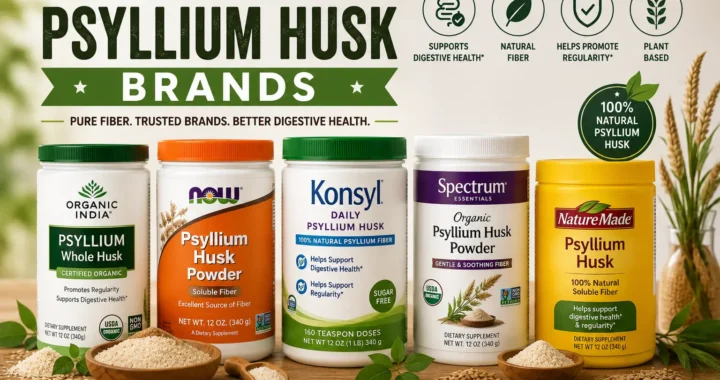
- You want more flexibility in dosing and timing — see best psyllium husk picks
Choose neither (or a gentler fiber) if:
- You have a history of swallowing difficulty or bowel obstruction — talk to a healthcare provider first
- You’re new to fiber supplements and want to start with something less viscous, such as options in our soluble fiber overview
Frequently Asked Questions
Which is better for weight loss, glucomannan or psyllium? The evidence is more mixed than most marketing suggests. Glucomannan holds an EFSA weight-loss claim and some individual studies show a strong effect, but a large 2020 meta-analysis of 62 trials found psyllium produced a more statistically reliable reduction in body weight overall. Neither works without an accompanying calorie-controlled diet.
Is glucomannan more dangerous than psyllium? Not inherently, but its extreme expansion capacity means the water requirement is stricter, and there have been documented cases of esophageal blockage when it’s taken without enough liquid, especially in tablet form. Powder mixed thoroughly into water is generally considered safer than swallowing tablets.
Can I switch between glucomannan and psyllium? Yes, there’s no specific issue switching, though it’s best to reintroduce fiber gradually if you’ve had a break, since your gut needs time to adjust to any new fiber source.
Does psyllium have a weight-loss health claim like glucomannan? No. Psyllium’s regulatory claim in the US is specifically for heart health (cholesterol reduction) at 7g/day, not weight loss. Its weight-related benefits come from satiety and appetite research rather than a formal weight-loss claim.
Which one is gentler on digestion for beginners? Psyllium is generally considered more forgiving for people new to fiber supplements, partly because of its long track record and more moderate gel intensity. Glucomannan’s stronger expansion can feel more intense, especially at first.
How much water do I actually need with glucomannan? Most guidance recommends at least one to two full glasses (roughly 250-500 mL) of water per dose, taken promptly so the fiber doesn’t begin expanding before it’s swallowed.
Final Verdict
Glucomannan and psyllium are both legitimate, evidence-supported soluble fibers, but they serve slightly different purposes. Glucomannan is the more intense, targeted option — best suited to pre-meal appetite control for people who are diligent about taking it with plenty of water. Psyllium is the more versatile, better-studied, and generally better-tolerated option, with the stronger regulatory backing for cholesterol and — perhaps surprisingly — more consistent evidence for weight management across large pooled trials. For most people looking for one dependable, general-purpose fiber supplement, psyllium is the safer starting point. Glucomannan remains a reasonable specialized addition for those specifically targeting appetite control, provided the water and dosing guidance is followed closely.
To compare psyllium against other viscous fibers, see psyllium husk vs inulin, or browse our full best fiber supplement rankings.
This article is for educational purposes only and is not a substitute for medical advice. Speak with a healthcare provider before starting any new fiber supplement, especially if you have a swallowing difficulty, digestive condition, or take medication.