
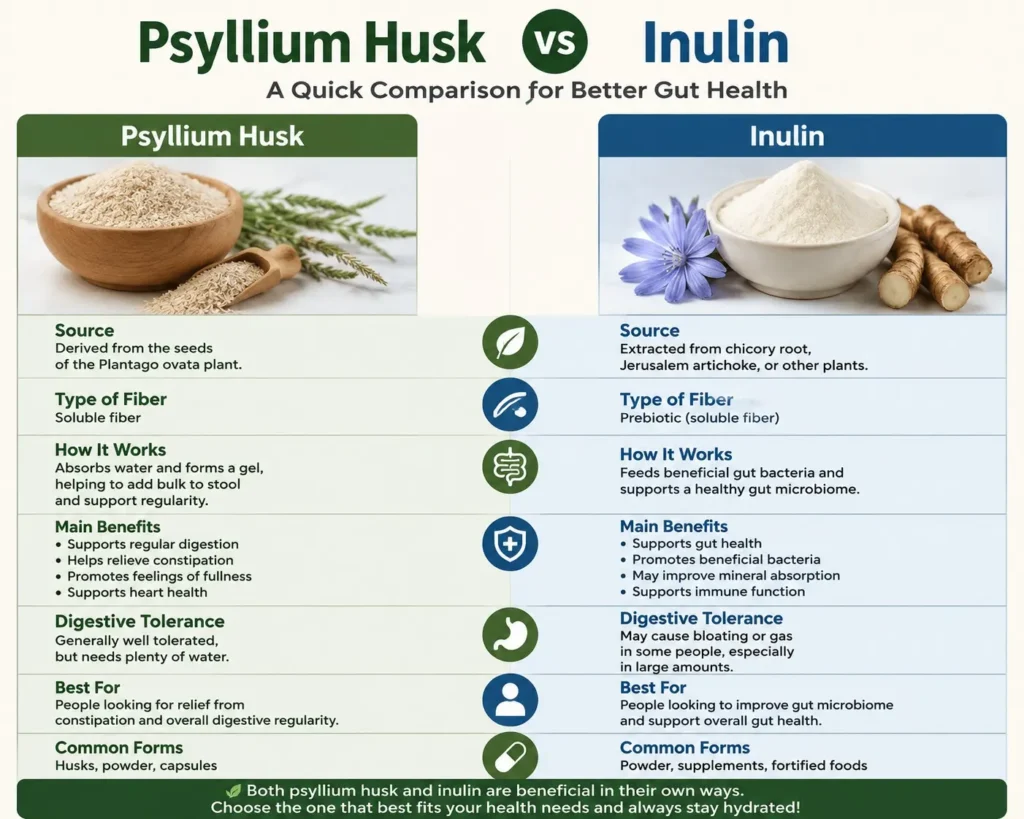
Psyllium husk and inulin are both soluble fibers, but they work through almost opposite mechanisms. Psyllium husk forms a thick gel when it meets water and is only slowly fermented by gut bacteria, which makes it the more reliable choice for constipation relief with relatively little gas. Inulin is fully fermentable and ferments quickly, feeding beneficial gut bacteria more aggressively — a stronger prebiotic effect, but with a real risk of gas and bloating, especially at higher doses.
If your main goal is fixing irregular bowel movements, psyllium husk has decades of clinical evidence behind it and is the gentler option for sensitive guts, including IBS. If your main goal is feeding your gut microbiome and supporting long-term digestive diversity, inulin is the stronger prebiotic — as long as your gut can tolerate the gas that comes with it. Many people actually benefit from using small amounts of both rather than picking one over the other.
Table of Contents
Psyllium Husk vs Inulin: The Fast Comparison
| Feature | Psyllium Husk | Inulin |
| Source | Plantago ovata seed husk | Chicory root (most common), Jerusalem artichoke, agave |
| Fiber category | Soluble, gel-forming | Soluble, fully fermentable (a fructan) |
| Fermentation speed | Slow, partial | Fast, extensive |
| Gas/bloating risk | Low | Moderate to high, especially at higher doses |
| Main mechanism | Absorbs water, forms gel, bulks stool | Feeds gut bacteria, produces short-chain fatty acids |
| Best-known benefit | Constipation and diarrhea relief, cholesterol support | Prebiotic effect, feeding Bifidobacteria |
| Bidirectional stool effect | Yes — can soften hard stool or firm loose stool | No — not built for stool regulation |
| IBS suitability | Often well tolerated; some guidelines list it first-line | Frequently a trigger fiber for IBS due to gas |
| Common products | Metamucil, Konsyl, plain psyllium husk powder | Chicory root fiber, FOS-based supplements, added to “high fiber” foods |
This table captures the real decision most people are making: bulk-forming regularity vs. gut-bacteria feeding, not “which fiber is better” in the abstract.
What Is Psyllium Husk?
Psyllium husk comes from the seed coating of Plantago ovata, a plant grown mainly in India. It’s a soluble fiber, but its defining trait is what happens when it meets water: it absorbs liquid and swells into a thick, viscous gel.
That gel is what makes psyllium effective as a bulk-forming laxative. It adds soft, substantial bulk to stool and can work in both directions — softening hard, constipated stool and firming up loose stool. This bidirectional effect is one reason some clinical guidelines for irritable bowel syndrome list psyllium as a first-line fiber recommendation.
Psyllium is only slowly and partially fermented by gut bacteria. That slower fermentation is the main reason it produces less gas than fully fermentable fibers like inulin.
For a deeper look at this ingredient, see our full psyllium husk guide, or explore psyllium husk benefits and psyllium husk side effects for more detail.
What Is Inulin?
Inulin is a soluble fiber that belongs to a class of carbohydrates called fructans. It occurs naturally in chicory root, Jerusalem artichokes, garlic, onions, leeks, asparagus, and bananas, though most commercial inulin supplements are extracted from chicory root.
Unlike psyllium, inulin doesn’t form a gel and doesn’t add much physical bulk on its own. Instead, its defining trait is that it’s fully fermentable — gut bacteria, especially Bifidobacteria, break it down almost completely in the colon. This fermentation produces short-chain fatty acids that nourish gut lining cells and support a healthier microbiome, which is why inulin is considered one of the most well-studied prebiotic fibers available.
The tradeoff is that this same fermentation process produces gas, sometimes a significant amount, particularly when someone starts at a high dose without building up gradually.
For more on this ingredient, see inulin fiber, inulin benefits, and inulin side effects.
The Core Difference: Gel-Forming Bulk vs Fast Fermentation
This is the detail that explains nearly every other difference between these two fibers, and it’s worth understanding before comparing benefits or side effects in isolation:
- Psyllium husk works mechanically. It traps water, forms a gel, and physically bulks and moves stool through the intestine. Because it’s poorly fermented, it does relatively little to feed gut bacteria directly.
- Inulin works biologically. It doesn’t bulk stool in the same physical sense; instead, it’s consumed almost entirely by gut bacteria, which is exactly where its prebiotic benefit — and its gas production — comes from.
In short: psyllium is a “mechanical” fiber built for stool regulation, and inulin is a “biological” fiber built for feeding your microbiome. Neither one does the other’s job particularly well, which is why the choice between them should be based on your actual goal, not a general sense that “more fiber is better.”
If you want the broader fiber classification system before comparing individual ingredients, see soluble vs. insoluble fiber.
Effectiveness for Constipation
Psyllium husk is the stronger, better-studied option here. Its gel-forming action adds significant bulk and moisture to stool, and it’s classified by the FDA as a bulk-forming laxative — the same category used in products like Metamucil. Multiple clinical trials support its use for both constipation and loose stools.
Inulin is not primarily built for constipation relief. While it contributes to overall stool bulk indirectly through bacterial fermentation and the byproducts of that process, it isn’t considered a first-choice fiber for treating constipation the way psyllium is.
Practical takeaway: if constipation is your main problem, psyllium husk is the more reliable, evidence-backed choice. Inulin can play a supporting role, but it shouldn’t be your primary tool for fixing irregularity.
For dedicated constipation-focused options, see best fiber supplement for constipation.
Gut Bacteria and Prebiotic Effects
This is where inulin has the clear advantage. As a fully fermentable fructan, inulin is one of the most extensively studied prebiotic fibers, with strong evidence for selectively increasing beneficial bacteria like Bifidobacterium in the colon. Some regions even recognize chicory-derived inulin with an authorized health claim related to bowel function.
Psyllium’s prebiotic effect is much weaker by comparison. Because it resists fermentation, it doesn’t feed gut bacteria to the same degree — its main value lies in its physical, gel-forming action rather than in nourishing the microbiome.
Practical takeaway: if feeding your gut bacteria and supporting microbiome diversity is your primary goal, inulin does more of that specific job than psyllium does.
For a broader view of prebiotic-focused options, see best prebiotic fiber supplement.
Gas, Bloating, and IBS Considerations
This is usually the deciding factor for anyone choosing between these two fibers in practice.
- Psyllium husk is slowly and only partially fermented, so gas production is limited and spread out, making it one of the better-tolerated fibers even at moderate-to-higher doses.
- Inulin ferments quickly and completely. That rapid fermentation can produce a noticeable amount of gas, especially at doses above roughly 5 grams, and it’s a common complaint among people who add inulin-fortified foods or supplements to their diet too quickly.
- For IBS specifically, psyllium is frequently recommended as a first-line fiber, while inulin is often flagged as a common trigger fiber due to its fermentation profile — it also falls into the FODMAP category that many IBS management approaches ask people to limit.
If gas tolerance is a major concern for you, this is likely the single most important factor in choosing between the two. See our guide to fiber supplement that doesn’t cause gas for more on managing this tradeoff.
Can You Take Psyllium Husk and Inulin Together?
Yes, and there’s a specific reason this combination comes up often: some research suggests that taking psyllium alongside inulin can reduce the gas inulin typically causes, while still preserving inulin’s prebiotic benefit. The idea is that psyllium’s gel may slow inulin’s fermentation rate, spreading gas production out rather than concentrating it.
If you want to combine them, start with low doses of each, increase gradually, and pay attention to how your gut responds — jumping to full doses of both at once is a common way to trigger discomfort. This combination isn’t necessary for everyone; it’s simply an option for people who specifically want both stool regulation and stronger prebiotic support.
A Better Decision Framework Than “Just Pick One”
Instead of guessing, run through these four questions:
1. What’s your main goal?
- Fixing constipation or irregular stools → Psyllium husk is the stronger, more direct tool.
- Feeding gut bacteria and supporting microbiome diversity → Inulin is the better fit.
2. How does your gut handle fermentable fiber?
- Sensitive to gas, or diagnosed with IBS → Psyllium is generally the safer starting point.
- Tolerates fermentable fibers well → Inulin’s prebiotic benefits are worth exploring.
3. Do you want a fiber that works mechanically or biologically?
- Want physical bulk and predictable stool changes → Psyllium.
- Want a fiber that works through your microbiome over time → Inulin.
4. Are you open to using both?
- Yes, and you’re willing to start low and go slow → Combining small amounts of each may offer complementary benefits.
- No, you’d rather keep things simple → Pick based on questions 1–3 above.
Running through these questions gets most people to a confident answer faster than reading ingredient lists in isolation.
Common Mistakes People Make With Either Fiber
- Starting inulin at a high dose. This is the single most common cause of significant gas and bloating; building up gradually from 2–3 grams avoids most of this problem.
- Not drinking enough water with psyllium. Psyllium’s gel-forming action requires adequate fluid; taking it too dry can worsen constipation or create a choking risk.
- Expecting inulin to fix constipation. Inulin isn’t a dedicated bulk-forming laxative; relying on it alone for regularity often leads to disappointment.
- Assuming “prebiotic” means “gentle.” Inulin’s prebiotic strength comes directly from aggressive fermentation, which is also what causes its gas — the benefit and the side effect are the same mechanism.
- Ignoring hidden inulin in packaged foods. Many “high fiber” bars, yogurts, and drinks contain added inulin or chicory root fiber; stacking these with a supplement can push gas-triggering doses higher than expected.
Frequently Asked Questions
Is inulin the same as psyllium husk? No. Inulin is a fermentable fructan usually extracted from chicory root that feeds gut bacteria. Psyllium husk comes from Plantago ovata seeds and works by forming a water-trapping gel that bulks stool. Both are soluble fibers, but they work through different mechanisms.
Which causes less bloating, psyllium or inulin? Psyllium generally causes less bloating because it’s only slowly and partially fermented. Inulin is rapidly and fully fermented, which tends to produce more gas, especially at higher doses or in sensitive guts.
Is psyllium husk a prebiotic? Only weakly. Because psyllium resists fermentation, its prebiotic activity is limited compared to inulin, which is one of the most studied and effective prebiotic fibers available.
Which is better for IBS, psyllium or inulin? Psyllium is more often recommended for IBS because of its low fermentability and its ability to normalize both constipation and loose stools. Inulin is frequently a trigger for IBS symptoms due to its fast fermentation and FODMAP content, though individual tolerance varies.
Can I take psyllium husk and inulin at the same time? Yes. Some evidence suggests combining them can reduce the gas inulin normally causes while preserving its prebiotic benefit. Start with low doses of each and increase gradually.
Which is better for weight management? Both can support satiety and fullness after meals by adding bulk or slowing digestion, but neither is a weight-loss product on its own. See best fiber supplement for weight loss for more context on how fiber fits into weight management.
Final Verdict
Psyllium husk and inulin are both legitimate, well-studied soluble fibers, but they’re built for different jobs. Psyllium husk works mechanically — gelling in water to bulk and regulate stool — making it the stronger, better-tolerated choice for constipation relief and IBS management. Inulin works biologically, fermenting quickly to feed gut bacteria, making it the stronger prebiotic, but at a higher cost in gas and bloating for many people.
If regularity is your main concern, start with psyllium husk. If your priority is nourishing your gut microbiome and you tolerate fermentable fiber well, inulin is worth adding, potentially alongside a small amount of psyllium. For more on how these compare with other fiber types, see types of dietary fiber ingredients or how to choose a fiber supplement.
This article is for educational purposes only and does not replace personalized medical advice. Talk to a healthcare provider before starting any new supplement, especially if you have IBS, a diagnosed digestive condition, or take regular medication.