
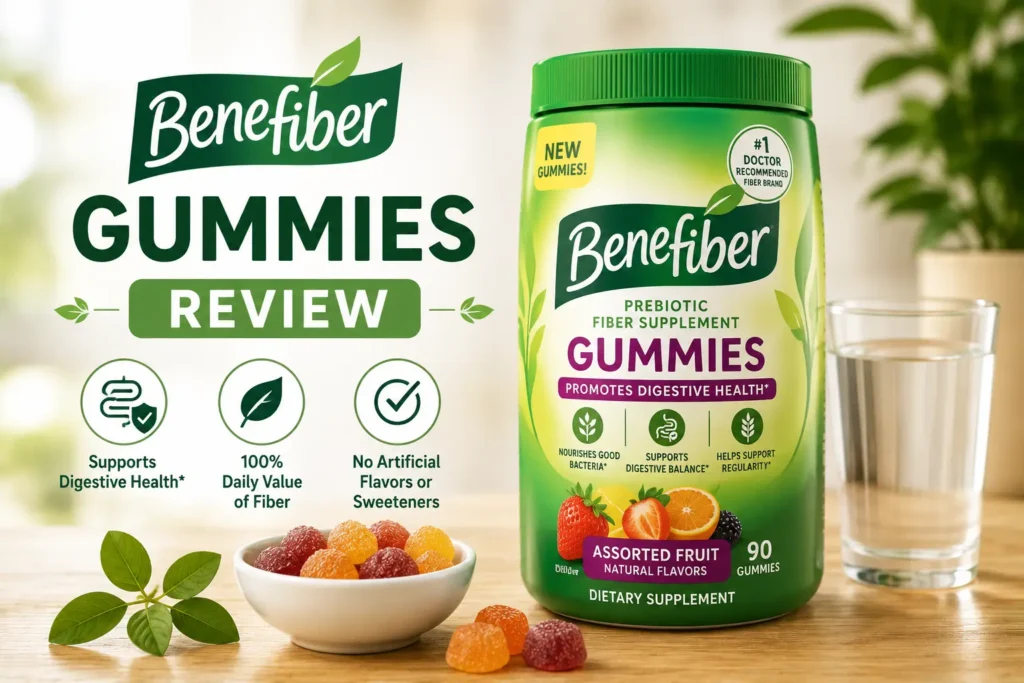
Benefiber Gummies Review: Benefiber Gummies are a chewable prebiotic fiber supplement built around inulin, a soluble fiber extracted from chicory root. Depending on the version you buy, you’ll get either straight prebiotic fiber or prebiotic fiber paired with a probiotic strain. They deliver a meaningful dose of soluble fiber per serving, taste closer to candy than a supplement, and work well for people who struggle to swallow pills or mix powders. They’re not a fit for anyone who needs a very high fiber dose from a single serving, watches their sugar intake closely, or has a sensitive gut that reacts to fermentable fibers. Below, we break down exactly what’s in Benefiber Gummies, how they compare to other Benefiber formats, and who they’re actually worth buying for.
Table of Contents
What Are Benefiber Gummies?
Benefiber Gummies are the chewable version of Benefiber’s fiber supplement line, designed for people who want the digestive benefits of fiber without swallowing a powder or a pill. They’re marketed as an easy way to add daily fiber intake without changing much about your routine — you chew a few gummies instead of stirring powder into a drink.
Benefiber currently sells this format in two distinct products, and it’s easy to confuse them if you’re shopping online:
- Benefiber Prebiotic Fiber Gummies — contain only prebiotic fiber (inulin plus soluble corn fiber), no added probiotic strain.
- Benefiber Prebiotic Fiber + Probiotic Gummies — combine inulin with the probiotic Bacillus coagulans (LactoSpore), aimed at people who want prebiotic and probiotic support in one product.
Both are separate from Benefiber Chewables, which are tablet-style chews rather than soft gummies, and from the original Benefiber Powder, which uses wheat dextrin instead of inulin as its fiber source. If you’re comparing formats, our Benefiber review covers the full product lineup in one place.
Ingredients: What’s Actually in the Gummies
This is where a lot of gummy fiber supplements fall short of expectations, so it’s worth looking closely.
Benefiber Prebiotic Fiber Gummies list inulin (as chicory root fiber) and soluble corn fiber as the active fiber sources, along with sugar, water, and a small amount of natural colors and flavors from sources like purple carrot and maqui berry concentrate.
Benefiber Prebiotic Fiber + Probiotic Gummies use inulin as the fiber source and add Bacillus coagulans (LactoSpore) as the probiotic. The rest of the formula includes sucrose, pectin, natural flavors, citric acid, and naturally sourced colors such as black carrot and annatto.
| Ingredient | Role | Present In |
| Inulin (chicory root fiber) | Primary soluble, prebiotic fiber | Both versions |
| Soluble corn fiber | Secondary soluble fiber | Prebiotic-only version |
| Bacillus coagulans (LactoSpore) | Probiotic strain | Probiotic version only |
| Sugar/sucrose | Sweetener, gummy texture | Both versions |
| Pectin | Gelling agent | Both versions |
| Natural fruit and vegetable colors | Coloring (no artificial dyes) | Both versions |
Both gummies are gluten-free, and neither relies on artificial dyes — they use plant-based colorants instead. If you want to understand inulin itself in more depth, including how it behaves in the gut, see our guide to inulin fiber and inulin’s potential side effects.
Fiber Content and Dosage
Fiber amount per serving is the number most people skip past, and it matters more than the marketing copy.
| Product | Fiber Type | Fiber Per Serving | Standard Dosage | Max Per Day |
| Prebiotic Fiber Gummies | Inulin | 6g soluble fiber (3 gummies) | 3 gummies, up to 2x/day (ages 6+); 3x/day for regularity (ages 12+) | Up to 18 gummies |
| Prebiotic Fiber + Probiotic Gummies | Inulin + probiotic | Fiber per 2 gummies (label-specific) | 2 gummies, up to 2x/day (ages 12+) | 4 gummies |
For comparison, the original Benefiber powder also provides 6g of soluble fiber per serving, so the gummies aren’t a “lighter” version of Benefiber — they match the powder’s fiber dose per serving, just in a different format. That’s a genuine advantage over many competing fiber gummies, which often deliver only 3-5g per serving and require you to eat more of them to hit a useful dose.
If you’re trying to figure out how fiber gummies stack up against fiber powder in general, our comparison of fiber gummies vs. fiber powder walks through the tradeoffs beyond just this one brand.
How Benefiber Gummies Work
Inulin is a soluble, fermentable fiber. Unlike insoluble fiber, which mostly adds bulk to stool, soluble fiber dissolves in water and forms a gel-like substance as it moves through the digestive tract. Inulin specifically is also classified as a prebiotic, meaning it serves as a food source for beneficial bacteria in the large intestine.
In practical terms, that means Benefiber Gummies are working on two fronts: adding soluble fiber to help support regularity, and feeding gut bacteria as part of general digestive health. This is different from insoluble fiber sources like wheat bran, and different from psyllium husk, which is soluble but not primarily prebiotic in the same way. If you want the deeper breakdown of soluble versus insoluble fiber, that’s covered in our soluble vs. insoluble fiber guide.
One thing worth understanding before you start: because inulin is fermentable, it tends to produce more gas than non-fermentable fibers as gut bacteria break it down. This is normal, but it explains a pattern you’ll see in the next section.
Taste and Texture
This is genuinely where Benefiber Gummies separate themselves from Benefiber’s other formats. The original Benefiber powder is marketed as “taste-free” when mixed into liquids, but many people still notice a slightly gritty texture. The gummies avoid that problem entirely.
Based on customer feedback across major retailers, the most consistent points are:
- A fruity, sweet-but-not-overpowering flavor across the assorted fruit varieties
- A soft, easy-to-chew texture that doesn’t feel like a “supplement”
- No noticeable chalky or gritty aftertaste, unlike some powder or tablet formats
This matters more than it sounds like on paper. Fiber supplements only work if you actually take them consistently, and a gummy that tastes good is one you’re less likely to skip. For people who’ve tried Benefiber powder or Benefiber chewables and abandoned them because of taste or texture, the gummies are worth a second look.
Pros and Cons
| Pros | Cons |
| 6g soluble fiber per serving (prebiotic version) — matches Benefiber powder | Contains added sugar, unlike Benefiber powder |
| Pleasant taste, easy to chew, no gritty texture | Higher cost per serving than powder or chewables |
| No artificial dyes; naturally sourced colors | Fermentable fiber can cause gas or bloating, especially at first |
| Gluten-free | Probiotic version has a lower max daily fiber dose |
| Convenient for travel, no mixing required | Not ideal for anyone strictly limiting sugar intake |
| Two formulas available (fiber-only or fiber + probiotic) | Requires chewing multiple gummies to hit full dose |
Benefiber Gummies vs. Benefiber Powder vs. Benefiber Chewables
Since all three formats carry the Benefiber name, it’s worth seeing them side by side before deciding which one fits your routine.
| Feature | Prebiotic Fiber Gummies | Benefiber Powder (Original) | Benefiber Chewables |
| Fiber source | Inulin + soluble corn fiber | Wheat dextrin | Inulin |
| Fiber per serving | 6g | 3g per teaspoon (6g per 2 tsp) | Varies by tablet count |
| Format | Soft chewable gummy | Powder, mixed into liquid or food | Solid chewable tablet |
| Sugar content | Contains added sugar | Sugar-free | Contains added sugar |
| Taste | Fruity, candy-like | Virtually tasteless when dissolved | Mild fruit flavor |
| Portability | High — no mixing needed | Lower — needs liquid or food | High — no mixing needed |
| Best for | People who dislike powders or pills | People who want zero sugar/calories | People who prefer solid chews over gummies |
If sugar content is your main concern, the original powder remains the lower-calorie, sugar-free option. If you’ve already decided a chewable format suits your routine, the choice mostly comes down to gummy versus tablet texture — our Benefiber chewables coverage goes further into that specific comparison.
Price and Value
Based on current retail listings, Benefiber Prebiotic Fiber Gummies (81-count) run in the range of roughly $0.20-$0.25 per gummy, which works out to a moderate per-serving cost compared to fiber powder, since powder servings are typically cheaper per gram of fiber delivered. The probiotic version tends to cost more per count due to the added probiotic strain.
If cost per gram of fiber is your main priority, plain fiber powders will almost always beat gummies. What you’re paying extra for with the gummy format is convenience, taste, and portability — not a cheaper way to hit your fiber target.
What Real Customers Are Saying
Customer feedback on Benefiber Gummies is largely positive, with a few recurring themes worth flagging honestly:
- Digestive improvement: Several reviewers, including people managing IBS-related symptoms, report more predictable bowel habits after a few weeks of consistent use.
- Taste satisfaction: The fruity flavor and soft texture come up repeatedly as a reason people stick with the product longer than powder or capsule alternatives.
- Price sensitivity: A recurring complaint is that the gummies cost more than other fiber formats, even among people who say the results are worth it.
- Adjustment period: As with any inulin-based fiber source, some reviewers mention initial bloating or gas that eased after their gut adjusted over one to two weeks.
None of this replaces individual medical advice — digestive response to any fiber supplement varies significantly from person to person.
Common Mistakes to Avoid
- Starting at the full dose immediately. Jumping straight to 3 gummies, multiple times a day, is the most common reason people experience uncomfortable gas or bloating. Building up gradually gives your gut bacteria time to adjust.
- Not drinking enough water. Soluble fiber works best with adequate fluid intake. Skipping water can reduce the benefit and increase bloating.
- Assuming more is always better. Exceeding the labeled maximum doesn’t speed up results and increases the likelihood of digestive discomfort.
- Confusing the two gummy versions. The prebiotic-only and prebiotic + probiotic gummies have different dosing instructions and different daily maximums — check the label of the exact product you bought.
- Expecting immediate results. Fiber supplements, especially prebiotic ones, typically take one to two weeks of consistent use before effects on regularity become noticeable.
Who Should (and Shouldn’t) Consider Benefiber Gummies
A good fit if you:
- Dislike the taste or texture of fiber powders
- Have trouble swallowing pills or capsules
- Want a fiber supplement you can take without water or mixing
- Are looking for a moderate, consistent daily fiber boost rather than a heavy single dose
Probably not the best fit if you:
- Are actively limiting added sugar intake
- Have a fiber sensitivity that reacts poorly to fermentable, prebiotic fibers like inulin
- Need a very high single-serving fiber dose (in which case a fiber powder will get you there in fewer servings)
- Are looking for the lowest possible cost per gram of fiber
If bloating from fermentable fibers is a known issue for you, it may be worth reading about fiber supplements that don’t cause gas before committing to an inulin-based product. And if constipation relief specifically is your goal, our guide to the best fiber supplement for constipation compares several fiber types side by side, not just this one brand.
Safety and Side Effects
Benefiber Gummies are generally well tolerated when introduced gradually. As with any inulin-containing product, the most commonly reported effects are mild and temporary:
- Gas or bloating, particularly in the first one to two weeks
- Mild stomach discomfort if the dose is increased too quickly
- Potential unsuitability for people with fructan sensitivities, since inulin is a fructan
People under 6 should not use this product without medical guidance, and anyone with a diagnosed digestive condition, or who is pregnant or nursing, should check with a healthcare provider before adding any new fiber supplement to their routine. This article is educational and isn’t a substitute for personalized medical advice.
Frequently Asked Questions
Are Benefiber Gummies as effective as Benefiber Powder? The Prebiotic Fiber Gummies deliver the same 6g of soluble fiber per serving as the original powder, so the fiber dose is comparable. The main differences are the fiber source (inulin versus wheat dextrin) and the fact that the gummies contain added sugar while the powder does not.
Do Benefiber Gummies cause gas or bloating? They can, especially when starting out or increasing the dose too quickly. This is a normal response to fermentable, prebiotic fibers like inulin and typically eases as your gut bacteria adjust over one to two weeks.
How many Benefiber Gummies should I take per day? For the Prebiotic Fiber Gummies, the standard dose is 3 gummies, up to twice a day for ages 6 and up, or up to three times a day for regularity support in ages 12 and up. The Prebiotic Fiber + Probiotic version uses a lower dose of 2 gummies, up to twice daily, with a maximum of 4 gummies per day. Always check the specific product’s label, since the two formulas differ.
Are Benefiber Gummies gluten-free? Yes, both the Prebiotic Fiber Gummies and the Prebiotic Fiber + Probiotic Gummies are labeled gluten-free.
What’s the difference between Benefiber Gummies and Benefiber Chewables? Gummies are soft, chewy, and candy-like, while chewables are a firmer, tablet-style chew. Both can use inulin as the fiber source, but the texture and eating experience are noticeably different, which matters most for people who are picky about mouthfeel.
Can I take Benefiber Gummies every day long-term? Yes, fiber supplements like this are generally designed for daily, ongoing use as part of a consistent fiber intake routine, rather than short-term or occasional use. If you have concerns about long-term use for your specific health situation, check with a healthcare provider.
Final Verdict
Benefiber Gummies do what they promise: a real 6g dose of soluble prebiotic fiber, delivered in a format that’s genuinely more pleasant to take than powder or tablets. The tradeoffs are the added sugar and a higher cost per serving, which matter more if you’re fiber-supplementing for weight management or blood sugar reasons rather than general digestive support.
For anyone who has fiber supplements sitting unused in a cabinet because the powder texture or tablet size put them off, these gummies solve that specific problem. For anyone optimizing purely for cost per gram of fiber or avoiding added sugar, the original Benefiber powder remains the stronger choice. If you’re still deciding between formats generally, our full best fiber gummies guide compares Benefiber against other prebiotic gummy brands on the market.