
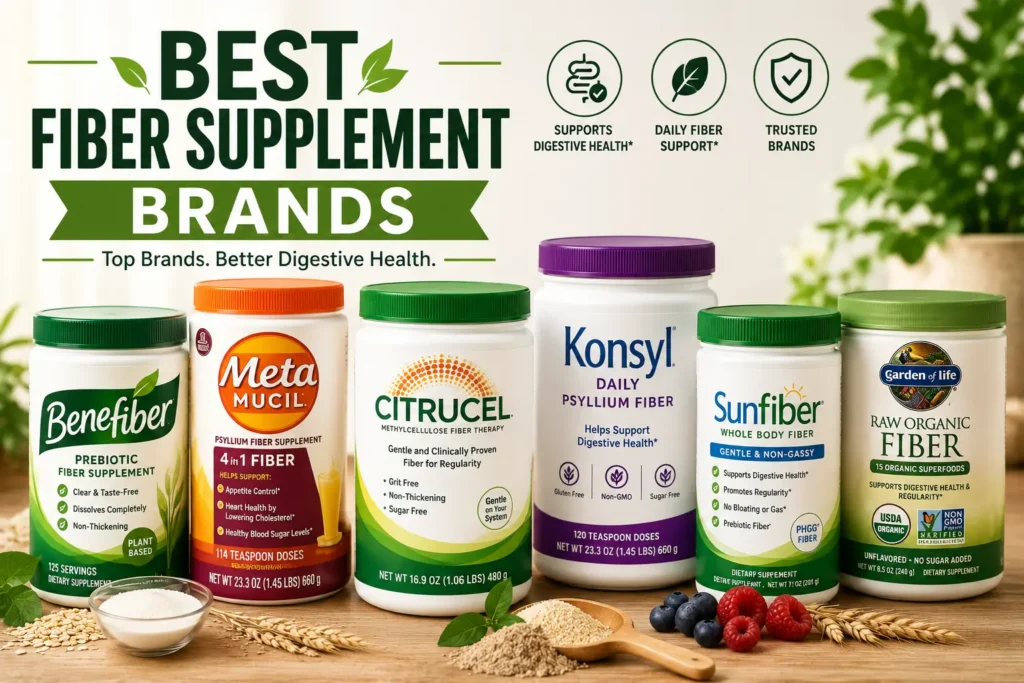
There isn’t one single “best” fiber supplement brand — the right choice depends on which type of fiber your gut tolerates and what you’re trying to fix. Metamucil (psyllium husk) is the strongest all-around choice for cholesterol support and stool bulking. Benefiber (wheat dextrin or inulin, depending on the product) is the gentlest-tasting option for people who want a fiber supplement they can’t detect. Citrucel (methylcellulose) causes the least gas of the major brands. Konsyl offers the simplest, single-ingredient psyllium formula at a lower cost. And specialty brands like Heather’s Tummy Fiber and Sunfiber are built specifically for sensitive guts, including IBS. Below, we break down every major brand by fiber type, tolerance, and best use case, so you can match the product to your actual goal instead of picking based on shelf placement.
Table of Contents
Why “Best Brand” Depends on Fiber Type, Not Marketing
Most roundups rank fiber supplement brands the way they’d rank shampoo — by price, reviews, and packaging. That approach misses the one variable that actually determines whether a fiber supplement works for you: the type of fiber inside it.
Two products can both say “fiber supplement” on the label and behave completely differently in your gut. Psyllium husk bulks stool and ferments slowly. Methylcellulose doesn’t ferment at all, so it produces almost no gas. Inulin and wheat dextrin ferment quickly, which is great for feeding gut bacteria but can cause more bloating in sensitive people. Acacia fiber sits in between.
That’s why the brand comparison below is organized around what each company’s core fiber ingredient actually does, not just star ratings. If you want the full breakdown of fiber categories before you compare brands, our guide to the types of dietary fiber ingredients is a useful starting point.
The Best Fiber Supplement Brands, Compared
| Brand | Primary Fiber | Fermentation / Gas Level | Best Known For | Typical Format |
| Metamucil | Psyllium husk | Moderate-high | Cholesterol support, strong bulking | Powder, capsules, gummies, wafers |
| Benefiber | Wheat dextrin (powder) / Inulin (gummies) | Low (dextrin) to high (inulin) | Taste-free mixing, convenience | Powder, chewables, gummies |
| Citrucel | Methylcellulose | Very low (non-fermentable) | Minimal gas and bloating | Powder, caplets |
| Konsyl | Psyllium husk | Moderate-high | Single-ingredient simplicity, lower cost | Powder, capsules, stick packs, gummies |
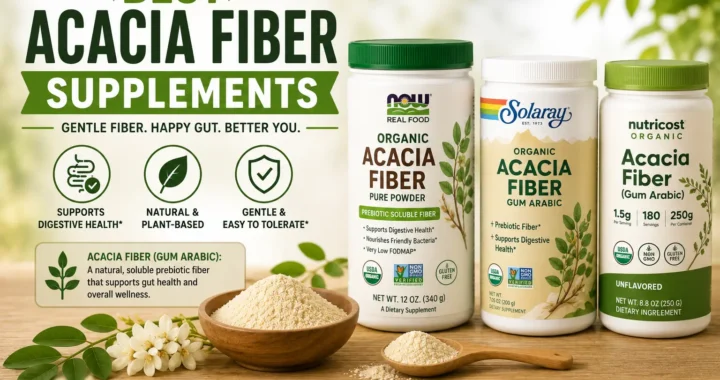
| Heather’s Tummy Fiber | Acacia senegal | Low, slow fermentation | IBS-specific gentleness | Powder |
| Sunfiber | PHGG (guar gum) | Very low | Clinically studied, mineral absorption | Powder |
| Garden of Life | Blended plant fibers | Varies by blend | Organic, whole-food, clean-label | Powder |
| NOW Foods | Acacia, psyllium (multiple lines) | Varies by product | Budget-friendly, wide product range | Powder, capsules |
| Yerba Prima | Psyllium husk | Moderate-high | Whole-husk, minimal additives | Powder, capsules |
| Bellway | Acacia/psyllium blends | Moderate | Value-focused blends | Powder |
This table intentionally leaves out a single “winner” column, because the right answer changes based on your priority — something most competing roundups skip entirely.
Brand-by-Brand Breakdown
Metamucil
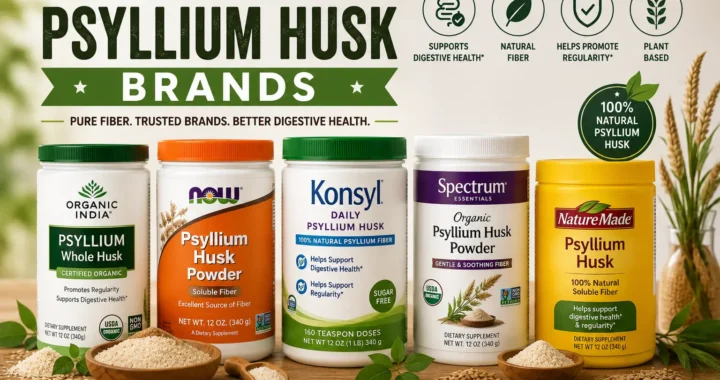
Metamucil is built on psyllium husk, a natural soluble fiber that forms a gel as it absorbs water. It’s the most clinically studied brand on this list for cholesterol support, and it remains the standard most doctors mention first when recommending an over-the-counter fiber supplement. The tradeoff is that psyllium ferments more than methylcellulose, so gas and bloating are more common, especially when starting out. Metamucil is also available in a wide range of formats, from classic powder to sugar-free versions and gummies, which makes it easy to find a format that fits your routine. See our full Metamucil review for a deeper look, or Metamucil fiber gummies review if you’re specifically comparing gummy formats.
Benefiber
Benefiber built its reputation on wheat dextrin, a soluble fiber that dissolves completely and is genuinely difficult to detect in food or drinks. That makes the original powder the go-to option for people who’ve tried other fiber supplements and disliked the taste or gritty texture. Benefiber has since expanded into chewables and gummies, with the gummy line using inulin instead of wheat dextrin — a meaningful difference worth knowing before you buy. For the full lineup breakdown, read our Benefiber review and Benefiber Gummies review.
Citrucel
Citrucel is the brand to know if gas and bloating are your main concern. Its active ingredient, methylcellulose, is a non-fermentable fiber, meaning gut bacteria don’t break it down the way they do psyllium or inulin. That makes Citrucel one of the gentler options on this list, though it also means it doesn’t offer the same prebiotic or cholesterol-lowering benefits associated with fermentable fibers. It’s a solid pick for people who’ve tried psyllium-based brands and found them too gas-producing.
Konsyl
Konsyl has been making psyllium-based fiber products for decades, and its core appeal is simplicity: many of its products contain just one ingredient — psyllium husk — with no added sweeteners or fillers. That makes it a strong choice for people who want the benefits of psyllium without extra additives, often at a lower price point than more heavily marketed brands. Konsyl has also expanded into gummies in recent years, following the same category shift seen across the industry.
Heather’s Tummy Fiber
This brand is built specifically around acacia senegal, a soluble fiber known for slow, gentle fermentation. It’s frequently recommended for people with IBS because it tends to be better tolerated than faster-fermenting fibers like inulin. Heather’s Tummy Fiber keeps its formula intentionally simple — pure acacia fiber, without added flavors or sweeteners — which appeals to people who react poorly to filler ingredients in other brands.
Sunfiber
Sunfiber uses partially hydrolyzed guar gum (PHGG), a soluble fiber studied for its mild fermentation profile and its ability to support mineral absorption rather than interfere with it, unlike some other fiber types. It’s tasteless and dissolves clearly in liquids, and you’ll often find it as an ingredient inside other companies’ formulas (like Thorne’s FiberMend) rather than sold only under its own name. For people managing IBS or general sensitivity, Sunfiber is one of the more clinically referenced options on this list.
Garden of Life
Garden of Life takes a whole-food, organic approach, blending multiple plant-based fiber sources rather than relying on a single ingredient. This appeals to people who prioritize clean-label, minimally processed products over the more clinical, single-ingredient approach of brands like Konsyl or Sunfiber. The tradeoff is that blended formulas can have a stronger taste and texture than the “invisible” fiber powders.
NOW Foods
NOW Foods offers a wide range of fiber products, including acacia fiber and psyllium husk, generally at a lower price point than the major national brands. It’s a reasonable choice for people who want an established supplement manufacturer without paying a premium for brand marketing, though the product lineup is broader and less curated than single-purpose fiber brands.
Yerba Prima
Yerba Prima focuses on whole psyllium husk with minimal processing and few additional ingredients. It’s positioned closer to a “whole food supplement” than a heavily processed powder, which appeals to people who specifically want psyllium in as close to its natural form as possible.
Bellway
Bellway offers value-oriented fiber blends, often combining acacia and psyllium fibers. It’s typically positioned as a budget-conscious alternative to the bigger national brands, with a similar fiber profile at a lower shelf price.
How to Choose Between These Brands (Decision Framework)
Instead of ranking brands by popularity, use this framework based on your actual priority:
If your main goal is cholesterol or heart health support → Psyllium-based brands (Metamucil, Konsyl, Yerba Prima) have the strongest evidence base.
If you’re sensitive to gas and bloating → Start with methylcellulose (Citrucel) or acacia-based brands (Heather’s Tummy Fiber, NOW Foods Acacia), since these ferment more slowly or not at all.
If you want a fiber supplement you genuinely can’t taste → Benefiber’s original wheat dextrin powder remains the most “invisible” option on the market.
If you have diagnosed IBS → Acacia senegal (Heather’s Tummy Fiber) or PHGG (Sunfiber) tend to be better tolerated than psyllium or inulin, based on how they ferment.
If cost per serving matters most → Konsyl and NOW Foods generally offer lower per-serving pricing than heavily marketed national brands.
If you want an organic, whole-food-style blend → Garden of Life leads this category, though expect a stronger taste and texture than single-ingredient powders.
For a more detailed walkthrough of this decision process across every fiber type (not just brand names), see our guide on how to choose a fiber supplement.
Fiber Type Cheat Sheet
Since brand choice really comes down to fiber type, here’s the quick reference most competitor articles don’t include:
| Fiber Type | Found In | Fermentation | Common Effect |
| Psyllium husk | Metamucil, Konsyl, Yerba Prima | Moderate-high | Strong bulking, cholesterol support |
| Wheat dextrin | Benefiber (powder) | Low | Gentle, low gas, taste-free |
| Methylcellulose | Citrucel | None (non-fermentable) | Minimal gas, less prebiotic benefit |
| Inulin | Benefiber Gummies, many gummy brands | High | Strong prebiotic effect, more gas |
| Acacia senegal | Heather’s Tummy Fiber, NOW Foods | Low, slow | Well tolerated, IBS-friendly |
| PHGG (guar gum) | Sunfiber | Low | Mild, supports mineral absorption |
If you want to go deeper on any single fiber type, our dedicated guides cover psyllium husk, wheat dextrin, methylcellulose fiber, inulin fiber, and acacia fiber individually.
Common Mistakes When Choosing a Fiber Brand
- Picking based on brand recognition alone. The most advertised brand isn’t automatically the best match for your digestive tolerance.
- Ignoring the fiber type on the label. Two products from the same brand (like Benefiber powder vs. Benefiber gummies) can use completely different fiber sources.
- Starting at full dose. Regardless of brand, jumping straight to the maximum labeled dose is the most common cause of early bloating and discomfort.
- Assuming “natural” means “better tolerated.” Whole-food blends aren’t automatically gentler than single-ingredient formulas — tolerance depends on the specific fiber, not how processed it looks.
- Not accounting for existing medication. Fiber supplements can affect how well the body absorbs certain medications, regardless of brand, so timing matters.
Frequently Asked Questions
What is the most recommended fiber supplement brand by doctors? Psyllium husk brands like Metamucil and Konsyl are the most frequently referenced in clinical and medical guidance, largely due to a stronger body of research on cholesterol and bowel regularity.
Which fiber supplement brand causes the least gas? Citrucel, built on non-fermentable methylcellulose, is generally the gentlest option for gas and bloating. Acacia-based brands like Heather’s Tummy Fiber are a close second among fermentable fibers.
Is a more expensive fiber supplement brand automatically better? No. Price often reflects marketing and packaging more than fiber quality. Simpler, single-ingredient brands like Konsyl frequently deliver comparable soluble fiber at a lower cost per serving.
Can I switch fiber supplement brands if one doesn’t work for me? Yes, and it’s common. If a psyllium-based brand causes too much gas, switching to a methylcellulose or acacia-based brand is a reasonable next step, since the fermentation behavior is genuinely different.
Do fiber supplement brands differ in quality, or just fiber type? Both. Fiber type is the biggest factor in how a product behaves in your gut, but manufacturing quality, added sweeteners, and third-party testing also vary meaningfully between brands.
Are newer fiber gummy brands as effective as traditional powders? It depends on the fiber dose per serving, which varies significantly by brand. Some gummy lines match traditional powder doses; others require eating more gummies to reach an equivalent amount of fiber. Always check grams of fiber per serving, not just gummy count.
Final Verdict
The best fiber supplement brand isn’t a single name — it’s the brand whose fiber type matches your goal and your gut’s tolerance. If you want the strongest overall evidence base, start with a psyllium brand like Metamucil or Konsyl. If gas is your main concern, Citrucel or an acacia-based brand will likely serve you better. If you’re managing IBS specifically, Heather’s Tummy Fiber and Sunfiber are worth prioritizing over the bigger national names. Use the decision framework above rather than star ratings alone, and expect to adjust your dose gradually regardless of which brand you choose. For a side-by-side look at how the top psyllium brands compare directly, our Metamucil vs. Benefiber and Benefiber vs. Citrucel comparisons go one level deeper than this brand overview.