
Quick answer: Psyllium husk is a natural, soluble fiber made from the seed husks of the Plantago ovata plant. When mixed with water, it forms a gel that softens stool, supports regular bowel movements, helps lower cholesterol, and can slow the absorption of sugar into the bloodstream. It’s one of the most researched fiber supplements available, and it’s FDA-recognized for relieving occasional constipation. Most people take 5–10 grams, once to three times a day, always with a full glass of water.
If you’ve ever picked up a bottle of Metamucil or seen “psyllium fiber” listed as an ingredient in a fiber supplement, this guide breaks down exactly what it does, how it works in your body, who benefits most, and how to use it correctly — without the marketing fluff.
Table of Contents
What Is Psyllium Husk?
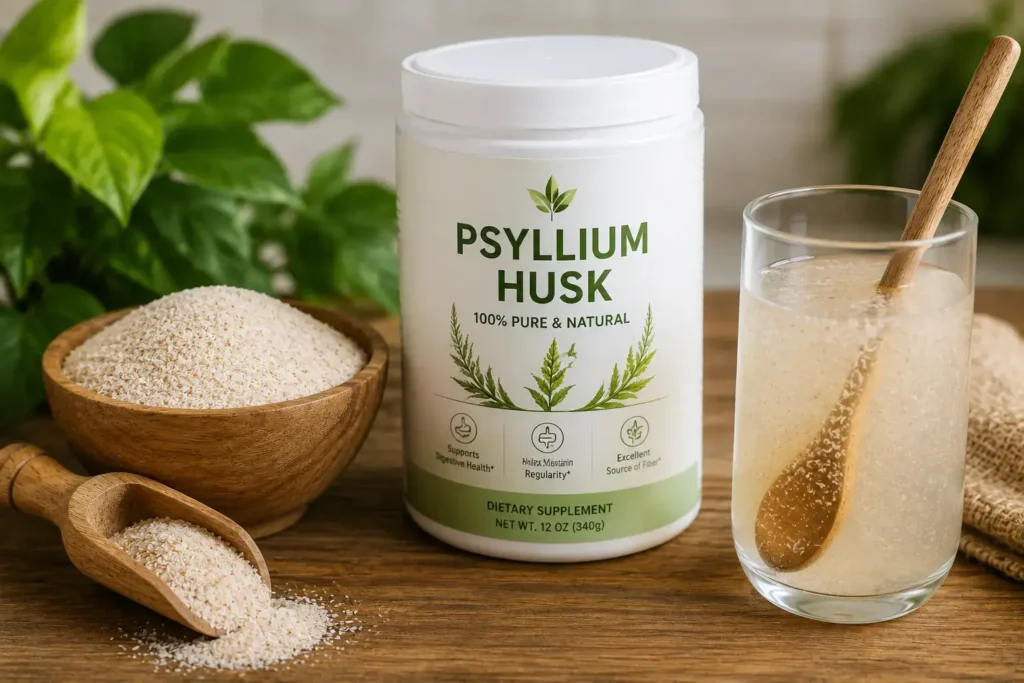
Psyllium husk is the outer coating (husk) of the seeds from the Plantago ovata plant, a shrub-like herb grown mainly in India and parts of the Middle East. Once the seeds are harvested, the husk is separated and ground into a fine or coarse powder.
That powder is almost entirely soluble fiber. Unlike fiber from wheat bran or vegetables, psyllium husk isn’t broken down much by digestive enzymes or gut bacteria. Instead, it absorbs water and swells into a thick, gel-like substance as it moves through your digestive tract. This gel-forming property is the reason psyllium behaves differently — and often more predictably — than other fiber sources.
You’ll typically find it sold as:
- Whole or ground husk powder (mixed into water or juice)
- Capsules or pills
- Chewable wafers
- An ingredient in fiber gummies, bars, and blended fiber powders
If you’re comparing formats, our guides on the best fiber powder and best fiber pills break down how each delivery method performs in practice.
How Psyllium Husk Works in the Body
Understanding the mechanism makes the benefits much easier to make sense of — this is where most articles just list effects without explaining why they happen.
- It absorbs water. Psyllium can hold up to roughly 10–20 times its weight in water, forming a viscous gel.
- It adds bulk and softness to stool. This gel increases stool weight and water content, making stool easier and more comfortable to pass — helpful for both constipation and, at controlled doses, loose stools.
- It slows gastric emptying and sugar absorption. The thick gel coats part of the digestive tract, slowing how quickly sugar enters the bloodstream after a meal.
- It binds bile acids. In the intestine, psyllium binds to bile acids (which are made from cholesterol) and carries them out of the body. To replace them, the liver pulls more cholesterol out of the blood — one of the main reasons psyllium is linked to lower LDL cholesterol.
- It largely resists fermentation. Unlike inulin or other fermentable fibers, psyllium is only partially fermented by gut bacteria. This means it produces less gas and bloating for most people, which is a meaningful, practical difference competitors rarely explain clearly.
Psyllium Husk Benefits (What the Evidence Actually Shows)
1. Relieves and Prevents Constipation
This is psyllium’s best-documented use. <cite index=”3-1″>Psyllium husk is approved by the U.S. Food and Drug Administration as an over-the-counter drug for the treatment of occasional constipation, and research indicates it is also the most effective fiber for treating chronic idiopathic constipation.</cite> It increases stool water content and bulk, which normalizes consistency in both healthy people and those with chronic constipation.
Clinical research in constipated women found <cite index=”10-1″>psyllium husk relieved constipation symptoms without serious adverse reactions</cite>, with significant improvements in straining, stool frequency, hard stool, and pain during bowel movements compared to placebo.
2. May Help With Diarrhea Too
Because the same gel that softens hard stool also absorbs excess water in loose stool, psyllium is considered useful for both ends of the spectrum. Research on Plantago ovata husk describes therapeutic effects in <cite index=”3-1″>both constipation (including occasional and chronic) and diarrhea (acute and chronic)</cite> — a dual action that few other fiber types offer.
3. Supports Healthy Cholesterol Levels
Psyllium’s bile-acid-binding action is linked to modest but consistent reductions in LDL (“bad”) cholesterol. This effect has been studied for decades and is one of the reasons psyllium fiber is included in heart-health–focused fiber blends and clinical cholesterol research protocols.
4. Supports Blood Sugar Management
By slowing gastric emptying and forming a physical barrier that delays carbohydrate absorption, psyllium can blunt the post-meal blood sugar spike. This makes it a common recommendation alongside meals for people focused on glycemic control — though it should never replace prescribed diabetes medication or monitoring.
5. Feeds a Healthier Gut Microbiome
Newer research shows psyllium doesn’t just pass through — it interacts with gut bacteria in a way that appears beneficial. Studies describe psyllium positively altering gut microbiota composition, supporting a more favorable bacterial balance even though it’s less fermentable than fibers like inulin.
6. May Support Satiety and Weight Management
Because the gel expands in the stomach and slows digestion, psyllium can increase feelings of fullness. It’s not a fat-burning ingredient, but as part of a balanced diet it may help reduce overeating. For a broader look at fiber’s role here, see our guide to the best fiber supplement for weight loss.
7. Investigated for IBS, Ulcerative Colitis, and Colorectal Health
Research has explored psyllium’s role in managing irritable bowel syndrome and ulcerative colitis, and in supporting colorectal health through its fermentation byproducts (short-chain fatty acids) and effect on transit time. Results are promising for symptom management in IBS specifically, but psyllium is a supportive tool — not a treatment — for inflammatory bowel conditions, and anyone with IBD should work directly with a gastroenterologist.
Psyllium Husk Nutrition Snapshot
| Per 1 tablespoon (about 7g) ground psyllium husk | Approximate Value |
| Calories | ~20 |
| Total Fiber | ~5–6g |
| Soluble Fiber | Majority of total fiber |
| Net Digestible Carbs | Near 0g |
| Protein | <1g |
| Fat | 0g |
Values vary slightly by brand and whether the product is pure husk or blended with other ingredients — always check the label.
How to Take Psyllium Husk (Dosage & Method)
There’s no single “correct” dose — it depends on the goal and your current fiber intake — but general, widely cited guidance looks like this:
- Starting dose: 1 teaspoon (about 3–5g) once daily, mixed into 8oz (240ml) of water or juice
- Typical maintenance dose: 5–10g, one to three times per day
- Upper range used in clinical settings: up to 20–30g per day in divided doses, though most people don’t need this much
<cite index=”4-1″>A typical laxative dose in humans ranges from about 2.5 grams to about 20 grams, taken one to three times per day.</cite>
How to take it correctly:
- Mix the powder into a full glass of water, juice, or a smoothie — never take it dry.
- Drink it immediately, before it thickens into a gel in the glass.
- Follow with a second full glass of plain water.
- Increase your dose gradually over 1–2 weeks to let your gut adjust and reduce bloating.
- Take it consistently — psyllium works best as a daily habit, not a one-time fix.
Clinical guidance is explicit on this point: each dose should be dissolved in roughly 150–200ml of liquid, followed by another glass of water, and psyllium should not be taken by anyone who has difficulty swallowing, due to the risk of the gel expanding before it’s fully swallowed.
Psyllium Husk vs. Other Common Fibers
This is a comparison most competitor articles skip entirely — and it’s often the exact question people have after reading “psyllium is good for you.”
| Fiber Type | Solubility | Fermentability | Best For | Common Side Effect |
| Psyllium husk | Soluble, gel-forming | Low–moderate | Constipation, diarrhea, cholesterol, blood sugar | Mild bloating if increased too fast |
| Inulin (chicory root) | Soluble | High | Feeding gut bacteria (prebiotic) | Gas, bloating, cramping |
| Methylcellulose | Soluble | Not fermented | Constipation with less gas | Generally low, but less multi-benefit |
| Wheat dextrin | Soluble | High | Mild, flavorless fiber boost | Gas in sensitive individuals |
| Wheat bran | Insoluble | Low | Adding bulk quickly | Can worsen bloating/cramping in IBS |
Key takeaway: Psyllium sits in a favorable middle ground — it’s fermentable enough to support gut bacteria, but not so fermentable that it causes the level of gas typical of inulin. That’s a major reason it’s the most-studied and most-recommended fiber for general digestive regularity.
If you’re deciding between soluble and insoluble options more broadly, our comparison guide on the best soluble fiber supplement goes deeper into that distinction.
Pros and Cons of Psyllium Husk
| Pros | Cons |
| Strong clinical evidence for constipation relief | Can cause bloating or gas if increased too quickly |
| Works for both constipation and diarrhea | Must be taken with enough water (choking/blockage risk if not) |
| Supports healthy cholesterol levels | Can interfere with absorption of some medications |
| May help regulate blood sugar after meals | Texture (gel/mucilage) isn’t pleasant for everyone |
| Widely available and inexpensive | Not a fast fix — effects build over days to weeks |
| Naturally gluten-free and low-calorie | Requires consistent daily use for best results |
Who Should Be Cautious or Avoid Psyllium Husk
Psyllium is generally considered safe for most healthy adults, but caution is warranted in certain situations:
- Difficulty swallowing: Because psyllium gels quickly, it should not be taken by anyone with swallowing difficulties, as the gel can expand in the throat or esophagus before reaching the stomach.
- Bowel obstruction or narrowing: People with a diagnosed or suspected intestinal blockage should avoid fiber supplements like psyllium entirely.
- Medication timing: Psyllium can bind to certain medications and reduce their absorption. As a general rule, take prescription medications at least 1–2 hours before or after psyllium.
- Allergies: Rare but documented allergic reactions to psyllium exist, especially with inhaled dust from the powder in occupational settings.
- Pregnancy or existing medical conditions: Anyone pregnant, breastfeeding, or managing a diagnosed digestive or metabolic condition should check with a doctor before starting any fiber supplement, including psyllium.
This article is for educational purposes and isn’t a substitute for personalized medical advice.
Common Mistakes People Make With Psyllium Husk
- Not drinking enough water. This is the single most common — and most avoidable — mistake, and it’s the main cause of discomfort or, rarely, blockage.
- Increasing the dose too fast. Jumping straight to 15–20g on day one almost always causes bloating. Start small and build up.
- Taking it right before bed without enough fluid. Lying down soon after can slow the gel’s movement through the esophagus.
- Expecting overnight results. Regularity typically improves over several days to two weeks of consistent use, not after a single dose.
- Taking it at the same time as medication. This can reduce how much of the medication your body actually absorbs.
- Assuming more is always better. Beyond a certain point, extra psyllium doesn’t add extra benefit — it just adds extra bloating risk.
Frequently Asked Questions
Is psyllium husk the same as psyllium fiber? Yes, in practical terms. “Psyllium fiber” usually refers to the soluble fiber content found in psyllium husk — the terms are used interchangeably in most supplement labeling.
How long does it take psyllium husk to work? For constipation relief, many people notice an effect within 12–72 hours. For cholesterol or blood sugar benefits, consistent daily use for several weeks is typically needed before changes show up in bloodwork.
Can I take psyllium husk every day? Yes — it’s designed for daily use, and most of its benefits (cholesterol, blood sugar, regularity) depend on consistent intake rather than occasional use.
Does psyllium husk cause bloating? It can, especially if you increase your dose too quickly or don’t drink enough water. Starting with a small dose and increasing gradually significantly reduces this risk.
Is psyllium husk a prebiotic? It has some prebiotic activity, but it’s less fermentable than fibers like inulin. This is actually an advantage for people who find highly fermentable fibers cause excessive gas.
Can psyllium husk help with weight loss? It may support weight management by increasing fullness and slowing digestion, but it isn’t a weight-loss treatment on its own. It works best alongside a balanced diet.
What’s the difference between psyllium husk powder and capsules? Powder mixed with water tends to work faster and is generally the most cost-effective format. Capsules are more convenient and portable but usually require taking several at once to match an equivalent powder dose, and you still need to drink a full glass of water with them.
Is psyllium husk gluten-free? Yes, psyllium husk itself is naturally gluten-free, though it’s sometimes used as a binder in gluten-free baking for that reason. Always check individual product labels for cross-contamination disclosures if you have celiac disease.
Final Verdict
Psyllium husk is one of the few fiber supplements with decades of clinical research behind it and an FDA-recognized use for occasional constipation. Its gel-forming, low-fermentation profile makes it easier on the gut than highly fermentable fibers like inulin, while still supporting cholesterol, blood sugar, and gut microbiota benefits.
It isn’t a quick fix, and it isn’t the right choice for everyone — particularly those with swallowing difficulties or bowel obstructions. But for most healthy adults looking for a well-studied, inexpensive way to support digestion, it’s a reasonable, evidence-backed place to start.
If you’re still narrowing down the right product for your needs, these comparison guides can help:
- Best Fiber Supplement (Overall)
- Best Fiber Supplement for Constipation
- Best Fiber Supplement for Women
- Best Daily Fiber Supplement
- Best Natural Fiber Supplement
This article is for educational purposes only and does not constitute medical advice. Talk to a healthcare provider before starting any new supplement, especially if you’re pregnant, nursing, or managing a medical condition.