
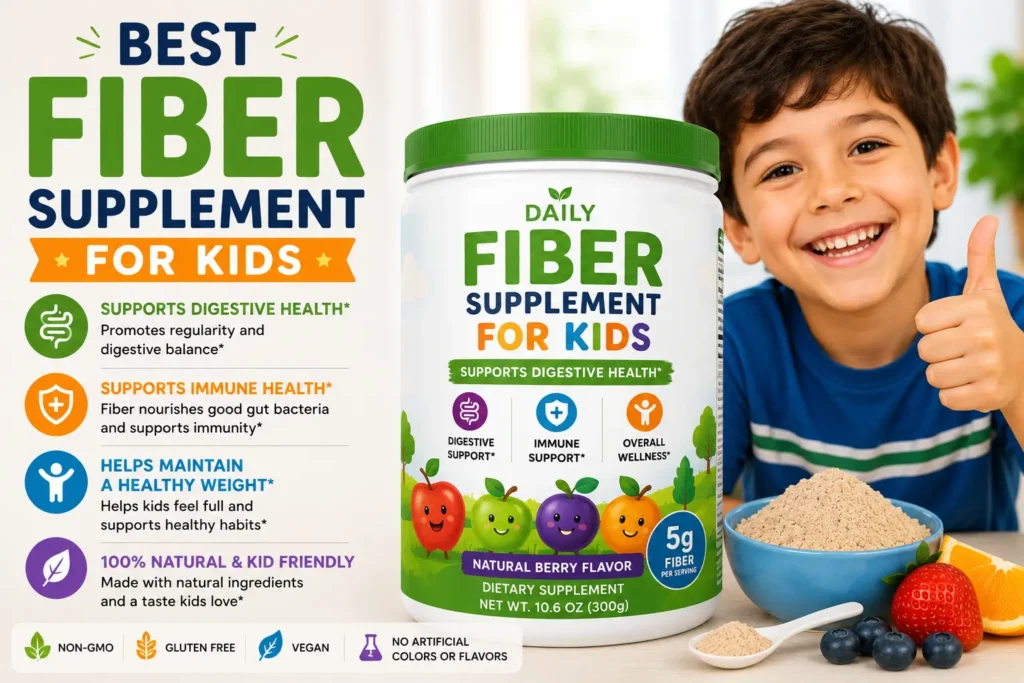
If your child is dealing with constipation, irregular bathroom habits, or just doesn’t eat enough fruits, vegetables, and whole grains, you’ve probably started searching for the best fiber supplement for kids. The good news is that fiber supplements for children can genuinely help — but the right choice depends on your child’s age, the reason you’re supplementing, and how their body tolerates different fiber types.
This guide walks through everything a parent needs to know before buying a children’s fiber supplement: how much fiber kids actually need, which types are gentlest and safest, how to read a label the right way, and the mistakes most parents make when introducing fiber for the first time.
This article is for general education only. It is not medical advice, and it doesn’t replace a conversation with your child’s pediatrician — especially if your child has ongoing digestive symptoms.
Table of Contents
Quick Answer
There isn’t a single “best” fiber supplement for every child, because the right pick depends on age and tolerance. As a general rule:
- Toddlers and young children (2–5 years): a gentle, low-dose soluble fiber powder mixed into food or a drink, introduced slowly and only with a pediatrician’s input.
- School-age children (6–12): chewable wafers, fiber gummies, or a mixable powder with modest added sugar are usually the easiest to get kids to actually take.
- Occasional constipation: a soluble fiber like psyllium husk or inulin, paired with more water, tends to work faster than insoluble fiber.
- Picky eaters with low overall fiber intake: a daily low-dose supplement can help close the gap, but it should support — not replace — high-fiber foods.
Do Kids Actually Need a Fiber Supplement?
Most pediatric nutrition experts agree on one thing first: food should be the primary source of fiber for children, not supplements. Fruits, vegetables, legumes, and whole grains provide fiber alongside vitamins, minerals, and other nutrients that a supplement can’t fully replace. Fiber supplements are best treated as a backup plan, not a shortcut.
That said, supplements can make sense when:
- Your child has diagnosed constipation and a doctor has recommended additional fiber
- Your child is an extremely picky eater who consistently rejects high-fiber foods
- Dietary changes alone haven’t resolved irregular bowel habits
- A pediatrician is actively managing your child’s digestive health and wants a consistent, measurable fiber intake
If your child eats a reasonably varied diet, focus on food first. If you’re unsure whether that’s realistic for your family, our guide on fiber supplements vs. fiber foods breaks down when each approach makes more sense.
How Much Fiber Do Kids Need? (Age-by-Age Chart)
Fiber needs increase as children grow. Two commonly cited benchmarks are used by pediatric health organizations: the American Academy of Pediatrics’ simple “Age + 5” formula, and the more detailed USDA Dietary Guidelines for Americans.
| Age Group | AAP Rule of Thumb (Age + 5) | USDA Dietary Guidelines |
| 1–3 years | Not typically applied under age 2–3 | 19 g/day |
| 4–8 years | 9–13 g/day | 25 g/day |
| 9–13 years (girls) | 14–18 g/day | 26 g/day |
| 9–13 years (boys) | 14–18 g/day | 31 g/day |
| 14–18 years (girls) | 19–23 g/day | 26 g/day |
| 14–18 years (boys) | 19–23 g/day | 38 g/day |
The AAP’s simplified formula — a child’s age in years, plus 5 grams — is often used as an easy minimum target, with “age plus 10” sometimes cited as the upper end of a safe range. The USDA guidelines, based on 14 grams of fiber per 1,000 calories consumed, tend to recommend higher totals. Both are reasonable reference points; neither is an exact medical requirement for every child, since research on fiber needs specifically in children is more limited than it is for adults.
The practical takeaway: most kids fall short of either target. A supplement is meant to help close that gap, not to hit an exact number every single day.
Signs Your Child Might Benefit from More Fiber
Not every stomachache means “add fiber.” But a few patterns are worth paying attention to:
- Bowel movements fewer than 3 times per week
- Hard, dry, or painful-to-pass stools
- A diet that’s heavy in refined carbs (white bread, crackers, pasta) and light on produce
- Frequent complaints of a full or bloated stomach
- A pediatrician-diagnosed history of constipation
If your child has severe abdominal pain, blood in the stool, unexplained weight loss, or vomiting, those symptoms need medical attention — not a supplement.
Types of Fiber Supplements for Kids
Children’s fiber supplements generally fall into a few categories, each with a different texture, taste, and fiber source.
1. Psyllium Husk Powder or Wafers
Psyllium is a soluble fiber that absorbs water and forms a gel-like consistency in the gut, which helps soften stool and support regularity. It’s one of the most studied fiber sources and is available in kid-friendly wafer or powder form.
Pros: Well-researched, effective for constipation, no artificial sweeteners in plain versions Cons: Needs to be taken with plenty of water; texture can be off-putting to some kids
Learn more in our full psyllium husk guide.
2. Inulin / Chicory Root Fiber
Inulin is a prebiotic soluble fiber often used in kids’ gummies because it blends easily and has a mild taste. It also feeds beneficial gut bacteria.
Pros: Easy to hide in food or drinks, supports gut bacteria Cons: Can cause more gas and bloating than other fibers, especially at higher doses
3. Methylcellulose
A synthetic, non-fermentable soluble fiber. It tends to cause less gas than inulin because gut bacteria don’t ferment it as much.
Pros: Gentler on gas and bloating Cons: Less commonly formulated specifically for children
4. Fiber Gummies
Gummies are the most popular format for kids because of the taste and format — no swallowing pills, no gritty texture. Most use inulin or chicory root fiber as the base.
Pros: High compliance (kids actually take them), easy dosing Cons: Often contain added sugar or sugar alcohols; gummies can be a choking risk for children under 4; easy to overdose if a child mistakes them for candy
5. Fiber Powders (Mixed into Drinks or Food)
Unflavored or lightly flavored powders that dissolve into water, milk, or smoothies.
Pros: Flexible dosing, easy to combine with food your child already eats Cons: Requires mixing; some kids notice the texture
Comparison Table: Fiber Supplement Types for Kids
| Type | Best For | Fiber Source | Gas/Bloating Risk | Ease of Use |
| Psyllium wafers/powder | Constipation relief | Soluble | Low–moderate | Moderate |
| Inulin gummies | Picky eaters, daily use | Soluble (prebiotic) | Moderate–high | Easy |
| Methylcellulose | Sensitive stomachs | Soluble | Low | Moderate |
| Mixable powders | Flexible daily fiber | Varies | Low–moderate | Easy |
What to Look for When Choosing a Children’s Fiber Supplement
- Age-appropriate dosing. Look for a product with clear pediatric dosing instructions, not adult dosing cut in half.
- Low added sugar. Many kids’ gummies pack several grams of sugar per serving — check the label rather than assuming “kids’ version” means healthier.
- Recognizable ingredients. Psyllium, inulin, chicory root fiber, and methylcellulose are all well-documented. Be cautious of proprietary blends that don’t disclose exact fiber amounts.
- Choking safety. Wafers, hard chews, and gummies aren’t appropriate for children under 4 without a pediatrician’s guidance on texture and choking risk.
- Third-party testing. Look for supplements tested by an independent body (like USP or NSF), since supplement manufacturing isn’t as tightly regulated as medication.
- No hidden stimulant laxatives. A fiber supplement should be fiber-based, not combined with senna or other stimulant laxatives, unless specifically directed by a doctor.
For a broader framework on evaluating any fiber product, see how to choose a fiber supplement.
How to Introduce a Fiber Supplement Safely
Adding fiber too quickly is the single most common reason kids end up with worse bloating, gas, or cramping — not better digestion. A slow, steady approach works far better than jumping straight to the full labeled dose.
- Start at half the recommended dose for the first several days
- Increase water intake alongside fiber — soluble fiber needs fluid to work properly and can worsen constipation if a child isn’t drinking enough
- Give it time. Most fiber supplements take several days to show a noticeable effect on regularity
- Watch for gas, bloating, or stomach discomfort, and dial back the dose if it appears
- Keep a simple log of dose, timing, and bowel habits for the first two weeks — this is genuinely useful information for a pediatrician if symptoms don’t improve
Common Mistakes Parents Make
- Jumping straight to the adult dose “just cut in half.” Pediatric dosing isn’t always a simple fraction of an adult dose.
- Skipping the water. Fiber without enough fluid can make constipation worse, not better.
- Treating gummies like candy. Because they taste good, kids may ask for more — and too much fiber at once causes cramping and gas.
- Using fiber as a substitute for food, long-term. A supplement is meant to bridge a gap, not to replace produce and whole grains indefinitely.
- Not checking in with a pediatrician for persistent symptoms. Ongoing constipation lasting more than two to three weeks deserves a medical evaluation, not just a fiber increase.
Fiber Supplements vs. Whole Foods for Kids
Fiber supplements can help in specific situations, but whole foods remain the preferred first step for most children. Fruits, vegetables, beans, and whole grains deliver fiber packaged with water, vitamins, and antioxidants — benefits a supplement alone can’t replicate.
Simple ways to boost fiber through food before reaching for a supplement:
- Leave the skin on apples, pears, potatoes, and cucumbers
- Swap white bread and pasta for whole-grain versions
- Add beans or lentils to soups, tacos, or rice dishes
- Offer fruit instead of juice, since juice strips out the fiber
- Sprinkle chia or ground flaxseed into oatmeal or yogurt (avoid whole flaxseed and whole chia for very young children due to choking risk)
See our full list of high-fiber foods for more ideas that don’t require a supplement at all.
Safety Considerations and Side Effects
Fiber supplements are generally considered safe for children when dosed appropriately, but a few things are worth knowing:
- Gas and bloating are the most common side effects, especially with fermentable fibers like inulin
- Choking risk applies to gummies, wafers, and hard chews in children under 4
- Medication timing matters. Fiber can interfere with the absorption of certain medications, so many products recommend taking them at least an hour apart from prescription drugs
- Not a substitute for a medical diagnosis. Chronic constipation, especially with pain, bleeding, or weight loss, needs a pediatrician’s evaluation rather than a supplement alone
- Sugar content adds up. Multiple daily gummies can mean several grams of added sugar, which matters for children already managing sugar intake
If you notice new or worsening symptoms after starting a fiber supplement, stop use and check with your child’s doctor.
Fiber Supplement Types by Situation: A Quick Decision Framework
| If your child… | Consider… |
| Refuses anything with texture or grit | Fiber gummies (check sugar content) |
| Has occasional hard stools | Psyllium powder mixed into a drink |
| Gets gassy easily | Methylcellulose over inulin |
| Needs daily support long-term | A low-sugar mixable powder alongside food-based fiber |
| Is under 4 years old | Talk to a pediatrician before any supplement — food-based fiber first |
Related Reading
If you’re building out a fuller picture of fiber for your family, these guides go deeper on related topics:
- Soluble vs. insoluble fiber — understand the two main fiber categories
- What is a fiber supplement? — the basics, for any age
- Best fiber gummies — a closer look at gummy options generally
- Best fiber powder — for families who prefer mixing over chewing
- Best fiber supplement for constipation — a symptom-specific comparison
FAQs
At what age can kids start taking a fiber supplement? Most fiber supplements marketed to children are designed for ages 4 and up, largely due to choking risk with gummies and wafers. For children under 4, talk to a pediatrician before introducing any supplement — food-based fiber is the safer starting point.
How many fiber gummies can my child have per day? This depends entirely on the product’s fiber content per gummy and your child’s age. Always follow the label’s age-specific dosing, and don’t let a child self-serve gummies the way they might with candy.
Can too much fiber be harmful to kids? Yes. Too much fiber too quickly can cause gas, bloating, cramping, and in some cases can interfere with mineral absorption. Increasing fiber gradually, alongside adequate water, minimizes this risk.
Is it better to get fiber from food or from a supplement? Food is generally the better first choice because it provides fiber along with other nutrients. Supplements are a reasonable option when diet alone isn’t meeting a child’s needs, ideally alongside — not instead of — high-fiber foods.
What’s the difference between soluble and insoluble fiber for kids? Soluble fiber dissolves in water and forms a gel that softens stool, which is why it’s commonly used for constipation relief. Insoluble fiber adds bulk and helps move things through the digestive tract. Most children’s supplements focus on soluble fiber because it tends to be gentler and more effective for common childhood constipation.
Should I talk to a pediatrician before starting a fiber supplement? Yes, especially for children under 4, for kids with ongoing digestive symptoms, or if your child takes other medications. A quick check-in helps rule out other causes and confirms an appropriate dose.
Final Verdict
There’s no universal best fiber supplement for kids — the right choice depends on your child’s age, symptoms, and how easily they’ll actually take it. As a general starting point: psyllium-based products tend to work well for constipation relief, inulin-based gummies are the easiest to get picky kids to take consistently, and methylcellulose is a reasonable alternative for children who get gassy easily. Whatever you choose, introduce it slowly, pair it with plenty of water, and treat it as a supplement to a fiber-rich diet — not a replacement for one. When symptoms persist or your child is very young, a conversation with their pediatrician is the safest next step.
For more comparisons across fiber types and formats, explore our complete fiber supplement guide or check out options tailored to seniors, women, and men in the rest of the family.