
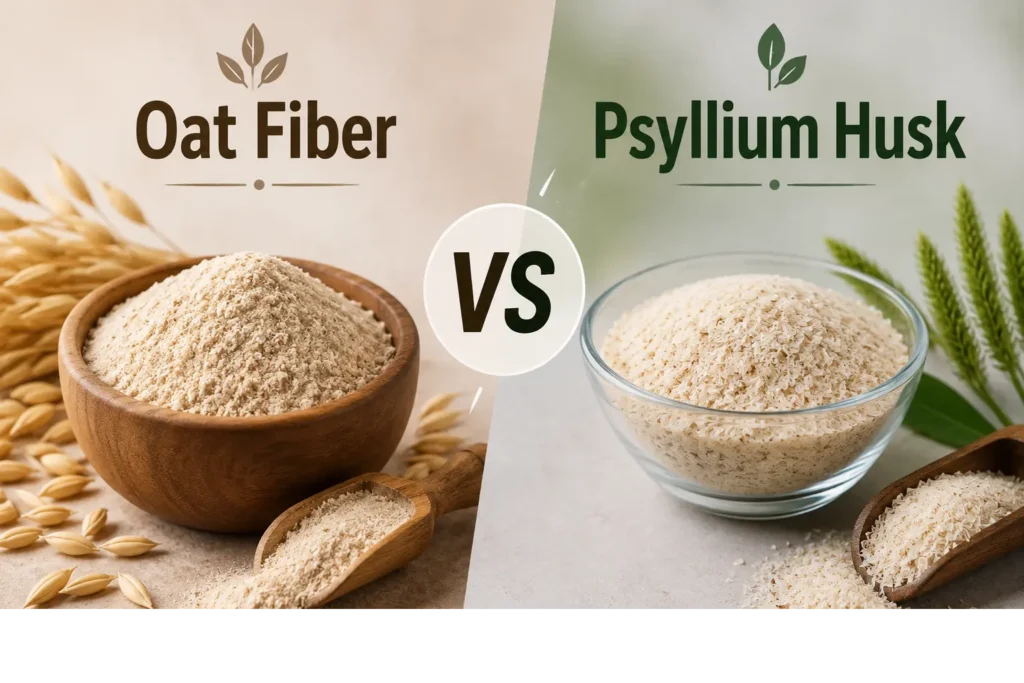
Oat Fiber vs Psyllium Husk: Oat fiber and psyllium husk are often shelved next to each other, but they behave very differently in your body. Oat fiber, the kind milled from the outer hull of the oat grain, is almost entirely insoluble. It doesn’t gel, adds bulk to stool, and is prized in the food industry mostly as a low-calorie filler and stool-bulking agent. Psyllium husk, from the seeds of Plantago ovata, is predominantly soluble and forms a thick, viscous gel in water. That gel is what gives psyllium its reputation for improving regularity, softening stool, and supporting cholesterol and blood sugar management.
If your main goal is cholesterol support, blood sugar stability, or relief from both constipation and loose stools, psyllium husk is generally the stronger choice. If you need a low-carb, low-calorie, flavorless bulking agent — often for baking, keto diets, or adding stool bulk without gel formation — oat fiber fits better. Many people benefit from using both for different reasons, and a few products combine them.
Table of Contents
A Confusion Worth Clearing Up First
Before comparing the two, it helps to clear up a mix-up that trips up even careful readers: “oat fiber” is not the same as “oat bran” or “beta-glucan.”
- Oat bran and the beta-glucan inside it are what give oatmeal its cholesterol-lowering reputation. Beta-glucan is soluble and gel-forming.
- Oat fiber, the ingredient used in supplements and processed foods, is milled from the oat hull (the tough outer husk), not the bran layer. It is classified as an insoluble fiber and does not form a gel the way beta-glucan or psyllium does.
This distinction matters because a lot of articles online use “oats” and “oat fiber” interchangeably, which overstates what oat fiber (the supplement ingredient) actually does. This guide is specifically about oat fiber the ingredient, not oatmeal or oat bran as a whole food.
What Is Oat Fiber?
Oat fiber is produced by grinding the outer hull of the oat grain into a fine powder. Because it comes from the hull rather than the starchy or bran portion of the oat, it carries very little of the oat’s natural nutrition — no meaningful protein, fat, or beta-glucan. What’s left is almost pure cellulose-based, insoluble fiber.
Key characteristics:
- Predominantly insoluble fiber (cellulose)
- Neutral in taste and color, easy to blend into baked goods
- Very low in digestible carbohydrates, which makes it popular in low-carb and keto baking
- Absorbs water without forming a true gel — it adds bulk rather than viscosity
- Not significantly fermented by gut bacteria, so it tends to produce less gas than fermentable fibers like inulin or acacia
Oat fiber is common in bread, crackers, pasta, and protein bars as a way to boost fiber content and lower net carbs without changing texture much. As a standalone supplement, it’s less common than psyllium, but it appears in some fiber powders marketed for stool bulk rather than cholesterol support. For a deeper look at how it’s produced and used, see our full oat fiber guide.
What Is Psyllium Husk?
Psyllium husk comes from the seeds of Plantago ovata, a plant grown mainly in India. The husk — the outer seed coating — is separated, dried, and ground into a powder or sold whole.
Key characteristics:
- Roughly 70% soluble, 30% insoluble fiber, making it one of the most gel-forming fibers available
- Absorbs many times its weight in water, forming a thick, mucilage-like gel
- Partially fermented by gut bacteria, but less than fibers like inulin — a reason it’s often better tolerated
- Backed by an FDA-recognized health claim: diets with 7 grams per day of psyllium soluble fiber, alongside a diet low in saturated fat and cholesterol, may reduce the risk of heart disease
- The gel-forming action works in both directions — it can firm up loose stools and soften hard ones, which is why it’s used for both constipation and diarrhea-type irregularity
Psyllium is the active ingredient in most well-known fiber supplement brands and is one of the most studied fibers for digestive and cardiovascular health. You can read more in our dedicated psyllium husk guide and psyllium husk benefits breakdown.
Oat Fiber vs Psyllium Husk: Side-by-Side Comparison
| Factor | Oat Fiber | Psyllium Husk |
| Source | Hull of the oat grain | Husk of Plantago ovata seeds |
| Fiber type | Mostly insoluble | Mostly soluble (~70%) |
| Gel-forming | No — adds bulk, not viscosity | Yes — forms a thick gel |
| Fermentability | Low (gentler on gas/bloating) | Moderate |
| Main strength | Stool bulk, low-carb baking filler | Regularity, cholesterol, blood sugar support |
| Calories (per tbsp, approx.) | Very low, near 0 | Low, ~10-20 |
| Net carbs | Minimal | Minimal (mostly fiber) |
| Taste/texture | Neutral, gritty in liquid | Slightly gritty, thickens quickly |
| Water needed | Moderate | High — must be taken with plenty of water |
| Best known evidence | Limited human clinical data as an isolated supplement | Strong evidence for cholesterol, regularity, blood sugar |
| Typical use case | Baking, low-carb recipes, general bulk | Daily fiber supplement, targeted heart/gut goals |
How They Work in the Body
Oat fiber passes through the digestive tract largely intact. Because it’s insoluble and barely fermented, its main job is mechanical: it adds physical bulk to stool, which stimulates the intestinal walls and can help move things along, similar to insoluble fiber from foods like wheat bran or vegetable skins.
Psyllium husk works differently. Once mixed with water, it swells into a viscous gel. That gel does several things at once: it softens and bulks stool (helpful for constipation), it can slow down and firm loose stool (helpful for diarrhea-type irregularity), it traps bile acids and cholesterol-containing compounds in the gut for excretion, and it slows the absorption of sugar into the bloodstream after meals. This multi-directional effect is why psyllium shows up so often in comparisons of soluble vs insoluble fiber as the go-to example of soluble fiber’s benefits.
Benefits: Where Each One Actually Wins
Digestive Regularity
Both can help with regularity, but through different mechanisms. Psyllium’s gel is more versatile — it’s one of the few fibers effective for both constipation and loose stool, which is part of why it’s a common recommendation for IBS. Oat fiber mainly helps with constipation-type sluggishness by adding sheer bulk; it isn’t typically used for firming loose stools.
Cholesterol Management
This is psyllium’s strongest evidence base. The FDA-recognized claim of 7g/day of psyllium soluble fiber for heart disease risk reduction doesn’t have an equivalent for isolated oat fiber. If cholesterol support is your priority, psyllium — or oat bran/beta-glucan specifically — has the research behind it, not oat fiber as a standalone ingredient. See our best fiber supplement for cholesterol guide for more.
Blood Sugar Support
Psyllium’s gel slows carbohydrate absorption, which can blunt post-meal blood sugar spikes. Oat fiber, being insoluble and largely unfermented, has minimal direct effect here.
Weight Management and Satiety
Both add bulk and can help with fullness, but psyllium’s gel-forming action tends to slow stomach emptying more noticeably, which may support satiety a bit more than oat fiber’s dry bulk. Neither is a weight-loss solution on its own — see best fiber supplement for weight loss for realistic expectations.
Gut Microbiome Support
Because psyllium is partially fermented, it offers modest prebiotic-like activity, though far less than fibers like inulin or acacia. Oat fiber, being minimally fermented, offers little in this department — its main contribution to gut health is mechanical, not microbial. If feeding gut bacteria is your priority, compare options in our best fiber supplement for gut health guide.
Low-Carb and Baking Uses
Here, oat fiber clearly wins. Its neutral flavor, high fiber-to-carb ratio, and lack of gel formation make it far easier to fold into bread, crackers, and baked goods without altering taste or texture. Psyllium can be used in low-carb baking too (it’s popular in keto bread for structure), but its gelling action changes texture significantly and requires recipe adjustment.
Side Effects and Who Should Be Cautious
| Oat Fiber | Psyllium Husk | |
| Common side effects | Mild bloating if increased too fast; generally well tolerated | Bloating, gas, or fullness, especially early on |
| Water intake | Recommended | Essential — taking psyllium without enough water can worsen constipation or, rarely, cause choking/blockage risk |
| Allergy considerations | Oat cross-contamination with gluten grains is possible unless certified gluten-free | Rare but documented psyllium allergy, including occupational exposure in people who handle it regularly |
| Medication interactions | Minimal reported concern | Can reduce absorption of some medications if taken too close together; space doses by a couple of hours |
| Not ideal for | People needing soluble fiber for cholesterol/blood sugar goals specifically | People with a diagnosed psyllium allergy or swallowing difficulties who can’t take it with adequate fluid |
This is educational information, not medical advice. Anyone with a chronic digestive condition, swallowing difficulty, or an existing bowel obstruction risk should talk to a healthcare provider before starting either fiber. For a broader look at tolerability across fiber types, see fiber supplement that doesn’t cause gas.
Common Mistakes People Make With These Two Fibers
- Assuming “oat fiber” means the same thing as oatmeal’s cholesterol benefits. As covered above, the isolated hull fiber doesn’t carry the beta-glucan responsible for that effect.
- Not drinking enough water with psyllium. Because it gels so aggressively, taking it dry or with too little liquid can actually worsen constipation rather than relieve it.
- Increasing dose too quickly. Both fibers can cause bloating and gas if you jump straight to a full serving. A gradual increase over 1-2 weeks, as covered in how to choose a fiber supplement, is more comfortable.
- Expecting oat fiber to firm up loose stools like psyllium does. Its mechanism is bulk, not gel — it won’t behave the same way in cases of diarrhea.
- Taking psyllium at the same time as medication. Its gel can interfere with absorption; most guidance suggests separating doses by at least two hours.
Can You Use Both Together?
Yes — and it’s a reasonable strategy if you want both benefits. Oat fiber can add bulk and texture without much gel, while psyllium contributes the soluble, cholesterol- and blood-sugar-supporting gel. Some people use oat fiber in baking and cooking throughout the day while taking a separate psyllium supplement for digestive and cardiovascular support. If you’re building a broader fiber routine, our types of dietary fiber ingredients guide breaks down how different fibers can complement each other.
Decision Framework: Which One Should You Choose?
Choose oat fiber if:
- You’re following a low-carb or keto diet and need a neutral, low-calorie bulking agent
- You want to boost fiber in baked goods without changing flavor or texture much
- You mainly need help with sluggish bowel movements, not gas, bloating, or cholesterol
Choose psyllium husk if:
- You want research-backed support for cholesterol or post-meal blood sugar
- You experience irregular bowel habits that swing between constipation and looseness
- You’re looking for a well-studied, general-purpose daily fiber supplement — see our best psyllium husk picks
Choose both if:
- You want the culinary flexibility of oat fiber alongside the physiological benefits of psyllium
Frequently Asked Questions
Is oat fiber the same as oat bran? No. Oat bran comes from the inner bran layer of the oat and contains beta-glucan, a soluble fiber tied to cholesterol benefits. Oat fiber comes from the outer hull and is almost entirely insoluble, without meaningful beta-glucan content.
Which is better for constipation, oat fiber or psyllium husk? Both can help, but psyllium is generally considered more effective because its gel softens stool while also adding bulk. Oat fiber adds bulk but doesn’t have the same softening, gel-based action.
Does oat fiber lower cholesterol like oatmeal does? Not to the same degree. The cholesterol-lowering effect associated with oats comes from beta-glucan, which is largely removed when oat fiber is isolated from the hull. For cholesterol support, psyllium or whole oat bran is the better-evidenced option.
Can I take oat fiber and psyllium husk on the same day? Yes, there’s no known issue combining them, as long as you increase both gradually and drink enough water. Many people use oat fiber in food and psyllium as a separate supplement.
Which one causes more bloating? This varies by person, but psyllium’s gel-forming and mildly fermentable nature makes bloating slightly more common when starting out, especially if water intake is too low. Oat fiber, being minimally fermented, tends to be gentler for people prone to gas.
Is oat fiber safe for people avoiding gluten? Oats themselves are naturally gluten-free, but cross-contamination during growing or processing is common. Choose a product labeled “certified gluten-free” if you have celiac disease or a gluten sensitivity.
How much psyllium husk do I need for the FDA cholesterol claim? The claim is based on 7 grams of psyllium soluble fiber per day, taken as part of a diet low in saturated fat and cholesterol. Always follow the dosing on your specific product and check with a healthcare provider for personalized guidance.
Final Verdict
Oat fiber and psyllium husk aren’t competitors so much as tools for different jobs. Oat fiber is a low-carb, neutral-tasting bulking agent best suited to baking and general stool bulk. Psyllium husk is a soluble, gel-forming fiber with strong evidence for regularity, cholesterol management, and blood sugar support — which is why it remains the more widely recommended option for a general-purpose fiber supplement. If you only need one, most people’s digestive and cardiovascular goals are better served by psyllium; if you’re focused on low-carb cooking or need a gentle bulking agent, oat fiber is the better fit. And if your goals span both, there’s no reason you can’t use them together.
For help narrowing down a specific product, explore our best fiber supplement rankings or compare psyllium against other options like psyllium husk vs inulin.
This article is for educational purposes only and is not a substitute for medical advice. Speak with a healthcare provider before starting any new fiber supplement, especially if you have a digestive condition or take medication.