
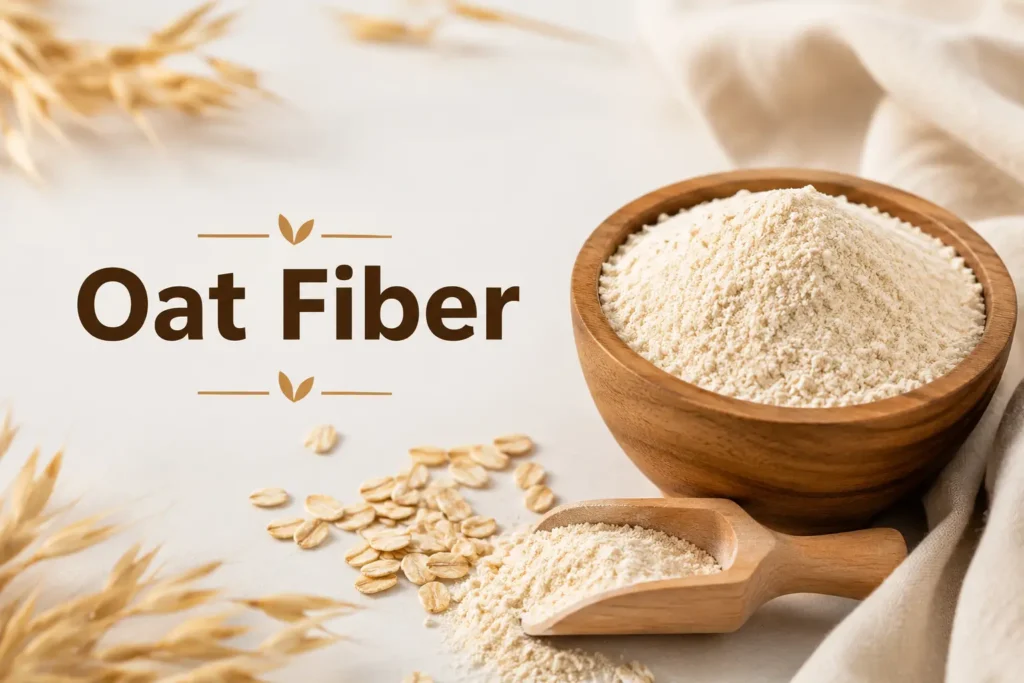
Oat fiber is a nearly calorie-free insoluble fiber made by finely grinding the outer hull of the oat grain. It isn’t the same as oat bran or oatmeal, and it doesn’t taste or behave like a typical whole grain. Because it’s almost pure fiber with virtually no digestible carbs, it’s widely used to boost fiber intake, bulk up stool, add structure to low-carb baking, and reduce net carbs in recipes. Most people tolerate 1–2 tablespoons (about 7–14 grams) per day when introduced gradually with plenty of water, though individual tolerance varies.
If you’re comparing fiber types to decide what fits your goals, our guide to soluble vs. insoluble fiber is a useful starting point before you commit to oat fiber specifically.
Table of Contents
What Is Oat Fiber, Exactly?
Oat fiber comes from the hull of the oat kernel — the tough, inedible outer shell that protects the grain during growth. This is different from the part of the oat that becomes rolled oats, steel-cut oats, or oat bran, all of which come from the edible groat inside the hull.
To make oat fiber, manufacturers separate the hull from the groat, then clean and grind the hull into a fine, off-white powder. The result is a byproduct that’s structurally similar to wood pulp or citrus fiber in function, but derived entirely from oats.
Nutritionally, oat fiber is almost entirely insoluble fiber, composed mainly of:
- Cellulose – the main structural fiber, largely indigestible
- Hemicellulose – a complex plant carbohydrate that adds bulk
- Lignin – a rigid plant compound that resists digestion
Because these components pass through the digestive tract largely intact, oat fiber contributes very few, if any, digestible calories. Most commercial oat fiber powders list 0 net carbs and around 0–10 calories per serving, which is why it shows up so often in keto and low-carb baking.
This also explains a common point of confusion: oat fiber is not the same as oat bran. Oat bran comes from the edible part of the oat and contains a meaningful mix of soluble and insoluble fiber, plus starch, protein, and micronutrients. Oat fiber, by contrast, is essentially just the indigestible structural material of the hull — almost no starch, no meaningful protein, and very little nutritional value beyond fiber itself.
Oat Fiber vs. Oat Bran vs. Oatmeal
Competitors covering oat fiber often skip this comparison entirely, even though it’s one of the most common points of confusion for shoppers. Here’s how the three compare directly.
| Feature | Oat Fiber | Oat Bran | Oatmeal (Rolled/Whole Oats) |
| Part of the oat used | Outer hull (inedible husk) | Outer layer of the edible groat | Whole groat |
| Fiber type | Almost entirely insoluble | Mix of soluble and insoluble | Mix of soluble and insoluble |
| Net carbs | Near 0g per serving | Moderate | Moderate to high |
| Calories | Very low (0–10 kcal per serving) | Moderate | Moderate to high |
| Beta-glucan content | Minimal to none | High | Moderate |
| Typical use | Baking bulk, fiber fortification, low-carb recipes | Breakfast cereal, baking, cholesterol support | Breakfast, whole-grain nutrition |
| Flavor | Neutral, mild, slightly nutty | Mild, oaty | Distinctly oaty |
The key takeaway: if you’re looking for the cholesterol-lowering beta-glucan that oats are famous for, oat bran or whole oats are the better choice. If you want bulk, texture, and fiber fortification without carbs or calories, oat fiber is the more targeted tool.
How Oat Fiber Works in the Body
Insoluble fiber like oat fiber doesn’t dissolve in water and isn’t fermented significantly by gut bacteria the way soluble fibers (like psyllium or inulin) are. Instead, it works mechanically:
- It absorbs water as it moves through the digestive tract, adding bulk to stool.
- The added bulk stimulates the intestinal walls, which can help promote more regular, comfortable bowel movements.
- It moves through the gut largely unfermented, which means it typically produces less gas and bloating than highly fermentable fibers.
This mechanical, low-fermentation profile is exactly why oat fiber is often recommended for people who find soluble, highly fermentable fibers (like inulin or certain prebiotic fibers) uncomfortable. If gas and bloating from fiber supplements are a concern for you, our guide to a fiber supplement that doesn’t cause gas covers this in more depth.
Oat Fiber Benefits
1. Supports Regularity
By adding bulk to stool, oat fiber can help support more consistent bowel movements. This is the same mechanical principle behind many bulk-forming laxatives and fiber supplements. If constipation is your main concern, compare oat fiber against other options in our guide to the best fiber supplement for constipation.
2. Helps Increase Daily Fiber Intake
Most adults fall well short of the recommended 25–38 grams of fiber per day. Because oat fiber is concentrated and low in calories, even small amounts contribute meaningfully toward daily fiber goals without adding significant carbs or calories.
3. Low-Calorie, Low-Carb Bulking Agent
Unlike flour or starch-based bulking agents, oat fiber adds volume and texture to food without contributing meaningful calories or net carbs. This makes it a staple in keto, low-carb, and calorie-conscious baking.
4. May Support Feelings of Fullness
Bulk-forming fibers absorb water and expand in the stomach, which can contribute to a feeling of fullness. This effect is generally modest and works best as part of a broader eating pattern rather than as a standalone weight-loss tool. For a broader look at fiber’s role in weight management, see our guide on the best fiber supplement for weight loss.
5. Gentle on Digestion for Fermentation-Sensitive People
Because it’s minimally fermented by gut bacteria, oat fiber tends to cause less gas and bloating compared to highly fermentable soluble fibers. This makes it a reasonable option for people managing IBS or other fermentation-sensitive digestive conditions, though individual tolerance varies and a doctor or dietitian should guide decisions here. Our best fiber supplement for IBS page goes into more detail on fiber selection for sensitive digestive systems.
Important: Oat fiber is an educational topic, not a treatment. Any digestive or health condition should be discussed with a healthcare provider before changing your fiber intake significantly.
Oat Fiber Uses
Oat fiber shows up in more places than most people realize:
- Low-carb and keto baking — replacing part of the flour in bread, muffins, tortillas, and crackers to reduce net carbs and add structure
- Commercial food manufacturing — used in bread, pasta, and baked goods to boost fiber content and extend shelf life by retaining moisture
- Smoothies and shakes — stirred into liquids to increase fiber content without altering flavor significantly
- Meat and food processing — used as a moisture-retention and texture agent in some processed foods
- Homemade fiber supplementation — mixed into oatmeal, yogurt, or baked goods by people trying to close their daily fiber gap
If your main interest is baking rather than supplementation, it helps to understand the difference between fiber supplements vs. fiber foods — oat fiber can function as either, depending on how it’s used.
How to Use Oat Fiber (Practical Guidance)
Oat fiber has almost no flavor and a very fine, powdery texture, which makes it flexible but also easy to overuse. A few practical guidelines:
- Start small. Begin with 1–2 teaspoons per day and increase gradually over one to two weeks.
- Always pair with extra water. Insoluble fiber absorbs water as it moves through the gut; without enough fluid, it can worsen constipation instead of relieving it.
- In baking, oat fiber is not a 1:1 flour substitute. It absorbs far more liquid than regular flour, so recipes typically use it at 10–20% of total flour weight, alongside added liquid to compensate.
- Mix it into liquids or wet batters rather than dry mixes alone, since it can clump if added directly to thick, dry ingredients.
- Don’t take it at the same time as medications unless a doctor or pharmacist confirms it’s fine — like other bulk fibers, it can potentially affect the absorption of some oral medications if taken simultaneously.
For a broader comparison of fiber formats — powders, capsules, and gummies — see our guide on fiber powder vs. capsules and best fiber pills.
Common Mistakes People Make With Oat Fiber
Most articles on oat fiber skip this section entirely, but these mistakes come up often:
- Confusing it with oat bran. They are not interchangeable in recipes or in their fiber profile.
- Adding too much, too fast. A sudden jump in insoluble fiber intake without adequate water is one of the most common causes of bloating or worsened constipation.
- Using it as a full flour replacement. Because of its high water-absorption capacity, using too much oat fiber in baking creates a dry, dense, or crumbly result.
- Expecting it to behave like soluble fiber. Oat fiber does not gel, thicken liquids the way psyllium husk does, or provide the same prebiotic fermentation benefits as inulin or acacia fiber.
- Assuming it’s a source of beta-glucan. The cholesterol-supporting beta-glucan found in oats is concentrated in the groat, not the hull — oat fiber contains little to none.
Pros and Cons of Oat Fiber
| Pros | Cons |
| Very low in calories and net carbs | Provides little nutritional value beyond fiber |
| Neutral flavor, easy to incorporate into food | Can cause bloating or discomfort if increased too quickly |
| Adds bulk and structure in low-carb baking | Not a source of oat’s beta-glucan benefits |
| Generally well tolerated, low fermentation | Requires adequate water intake to work properly |
| Widely available and inexpensive | Not ideal as a standalone soluble-fiber source |
Is Oat Fiber Gluten-Free?
Oats themselves are naturally gluten-free, and this applies to oat fiber as well. However, oats are frequently grown, harvested, or processed using equipment shared with wheat, barley, or rye, which creates a risk of cross-contamination. If you have celiac disease or a significant gluten sensitivity, look specifically for oat fiber labeled “certified gluten-free,” which confirms it was processed on dedicated equipment.
Oat Fiber Side Effects and Safety Considerations
Oat fiber is generally considered safe for most people when introduced gradually and taken with adequate fluids. Reported side effects are typically mild and dose-dependent, and may include:
- Bloating or gas, particularly when intake increases quickly
- Abdominal discomfort in sensitive individuals
- Worsened constipation if fluid intake is insufficient
People with swallowing difficulties, certain gastrointestinal conditions, or those on medications that could interact with fiber timing should speak with a healthcare provider before adding oat fiber to their routine. This article is educational and is not a substitute for personalized medical advice.
Oat Fiber vs. Other Common Fiber Supplements
Since oat fiber is often chosen alongside or instead of other supplemental fibers, here’s how it stacks up against the most common alternatives.
| Fiber Type | Solubility | Fermentation | Best Known For |
| Oat fiber | Insoluble | Low | Bulk, low-carb baking, minimal calories |
| Psyllium husk | Mostly soluble, gel-forming | Low to moderate | Regularity, cholesterol support |
| Inulin | Soluble | High | Prebiotic gut support, can cause gas |
| Acacia fiber | Soluble | Low to moderate | Gentle, low-gas prebiotic fiber |
| Wheat dextrin | Soluble | Moderate | Easily dissolves, mild taste |
| Methylcellulose | Insoluble, non-fermentable | None | Predictable bulking, minimal gas |
If you’d like a deeper comparison, our psyllium husk and inulin fiber guides break down those alternatives individually, and our soluble fiber and insoluble fiber pages explain the broader category differences.
Who Should Consider Oat Fiber?
Oat fiber tends to be a good fit for:
- People following keto or low-carb diets who want to boost fiber without adding net carbs
- Home bakers looking to reduce calories or improve texture in low-carb recipes
- People who experience gas or bloating from highly fermentable soluble fibers
- Anyone trying to close a daily fiber gap through food fortification rather than supplementation alone
It may be less ideal for:
- People specifically seeking oats’ cholesterol-lowering beta-glucan benefits (oat bran is a better source)
- People who prefer a supplement that gels or thickens liquids, like psyllium
- Anyone with a diagnosed digestive condition who hasn’t yet spoken with a healthcare provider about fiber type and timing
If you’re still narrowing down which fiber type fits your goals, our guide on how to choose a fiber supplement walks through the decision process step by step.
Frequently Asked Questions
Is oat fiber the same as oat bran? No. Oat fiber comes from the inedible outer hull of the oat and is almost entirely insoluble fiber with minimal nutritional value beyond fiber content. Oat bran comes from the edible part of the grain and contains a mix of soluble and insoluble fiber, along with some protein and micronutrients.
Does oat fiber have any carbs? Most commercial oat fiber powders are labeled as having 0 net carbs per serving because nearly all of the carbohydrate content is indigestible fiber.
Can oat fiber cause bloating? It can, particularly if intake increases too quickly or without enough water. Compared to highly fermentable soluble fibers, oat fiber generally causes less gas because it isn’t significantly fermented by gut bacteria.
Is oat fiber good for weight loss? It may support feelings of fullness and helps reduce calories in baked goods when used as a partial flour substitute, but it isn’t a standalone weight-loss solution. It works best as part of an overall balanced approach to diet.
How much oat fiber should I take per day? There’s no single official dosage, but many people start with 1–2 teaspoons daily and gradually work up to 1–2 tablespoons, always with extra water. Individual tolerance varies, so it’s worth adjusting based on how your body responds.
Can I use oat fiber instead of flour in baking? Not as a full 1:1 replacement. Because it absorbs significantly more liquid than flour, oat fiber typically works best at 10–20% of total flour weight, with additional liquid added to the recipe.
Is oat fiber safe for people with celiac disease? Oats are naturally gluten-free, but cross-contamination during growing or processing is common. People with celiac disease should choose oat fiber that’s certified gluten-free.
Final Verdict
Oat fiber is a highly specific tool: a nearly calorie-free, carb-free insoluble fiber best suited for bulking, fiber fortification, and low-carb baking. It isn’t a replacement for the beta-glucan benefits of oat bran, and it isn’t a gel-forming fiber like psyllium. But for people who want to quietly boost daily fiber intake, reduce net carbs in recipes, or avoid the gas and bloating that come with highly fermentable fibers, it’s one of the most practical and affordable options available.
As with any fiber change, the safest approach is to start low, increase gradually, drink enough water, and talk to a healthcare provider if you have an existing digestive condition. For a wider view of how oat fiber compares to other supplement formats and fiber types, explore our full library of guides, starting with what is a fiber supplement.