
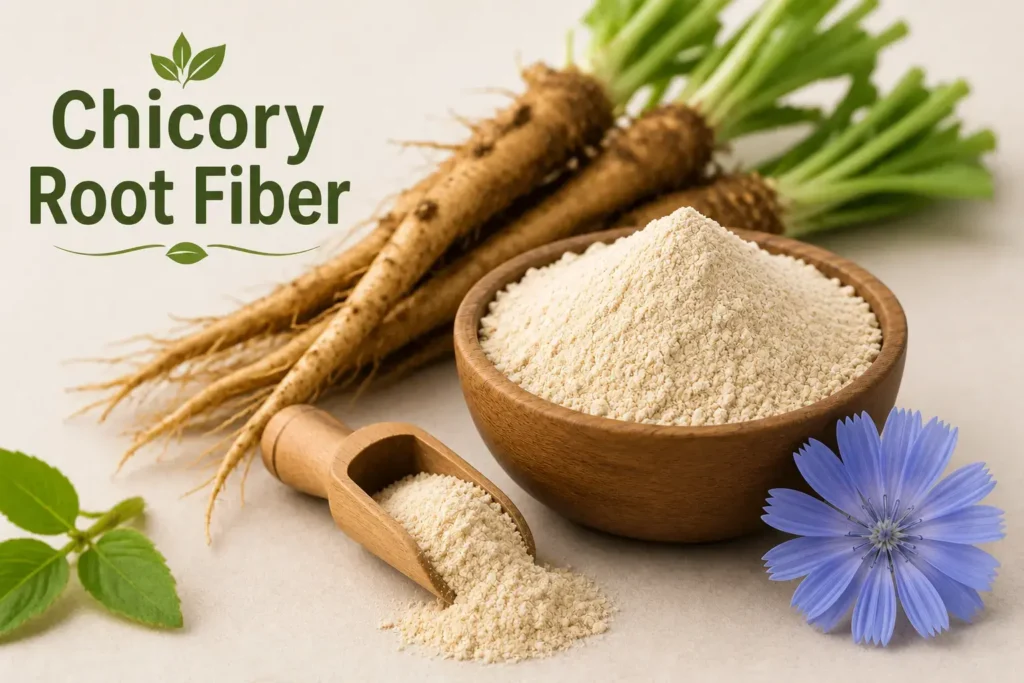
Chicory root fiber is a plant-based fiber extracted from the chicory root and made almost entirely of inulin, a soluble, fermentable fiber. It feeds beneficial gut bacteria, supports regular bowel movements, and helps close the daily fiber gap in the average diet. It’s generally safe in amounts of 5-10 grams per day, but larger doses can cause gas, bloating, and stomach discomfort, especially in people with IBS or other digestive sensitivities.
If you’ve ever checked the ingredient label on a “high fiber” granola bar, protein bar, or yogurt and seen “chicory root fiber” or “inulin” listed, you’ve already met this ingredient. It’s one of the most common fiber additives in the food industry, yet most people have no idea what it actually does once it’s inside them. This guide breaks down exactly what chicory root fiber is, how it works in the body, what the research actually supports, and how to decide whether it belongs in your routine.
Table of Contents
What Is Chicory Root Fiber?
Chicory root comes from Cichorium intybus, a flowering plant in the dandelion family that has been used for centuries, most famously as a coffee substitute in the American South and parts of Europe. The root itself is rich in a carbohydrate called inulin, making up roughly two-thirds of the root’s dry weight.
To make the fiber used in supplements and food products, manufacturers extract inulin from the root, purify it, and dry it into a fine powder. The finished ingredient is typically over 90% inulin, with small amounts of other natural compounds from the root left behind.
Inulin belongs to a class of carbohydrates called fructans. Structurally, it’s a chain of fructose molecules linked together, usually with one glucose molecule capping the end. Human digestive enzymes can’t break these bonds apart, so inulin passes through the stomach and small intestine largely untouched. It arrives intact in the large intestine, where gut bacteria take over.
This single property, resistance to digestion, is what puts chicory root fiber in the same conversation as inulin fiber and other soluble fiber sources, and it’s the reason the ingredient is classified as dietary fiber on nutrition labels in the United States.
How Chicory Root Fiber Works in the Body
Once inulin reaches the colon, resident bacteria ferment it. This process is what earns chicory root fiber its “prebiotic” label: it doesn’t just pass through, it actively feeds specific bacterial populations, particularly Bifidobacterium species, which are associated with a healthier gut lining and lower inflammation markers.
Fermentation produces short-chain fatty acids, including butyrate, which serves as the primary fuel source for the cells lining the colon. This is a meaningfully different mechanism than insoluble fibers like wheat bran, which add bulk to stool mechanically rather than feeding bacteria. If you’re trying to understand fiber types more broadly, our guide on soluble vs. insoluble fiber breaks down that distinction in more depth.
Because it’s fermented rather than digested, chicory root fiber also contributes fewer calories than sugar or starch, roughly 1.5 to 2 calories per gram compared to 4 calories per gram for typical carbohydrates. That’s part of why food manufacturers use it to boost fiber content and cut sugar or calories at the same time.
Chicory Root Fiber Benefits
1. Supports a healthier gut microbiome
The most consistent finding across research is that chicory-derived inulin increases populations of beneficial bacteria, especially Bifidobacterium, across a wide range of ages and health conditions. This effect shows up reliably in healthy adults, though people with existing gastrointestinal disorders don’t always see the same consistent bacterial shift, which is worth knowing if you have a diagnosed digestive condition.
2. May help with regularity
Several small studies have looked at chicory inulin and constipation. Doses in the range of 10 to 20 grams per day have been shown to increase how often people have bowel movements, and in some studies, soften stool consistency. The effect isn’t as dramatic or as well-established as what’s seen with psyllium husk, which remains the better-researched option specifically for constipation relief.
3. May support blood sugar management
Because inulin isn’t broken down into glucose, adding it to a food or drink doesn’t spike blood sugar the way sugar or refined starch would. Some research suggests inulin may modestly improve insulin sensitivity and post-meal blood sugar response, though results are mixed and this shouldn’t be treated as a substitute for medical management of diabetes.
4. Can help close the fiber gap
Most adults in the U.S. eat well below the recommended 25 to 38 grams of fiber per day. A single serving of a chicory-root-fortified product typically adds 3 to 10 grams of fiber, which can meaningfully help people get closer to that target, especially if their overall diet is low in whole plant foods. For a broader look at how food-based fiber compares to supplementing, see our page on fiber supplements vs. fiber foods.
5. May support mineral absorption
Some research links inulin fermentation to improved absorption of minerals like calcium and magnesium, likely tied to the change in gut environment created by fermentation. Evidence here is still developing and shouldn’t be the main reason someone chooses this fiber.
Where the evidence is weaker: claims around significant weight loss and appetite suppression are common in marketing, but the actual research shows only modest, inconsistent trends in overweight and obese populations. It’s reasonable to view chicory root fiber as a general health-supporting addition rather than a weight-loss tool on its own. If weight management is your main goal, our guide to the best fiber supplement for weight loss covers options with stronger supporting data.
Chicory Root Fiber vs. Other Common Fibers
| Fiber | Type | Fermentability | Best known for | Common side effect risk |
| Chicory root fiber (inulin) | Soluble, prebiotic | High | Feeding gut bacteria, blood sugar neutrality | Gas, bloating at higher doses |
| Psyllium husk | Soluble, gel-forming | Low | Constipation relief, cholesterol support | Generally well tolerated |
| Wheat dextrin | Soluble | Moderate | Mild fiber boost, low taste impact | Bloating in sensitive users |
| Acacia fiber | Soluble | Low-moderate | Gentle digestion, low gas | Rarely causes discomfort |
| Methylcellulose | Soluble, non-fermentable | None | Constipation without gas | Minimal gas/bloating |
This table highlights something competitors rarely spell out clearly: chicory root fiber’s biggest strength (fermentability, which feeds bacteria) is also the source of its main drawback (gas and bloating). If your priority is gentle, low-gas regularity, acacia fiber or methylcellulose fiber may suit you better. If your priority is feeding your microbiome, chicory root fiber is one of the more effective, well-studied options available.
How Much Chicory Root Fiber Is Safe?
There’s no official recommended dose, but research and clinical experience point to a fairly consistent pattern:
- 5-10 grams per day: Well tolerated by most healthy adults.
- 10-20 grams per day: May cause mild gas or bloating in some people, especially without a gradual buildup.
- Above 20-30 grams per day: Digestive discomfort becomes much more common, even in people without underlying digestive conditions.
The key practical advice missing from most competitor articles: start low, around 2 to 3 grams a day, and increase gradually over one to two weeks. This gives your gut bacteria time to adjust to the new fuel source, which significantly reduces gas and bloating compared to jumping straight to a full dose. Taking it with plenty of water also helps.
If you’re deciding when in the day to take it, our page on the best time to take a fiber supplement walks through the timing considerations in more detail.
Who Should Be Cautious With Chicory Root Fiber
- People with IBS: Chicory root fiber is a fermentable fiber, which places it on the FODMAP list. Many people with IBS find it triggers symptoms even at small doses. If this applies to you, our guide on the best fiber supplement for IBS covers gentler alternatives.
- People with SIBO (small intestinal bacterial overgrowth): Because it’s rapidly fermented, some clinicians advise caution with prebiotic fibers like inulin in this group.
- Anyone new to fiber supplements: Starting at a high dose, rather than building up slowly, is the single most common cause of unnecessary discomfort.
- People with a chicory or ragweed-family allergy: Chicory belongs to the same plant family as ragweed and daisies; cross-reactive allergic reactions are rare but documented.
This isn’t medical advice, and if you have a diagnosed digestive condition, it’s worth discussing any new fiber source with a healthcare provider before adding it regularly.
Common Mistakes People Make With Chicory Root Fiber
- Assuming more fiber is always better. With a fermentable fiber like this, doubling the dose often just doubles the gas, not the benefit.
- Not checking cumulative intake. Chicory root fiber shows up in bars, yogurts, ice cream, and drinks. Someone can unknowingly stack several servings in one day and be surprised by bloating.
- Expecting the same effect as psyllium. Chicory root fiber doesn’t add the same mechanical bulk to stool, so people expecting a psyllium-like laxative effect are often disappointed.
- Stopping at the first sign of gas. Mild, temporary gas during the first week or two is common and usually settles down as gut bacteria adapt. Persistent, severe discomfort is a signal to reduce the dose or stop.
Chicory Root Fiber in Foods vs. Supplements
Chicory root fiber appears in two main contexts:
- As a food additive: used to boost fiber content and replace sugar in bars, cereals, dairy products, and baked goods. Amounts here are usually modest (3-10 grams per serving).
- As a standalone supplement: sold as a powder, often marketed as chicory root inulin or prebiotic fiber, allowing for more precise, higher dosing.
If you’re comparing forms more broadly, our overview of fiber powder versus fiber pills can help you decide which format fits your routine best.
Chicory Root Fiber FAQs
Is chicory root fiber the same as inulin? Yes, in commercial products, chicory root fiber and chicory root inulin refer to the same ingredient. Inulin is simply the specific compound extracted from the chicory root.
Does chicory root fiber cause gas and bloating? It can, particularly at doses above 10-15 grams taken all at once. This happens because gut bacteria ferment it, producing gas as a byproduct. Starting with a small dose and increasing gradually reduces this significantly.
Is chicory root fiber good for constipation? It may help modestly, with some studies showing improved bowel movement frequency at doses of 10-20 grams per day. However, it’s not as consistently effective for constipation as psyllium husk, which has stronger clinical backing for that specific purpose.
Can chicory root fiber help with weight loss? Evidence is limited and mixed. It may support satiety slightly by feeding gut bacteria and slowing digestion, but it shouldn’t be relied on as a primary weight-loss strategy.
Is chicory root fiber safe every day? For most healthy adults, 5-10 grams per day is well tolerated long-term. People with IBS, SIBO, or other digestive sensitivities should approach it more cautiously and may want to consult a healthcare provider first.
Does chicory root fiber affect blood sugar? It doesn’t spike blood sugar the way sugar or refined starch does, since it isn’t broken down into glucose during digestion. Some research suggests a modest, favorable effect on blood sugar response, though it’s not a treatment for diabetes.
What foods naturally contain chicory root fiber? The chicory root itself is the primary natural source. In practice, most people encounter it as an added ingredient in packaged foods rather than eating the whole root.
Final Verdict
Chicory root fiber is a well-researched, genuinely useful prebiotic fiber, particularly for supporting a healthier gut microbiome and helping close the everyday fiber gap. It’s not a cure-all, and it’s not the strongest option specifically for constipation or weight loss, but as a general-purpose fiber that feeds beneficial bacteria, it holds up well against the evidence.
The main thing to get right is dosing: start low, build up gradually, and pay attention to how your body responds, especially if you have a sensitive digestive system. Done that way, chicory root fiber can be a simple, low-cost addition to a fiber-conscious diet.
If you’re still deciding which type of fiber fits your goals best, our guide on how to choose a fiber supplement is a good next step.
This article is for educational purposes only and is not a substitute for professional medical advice. Speak with a healthcare provider before starting any new supplement, especially if you have a digestive condition or take medication.