
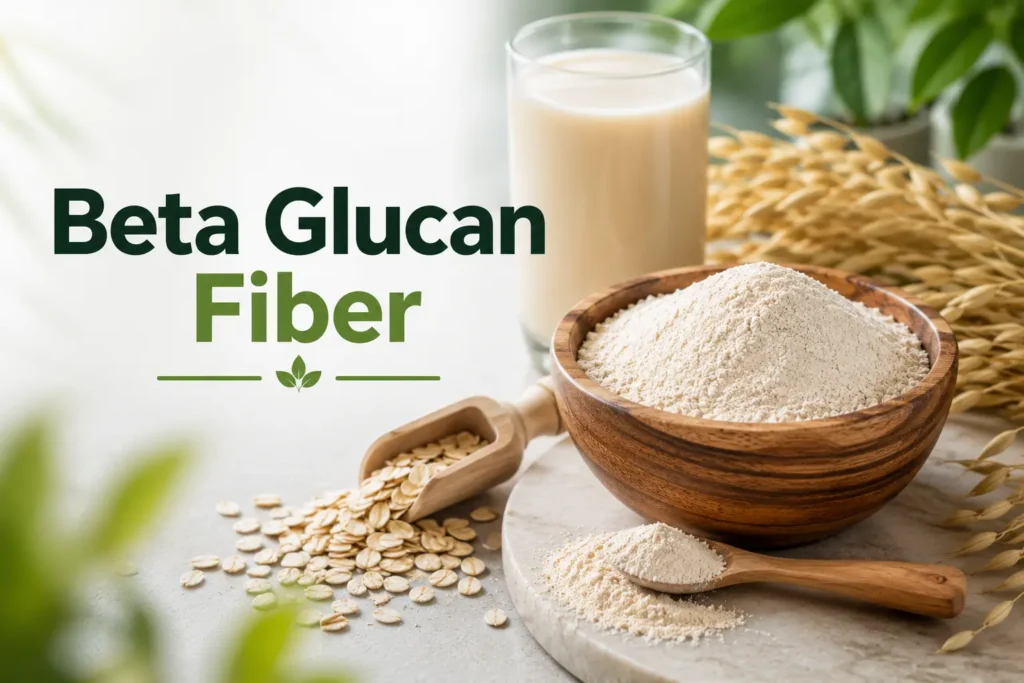
Beta glucan fiber is a type of soluble fiber found naturally in oats, barley, mushrooms, and baker’s yeast. It’s one of the most researched fibers for heart health because it forms a thick gel in your gut that binds cholesterol and helps remove it from the body. The FDA and European Food Safety Authority both recognize that at least 3 grams of oat beta glucan per day can help lower LDL (“bad”) cholesterol as part of a diet low in saturated fat. Beyond cholesterol, beta glucan is also studied for blood sugar control, immune support, and digestive health.
If you’re comparing it to other fibers, you may also want to see how it stacks up on our soluble vs. insoluble fiber page, or check our broader guide to soluble fiber.
Table of Contents
What Is Beta Glucan Fiber?
Beta glucan (sometimes written β-glucan) is a soluble fiber made of long chains of glucose molecules linked together in a specific pattern. That structure is what makes it different from starch, even though both are technically built from sugar units.
You’ll find beta glucan naturally in:
- Oats – concentrated in the bran and endosperm
- Barley – one of the richest natural sources
- Mushrooms – shiitake, maitake, and reishi contain unique beta glucan structures
- Baker’s and brewer’s yeast – a different type used mainly in immune-support supplements
- Algae – a minor dietary source
Not all beta glucans behave the same way in the body. Oat and barley beta glucan are known for their cholesterol-lowering and blood sugar effects, while yeast and mushroom beta glucans are studied more for immune modulation. This is a distinction most articles on this topic gloss over, but it matters if you’re choosing a supplement for a specific goal.
How Beta Glucan Works in the Body
When you eat beta glucan, it doesn’t get broken down and absorbed like sugar. Instead, it mixes with water in your digestive tract and forms a thick, viscous gel. That gel is responsible for most of beta glucan’s benefits:
- It binds bile acids. Your liver uses cholesterol to make bile acids for digestion. When beta glucan’s gel traps bile acids in the gut, your liver has to pull more cholesterol out of your bloodstream to replace them — which lowers circulating LDL cholesterol.
- It slows digestion. The gel slows how quickly food (and sugar) moves through your gut, which blunts blood sugar spikes after meals.
- It feeds gut bacteria. As a fermentable fiber, beta glucan is broken down by bacteria in the colon into short-chain fatty acids, which support gut lining health.
- It interacts with immune cells. Certain beta glucans (especially from yeast and mushrooms) bind to receptors on immune cells, which is why they’re marketed as immune-support ingredients — though this effect is separate from the cholesterol benefit.
The thicker and more intact the gel beta glucan forms, the stronger these effects tend to be. This is why processing matters, which we’ll cover below.
Beta Glucan and Cholesterol: What the Evidence Actually Shows
This is the best-documented benefit of beta glucan, and it’s worth explaining properly instead of just repeating “it lowers cholesterol.”
The regulatory story:
- In 1997, the FDA approved a health claim allowing oat products to state they may reduce heart disease risk, based on evidence that soluble fiber from oats lowers cholesterol.
- The FDA’s threshold is at least 3 grams of oat beta glucan per day, consumed as part of a diet low in saturated fat and cholesterol.
- The European Food Safety Authority reached a similar conclusion in 2010, also setting the effective dose at 3 grams per day.
- Similar claims have since been approved in Canada, the UK, Australia, and several other countries — beta glucan is one of the few fibers with this level of international regulatory agreement.
What the research shows:
Meta-analyses of randomized controlled trials have found that daily oat beta glucan intake is associated with roughly a 5% reduction in total cholesterol and about a 7% reduction in LDL cholesterol on average. The effect is dose-dependent — trials at or above the 3-gram threshold are far more likely to show a statistically significant drop than trials using less.
That said, the size of the effect varies between people and between studies. A 5–8% LDL reduction is meaningful, but it’s not a substitute for cholesterol medication in people who need it — it’s best understood as a supportive, diet-based tool.
Why Some Oat Products Don’t Deliver the Promised Benefit
Here’s something most competing articles miss: not all oat products with a “heart healthy” label actually deliver an effective dose of active beta glucan.
Processing can break down the molecular structure of beta glucan and reduce its viscosity — and viscosity is what drives the cholesterol-binding effect. Instant oatmeal, oat-based snack bars, and ultra-processed “oat” products may technically contain beta glucan by weight, while delivering far less of the functional, gel-forming fiber than a bowl of steel-cut oats or a standardized supplement would.
This is one reason some people don’t see the cholesterol benefit they expect from eating oat cereal, and it’s also why supplement dosing (where beta glucan content and molecular weight can be standardized) is often more reliable for hitting the 3-gram threshold consistently.
Beta Glucan Benefits Beyond Cholesterol
| Benefit | What the evidence suggests | Strength of evidence |
| Lowers LDL cholesterol | 3g/day of oat beta glucan reduces LDL by ~7% on average | Strong (FDA/EFSA-recognized) |
| Blunts post-meal blood sugar spikes | Slows carbohydrate digestion and absorption | Moderate, well-studied |
| Supports gut health | Fermented into short-chain fatty acids by gut bacteria | Moderate |
| Increases fullness | Gel-forming fiber slows stomach emptying | Moderate |
| Immune modulation | Mainly seen with yeast/mushroom beta glucans, via immune cell receptors | Emerging, mixed quality |
| Modest blood pressure support | Seen in some trials, especially in people with higher BMI | Preliminary |
If your main goal is blood sugar or weight management rather than cholesterol, it’s worth comparing beta glucan to other options on our best fiber supplement for weight loss page.
Oat Beta Glucan vs. Other Beta Glucan Sources
Competitors covering this keyword tend to treat “beta glucan” as one single ingredient. It isn’t. Here’s a clearer breakdown:
| Source | Primary studied benefit | Typical form | Best for |
| Oat beta glucan | Cholesterol, blood sugar | Whole oats, oat bran, standardized extract | Heart health, general fiber intake |
| Barley beta glucan | Cholesterol, blood sugar | Whole barley, barley flour | Similar to oats, slightly higher concentration |
| Yeast beta glucan (1,3/1,6-D-glucan) | Immune modulation | Supplement capsules | Immune support (not cholesterol) |
| Mushroom beta glucan | Immune modulation | Extracts (shiitake, maitake, reishi) | Immune support |
If you’re specifically shopping for a cholesterol-support fiber, oat or barley beta glucan is the evidence-backed choice — not yeast or mushroom beta glucan, despite both being marketed under the same umbrella term. This distinction alone will save you from buying the wrong product for your goal.
How Much Beta Glucan Do You Need?
- For cholesterol support: at least 3 grams per day of oat or barley beta glucan, consistently, as part of a low-saturated-fat diet.
- For general fiber intake: beta glucan counts toward your total daily fiber target (25g for women, 38g for men, per general dietary guidelines), but it’s not meant to be your only fiber source.
- Food sources to reach 3g: roughly 1 cup of cooked oatmeal (from rolled or steel-cut oats) provides around 2–4 grams of beta glucan, depending on processing. A combination of oatmeal plus a small serving of barley or an oat bran supplement can reliably hit the 3-gram mark.
Practical Example
A realistic day that hits the 3-gram threshold might look like:
- Breakfast: 1 cup cooked steel-cut oats (~2g beta glucan)
- Snack: a small handful of oat bran added to yogurt (~1g beta glucan)
That’s a more achievable, food-first approach than trying to get all 3 grams from one product — and it naturally fits into a normal eating pattern rather than requiring a special “cholesterol diet.”
Common Mistakes People Make With Beta Glucan
- Assuming any oat product counts. Flavored instant oatmeal packets and oat-based cereals often deliver far less functional beta glucan than plain oats.
- Taking it inconsistently. The cholesterol effect depends on regular daily intake over weeks, not a single serving.
- Confusing yeast beta glucan with oat beta glucan. They’re structurally different and studied for different purposes — one is not a substitute for the other.
- Expecting dramatic results. A 5–8% LDL reduction is real and clinically meaningful, but it works best alongside — not instead of — a broader heart-healthy diet.
- Not drinking enough water. Beta glucan’s gel-forming effect depends on adequate fluid intake; too little water can reduce its effectiveness and, for some people, contribute to bloating.
Beta Glucan Pros and Cons
| Pros | Cons |
| Strong regulatory and clinical backing for cholesterol | Effect size is modest, not dramatic |
| Also supports blood sugar and fullness | Quality varies a lot between processed food sources |
| Naturally found in everyday foods like oats | Some people experience bloating or gas when starting out |
| Well-tolerated for most people | Yeast/mushroom forms aren’t interchangeable with oat forms |
| Multiple international health authorities agree on effective dose | Requires consistent daily intake to see benefits |
Is Beta Glucan Safe? Side Effects to Know
Beta glucan is generally well tolerated. The most common side effects are digestive — mild bloating, gas, or a change in stool consistency — especially when increasing intake quickly. Introducing it gradually and drinking enough water typically resolves this.
People taking cholesterol medication or managing diabetes should talk to a healthcare provider before adding a beta glucan supplement, since it may modestly enhance the effects of these treatments. This article is for educational purposes and isn’t a substitute for personalized medical advice.
Beta Glucan Supplements vs. Food Sources
Both can work, but they serve slightly different purposes:
- Food sources (oats, barley): Provide beta glucan alongside other nutrients, are inexpensive, and fit naturally into meals — but the actual beta glucan content can vary with processing.
- Supplements: Allow for a standardized, consistent dose, which is useful if you want to reliably hit the 3-gram daily target without tracking food intake closely.
If you’re deciding between getting your fiber from food or a supplement in general, our guide on fiber supplements vs. fiber foods breaks this down further. And if cholesterol is your main concern, see our dedicated page on the best fiber supplement for cholesterol.
Frequently Asked Questions
Is beta glucan the same as oat fiber? No. Oat fiber (sometimes listed as “oat hull fiber”) is mostly insoluble and has little effect on cholesterol. Beta glucan is the specific soluble fiber within oats responsible for the cholesterol-lowering effect. See our oat fiber page for the distinction.
How long does it take to see cholesterol results from beta glucan? Most clinical trials measuring LDL reduction ran for 4–8 weeks of consistent daily intake. It’s not a fast-acting effect — think of it as a dietary habit, not a quick fix.
Can beta glucan help with weight loss? It may support weight management indirectly by increasing fullness and slowing digestion, but it isn’t a standalone weight-loss ingredient. It works better as one part of an overall high-fiber eating pattern.
Is beta glucan a soluble or insoluble fiber? Beta glucan is a soluble fiber — it dissolves in water and forms a gel, which is the basis of its cholesterol and blood sugar effects.
Does cooking destroy beta glucan? Normal cooking (like making oatmeal) doesn’t destroy beta glucan, but heavy industrial processing can reduce its molecular weight and viscosity, weakening its functional effect.
Can I get too much beta glucan? There’s no established upper limit, but very high intakes may cause digestive discomfort. Increasing gradually alongside adequate water intake is the safest approach.
Final Verdict
Beta glucan fiber is one of the few fibers with strong, internationally recognized evidence for lowering LDL cholesterol — specifically oat and barley beta glucan at a daily intake of 3 grams or more. It also offers secondary benefits for blood sugar and fullness, though these effects are more modest than the cholesterol data.
The biggest factor in whether beta glucan works for you isn’t which product you choose — it’s consistency, and making sure the source you’re using (whether food or supplement) actually delivers a meaningful, intact dose of the fiber. Start with real food sources like oats and barley where possible, and consider a standardized supplement if you find it hard to hit the 3-gram target through diet alone.
For a broader look at how beta glucan compares to other soluble fibers, visit our soluble fiber guide, or explore our full fiber supplement resource hub.