
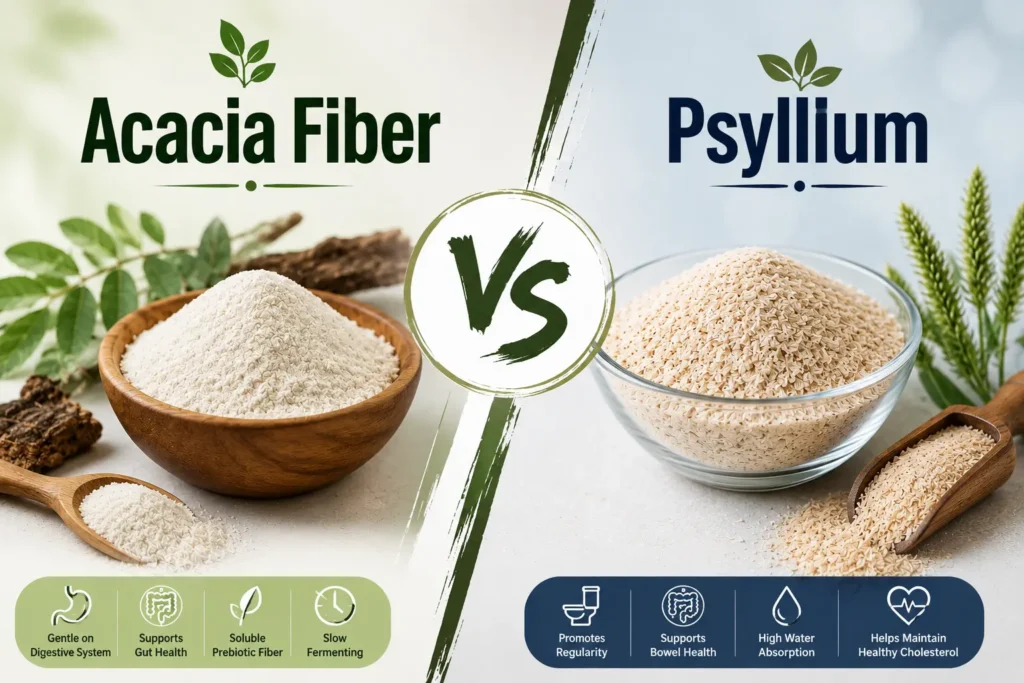
Acacia fiber and psyllium husk are both soluble fibers, but they sit at opposite ends of the tolerability-versus-effectiveness spectrum. Acacia fiber (also called gum arabic), harvested from the sap of the Acacia senegal tree, ferments slowly and gently, making it one of the best-tolerated prebiotic fibers available — but it doesn’t form a gel and has limited direct evidence for cholesterol or blood sugar control. Psyllium husk, from Plantago ovata seeds, forms a thick, viscous gel that makes it far more effective for regularity, cholesterol, and blood sugar — but that same gel-forming, moderately fermentable nature means it’s more likely to cause bloating, especially when introduced too quickly.
If you have a sensitive gut, IBS, or have struggled with bloating on other fibers, acacia is usually the gentler starting point. If you need a fiber with strong evidence for constipation relief, cholesterol reduction, or blood sugar support, psyllium remains the better-researched option — and notably, it’s the only fiber supplement with a formal recommendation from the American Gastroenterological Association for IBS symptom management. Many people successfully use both, for different reasons.
Table of Contents
What Is Acacia Fiber?
Acacia fiber, also sold as gum arabic, is a soluble fiber harvested from the hardened sap of acacia trees native to parts of Africa and Asia. It’s one of the oldest food additives in use, long valued in the food industry as a stabilizer and thickener before it became popular as a standalone fiber supplement.
Key characteristics:
- Nearly 100% soluble fiber
- Non-viscous — dissolves clear in liquid without thickening, similar in texture behavior to wheat dextrin
- Slowly fermented by gut bacteria, which is the key reason it tends to cause less gas than more rapidly fermented fibers like inulin
- Considered a strong, selective prebiotic — research suggests it favors the growth of beneficial bacteria such as Bifidobacterium and Lactobacillus
- Generally regarded as low-FODMAP at moderate doses, though it hasn’t been as extensively lab-tested for FODMAP content as some other fibers
Acacia’s main appeal is comfort: no grit, no gel, no noticeable taste, and a gentler fermentation curve than most other prebiotic fibers. To see how it compares against another common prebiotic, check our acacia fiber guide and inulin vs acacia fiber comparison.
What Is Psyllium Husk?
Psyllium husk comes from the seed coating of Plantago ovata, a plant grown mainly in India. It’s roughly 70% soluble and 30% insoluble fiber, and its defining trait is how aggressively it gels in water.
Key characteristics:
- Highly viscous, gel-forming fiber — absorbs many times its weight in water
- Moderately fermented, which is less aggressive than inulin but more than acacia
- Holds an FDA-recognized health claim: 7g/day of psyllium soluble fiber, as part of a diet low in saturated fat and cholesterol, may reduce heart disease risk
- The only fiber supplement carrying a formal recommendation from the American Gastroenterological Association (AGA) for managing IBS symptoms
- One of the most extensively studied fiber supplements available
For more detail, see our psyllium husk guide and psyllium husk benefits page.
Acacia Fiber vs Psyllium: Side-by-Side Comparison
| Factor | Acacia Fiber | Psyllium Husk |
| Source | Sap of the Acacia senegal tree | Husk of Plantago ovata seeds |
| Fiber type | ~100% soluble | ~70% soluble, ~30% insoluble |
| Viscosity | Non-viscous — dissolves without thickening | Highly viscous — forms a thick gel |
| Fermentation speed | Slow (gentlest of the common prebiotic fibers) | Moderate |
| Gas/bloating risk | Low | Moderate, especially early on |
| Prebiotic strength | Strong, selective for beneficial bacteria | Moderate |
| Cholesterol evidence | Limited, less studied | Strong — FDA-recognized claim |
| Constipation relief | Mild, gradual | Fast-acting, effective (often within 12-72 hours) |
| Texture in drinks | Invisible, no thickening | Noticeably thickens, slightly gritty |
| IBS suitability | Well tolerated; considered a gentle middle ground | AGA-recommended, though some sensitive individuals need a slow start |
| Best known for | Gentle daily prebiotic support | Regularity, cholesterol, blood sugar |
How They Work in the Body
Acacia fiber’s main action happens in the large intestine, where gut bacteria break it down slowly and steadily. This measured fermentation produces short-chain fatty acids gradually rather than in a burst, which is the biological reason it tends to feel gentler than faster-fermenting fibers. It doesn’t gel, so it offers little mechanical bulking or bile-binding action.
Psyllium’s gel begins forming as soon as it meets liquid, well before it reaches the colon. That gel physically slows gastric emptying, binds bile acids and cholesterol-related compounds for excretion, moderates how fast sugar is absorbed, and adds bulk and moisture to stool. Because it’s only moderately fermented rather than rapidly broken down, it produces less gas than fast-fermenting prebiotics like inulin, but generally more than acacia. This viscosity-driven mechanism is explained further in our soluble vs insoluble fiber guide.
Benefits: Where Each One Actually Wins
Gut Microbiome Support
This is acacia’s strongest category. Several studies point to it selectively feeding beneficial bacteria strains like Bifidobacterium and Lactobacillus with comparatively little gas production. Psyllium offers some prebiotic activity too, but it’s considered more moderate and less studied than acacia’s specifically. For more on feeding gut bacteria through fiber, see best prebiotic fiber supplement.
Constipation and Regularity
Psyllium wins clearly here. Its gel-forming, bulk-forming action produces measurable results for constipation, often within a day or two. Acacia can offer mild support for regularity as its fermentation improves the gut environment over time, but it isn’t considered a fast-acting bulk laxative the way psyllium is. See best fiber supplement for constipation for more options.
Cholesterol and Blood Sugar
Psyllium has a substantially stronger evidence base, including a formal FDA health claim tied to its viscosity. Acacia fiber hasn’t been studied as extensively for these outcomes, and its non-viscous structure means it likely doesn’t work through the same bile-binding mechanism. See best fiber supplement for cholesterol.
IBS and Sensitive Digestion
This is where the comparison gets interesting. Psyllium is the only fiber supplement with a formal AGA recommendation for IBS symptom management, and it’s typically the most effective option for normalizing stool consistency. But for people who find psyllium’s gel and fermentation uncomfortable, acacia is often recommended as a gentler alternative that still provides prebiotic value without triggering the same gas response. Explore both angles in our best fiber supplement for ibs and fiber supplement that doesn’t cause gas guides.
Everyday Convenience
Acacia’s non-viscous, flavorless profile makes it easy to mix into coffee, smoothies, or water without any noticeable texture change — a genuine advantage for people who dislike the thickness of psyllium. Psyllium requires more deliberate mixing and hydration.
Side Effects and Practical Considerations
| Acacia Fiber | Psyllium Husk | |
| Common side effects | Mild gas, usually less pronounced than other fibers | Gas, bloating, or fullness, especially if increased too quickly |
| Water requirement | Standard fluid intake | Important — must be taken with a full glass of water |
| Onset of effect | Gradual, builds with consistent daily use | Often noticeable within 12-72 hours for regularity |
| Texture tolerance | Easy — no thickening or grit | Some people dislike the gel texture; capsules are an alternative, see psyllium husk capsules |
| Medication interaction | Minimal reported concern | Can affect absorption of some medications; space doses by roughly two hours |
| Not ideal for | Those wanting fast constipation relief or cholesterol support | People who dislike gel texture or have a diagnosed psyllium allergy |
This is educational information, not medical advice. Anyone with a chronic digestive condition, or who is unsure how their gut will respond to a new fiber, should introduce either one gradually and speak with a healthcare provider if symptoms persist.
Common Mistakes People Make With These Two Fibers
- Choosing acacia fiber expecting fast constipation relief. Its gentle, slow fermentation means it supports regularity gradually, not through the fast mechanical bulking action psyllium provides.
- Assuming psyllium is “too harsh” without trying a lower starting dose. Much of psyllium’s bloating reputation comes from jumping straight to a full serving rather than ramping up gradually, as covered in how to choose a fiber supplement.
- Expecting acacia fiber to lower cholesterol like psyllium does. Its non-viscous structure means it doesn’t work through the same bile-binding mechanism that drives psyllium’s cholesterol effect.
- Overlooking acacia as an IBS option because psyllium is more commonly recommended. For people who find psyllium uncomfortable, acacia’s gentler fermentation profile is worth trying before giving up on fiber supplementation altogether.
- Not drinking enough water with psyllium. Its gel needs adequate liquid to work as intended; too little water can worsen constipation rather than relieve it.
Can You Use Both Together?
Yes, and this is one of the more genuinely complementary fiber pairings available. Acacia provides steady, gentle prebiotic support for the gut microbiome, while psyllium contributes the mechanical bulk and gel-based benefits for regularity, cholesterol, and blood sugar. If combining, it’s best to start with about half the standard dose of each for the first one to two weeks to let your gut adjust before increasing. For more on layering fibers with different mechanisms, see types of dietary fiber ingredients.
Decision Framework: Which One Should You Choose?
Choose acacia fiber if:
- You have a sensitive gut, IBS, or have experienced bloating with other fibers
- Your main goal is gentle, long-term microbiome support rather than a fast digestive effect
- You want a completely tasteless, texture-free way to add fiber to drinks
Choose psyllium if:
- You need effective, research-backed relief from constipation
- You want support for cholesterol or blood sugar specifically
- You’re comfortable mixing a thicker fiber and drinking enough water with it — see best psyllium husk options
Choose both if:
- You want the gentle, ongoing prebiotic support of acacia alongside the more targeted regularity and cardiovascular benefits of psyllium
Frequently Asked Questions
Which fiber is better for IBS, acacia or psyllium? Psyllium has the strongest formal backing — it’s the only fiber supplement with an AGA recommendation for IBS symptom management. However, some people with IBS find psyllium’s fermentation and gel uncomfortable, in which case acacia’s gentler, slower fermentation often makes it the more tolerable choice.
Does acacia fiber cause less bloating than psyllium? Generally, yes. Acacia’s slow fermentation rate produces gas more gradually than psyllium’s moderate fermentation combined with its gel-forming bulk. That said, individual tolerance varies, and both can cause some gas if introduced too quickly.
Can acacia fiber lower cholesterol like psyllium? Not to the same extent. Psyllium’s cholesterol-lowering effect is tied to its viscosity and gel-forming ability, which acacia doesn’t share. Acacia hasn’t been studied as extensively for cholesterol outcomes.
Is acacia fiber a good substitute for psyllium in a fiber supplement? It depends on your goal. If you’re using psyllium primarily for its prebiotic effect, acacia can be a gentler substitute. If you rely on psyllium for its bulk-forming, gel-based regularity or cholesterol benefits, acacia isn’t a direct substitute since it works through a different mechanism.
Can I take acacia fiber and psyllium husk together? Yes. They work through different mechanisms and are commonly combined — acacia for gentle prebiotic support, psyllium for bulk-forming regularity. Start with lower doses of each and increase gradually.
Which fiber works faster for constipation? Psyllium typically works faster, often producing noticeable results within 12 to 72 hours due to its bulk-forming gel. Acacia’s effect on regularity tends to build more gradually with consistent use.
Final Verdict
Acacia fiber and psyllium husk aren’t really competing for the same job. Acacia is the gentler, slower-acting option — a well-tolerated prebiotic that’s especially useful for people with sensitive digestion or IBS who want steady gut microbiome support without the gas that comes with faster-fermenting fibers. Psyllium is the more powerful, better-researched option for constipation, cholesterol, and blood sugar, backed by a formal FDA claim and an AGA recommendation for IBS — but its gel-forming, moderately fermentable nature makes it more likely to cause bloating if introduced too quickly. If your gut tolerates it, psyllium offers the broadest evidence-based benefit. If you’ve struggled with fiber supplements before, acacia is worth trying first, and there’s no reason you can’t eventually use both.
For more comparisons involving psyllium, see psyllium husk vs inulin, wheat dextrin vs psyllium, or browse our full best fiber supplement rankings.
This article is for educational purposes only and is not a substitute for medical advice. Speak with a healthcare provider before starting any new fiber supplement, especially if you have a chronic digestive condition or take medication.