
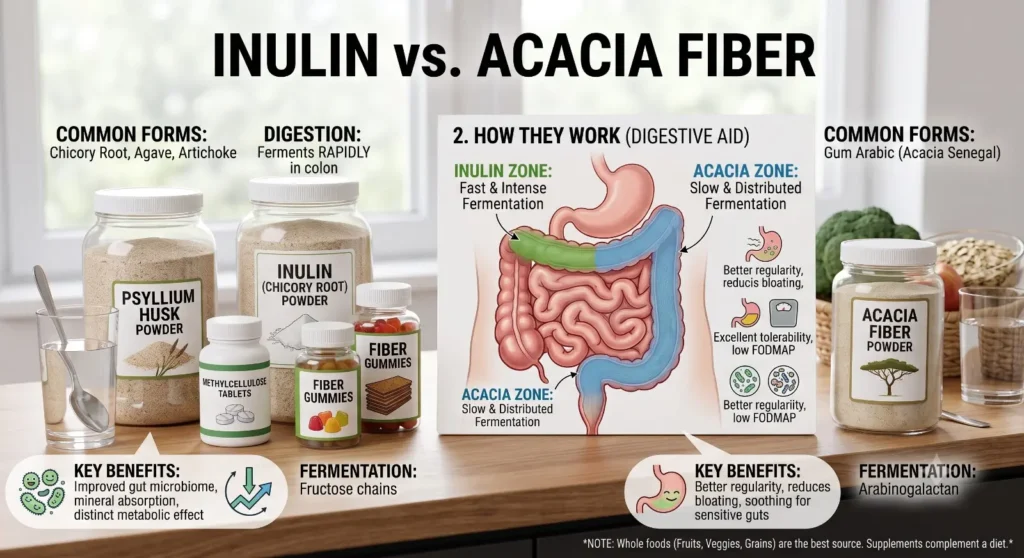
Inulin and acacia fiber are both soluble, fermentable prebiotic fibers, but they ferment at very different speeds — and that single difference explains most of what people notice when comparing them. Inulin ferments quickly and completely, giving it strong, well-documented prebiotic effects but a real risk of gas and bloating, especially at higher doses. Acacia fiber (also called gum arabic) ferments much more slowly, which spreads out gas production and makes it one of the better-tolerated prebiotic fibers available, including for people with IBS.
If you’ve tried a prebiotic fiber before and gave up because of bloating, acacia fiber is usually the gentler place to restart. If you want the fiber with the deepest research base for boosting beneficial gut bacteria and you tolerate fermentable fiber well, inulin remains the more studied option.
Table of Contents
Inulin vs Acacia Fiber: The Fast Comparison
| Feature | Inulin | Acacia Fiber |
| Source | Chicory root (most common), Jerusalem artichoke | Sap of the Acacia senegal or Acacia seyal tree (gum arabic) |
| Fiber category | Soluble, fully fermentable fructan | Soluble, slowly fermentable |
| Fermentation speed | Fast and extensive | Slow and gradual |
| Gas/bloating risk | Moderate to high, especially over 5 g | Low to moderate, even at higher doses |
| Prebiotic research depth | Extensive — one of the most studied prebiotics | Growing, but smaller evidence base than inulin |
| Bifidobacteria-boosting effect | Strong, well documented | Documented, though studied less extensively |
| IBS/sensitive gut suitability | Often a trigger fiber; high FODMAP | Generally well tolerated; considered low-to-moderate FODMAP |
| Typical starting dose | 2–3 g, increasing gradually | 5–15 g, often tolerated even at higher amounts |
| Common products | Chicory root fiber, FOS blends, added to “high fiber” foods | Acacia gum powder, gut-health blends |
This table addresses the real question behind this search: “which prebiotic will actually feed my gut bacteria without wrecking my stomach?”
What Is Inulin?
Inulin is a soluble fiber belonging to a class of carbohydrates called fructans. It occurs naturally in chicory root, Jerusalem artichokes, garlic, onions, leeks, and asparagus, though most commercial inulin supplements are extracted from chicory root.
Inulin’s defining trait is that it’s fully fermentable — gut bacteria, especially Bifidobacteria, break it down almost completely and quickly in the colon. This fermentation produces short-chain fatty acids that support gut lining health, which is why inulin is one of the most extensively studied prebiotic fibers on the market.
The tradeoff is that this fast, thorough fermentation also produces gas, sometimes substantial amounts, particularly when someone jumps straight to a higher dose.
For more detail, see our guides to inulin fiber, inulin benefits, and inulin side effects.
What Is Acacia Fiber?
Acacia fiber, also known as gum arabic, is a soluble fiber extracted from the dried sap of the Acacia senegal or Acacia seyal tree. It has a long history of traditional use and has more recently gained attention as a gut-health supplement.
Like inulin, acacia fiber is fermentable and feeds gut bacteria, including Bifidobacteria. The key difference is speed: acacia ferments slowly and gradually, spreading its short-chain fatty acid production out over a longer period instead of concentrating it. That slower pace is the main reason acacia is generally considered one of the more comfortable prebiotic fibers to take, even at relatively high doses.
For more on this ingredient, see acacia fiber, acacia fiber benefits, and acacia fiber side effects.
The Core Difference: Fermentation Speed, Not Fermentation Amount
Most comparison articles say “inulin causes more gas than acacia” without explaining why, and the explanation matters. Both fibers are fermented by gut bacteria and both ultimately support beneficial bacterial populations. The real difference is how fast that fermentation happens:
- Inulin is broken down quickly and almost completely, often within a relatively short window. That concentrated burst of fermentation activity is what produces a noticeable amount of gas in a short period.
- Acacia fiber is broken down more gradually. The same general fermentation process happens, but it’s spread out over more time, which means gas production at any given moment is much lower.
Think of it like burning fuel quickly versus slowly: the total energy released may be similar, but a slow burn feels completely different than a fast one. That’s essentially what’s happening with inulin versus acacia fiber in your gut.
This is also why some research has looked at whether acacia might be even more thoroughly fermented than inulin overall — the point of disagreement across sources isn’t whether acacia ferments, but how much gas that fermentation produces at once. The gradual pace is the consistent, well-supported finding.
For the broader fiber classification system, see soluble vs. insoluble fiber.
Prebiotic Strength: Where Inulin Still Leads
Inulin has a much longer research track record. Multiple studies have documented its ability to selectively increase Bifidobacterium populations in the colon, and it’s considered one of the “gold standard” prebiotic fibers used in clinical research.
Acacia fiber also has a documented bifidogenic effect — meaning it can boost Bifidobacteria too — but the evidence base is smaller and newer compared to decades of inulin research. That doesn’t mean acacia is weaker in effect; it means there’s simply less research volume behind it so far.
Practical takeaway: if you want the prebiotic fiber with the deepest evidence base, inulin remains the more established choice. If you want a prebiotic effect with a meaningfully lower risk of discomfort, acacia is a well-supported alternative, even if its research library is still growing.
For more on prebiotic-focused supplement options, see best prebiotic fiber supplement.
Gas, Bloating, and IBS Considerations
This is the deciding factor for most people choosing between these two fibers.
- Inulin is a high-FODMAP fiber for many people and is a well-known trigger for gas, bloating, and cramping, especially at doses above roughly 5 grams or when introduced too quickly.
- Acacia fiber is generally considered low-to-moderate FODMAP at typical doses and tends to be well tolerated even at higher amounts, largely because of its slower fermentation profile.
- For IBS specifically, acacia fiber is increasingly discussed as a middle-ground option: it offers a genuine prebiotic effect without the sharp fermentation spike that makes inulin difficult for many IBS patients to tolerate.
If you’ve tried inulin and found it uncomfortable, that alone is a reasonable signal to try acacia fiber next rather than giving up on prebiotic fiber altogether. For a broader comparison of low-gas fiber options, see fiber supplement that doesn’t cause gas.
Practical Examples: Matching the Fiber to the Person
- Someone new to prebiotic fiber who wants to avoid a rough start → Acacia fiber, starting around 5 grams daily and increasing gradually.
- Someone who tolerates inulin well and wants the most well-studied prebiotic option → Inulin, starting at 2–3 grams and building up slowly.
- Someone with diagnosed IBS looking for gut bacteria support without a FODMAP flare → Acacia fiber is generally the more comfortable starting point, though individual tolerance still varies.
- Someone who already eats inulin-rich foods (garlic, onions, chicory-fortified snacks) regularly → May already be getting meaningful inulin intake and could consider acacia as a lower-gas way to add more prebiotic fiber without stacking additional inulin.
A Better Decision Framework Than “Just Pick One”
Run through these four questions:
1. How has fermentable fiber treated you in the past?
- Gas or bloating has been a problem → Acacia fiber’s slower fermentation is the safer starting point.
- No history of issues → Either fiber is reasonable to try.
2. Do you have IBS or a known sensitive gut?
- Yes → Acacia fiber is generally the more comfortable choice.
- No → Inulin’s deeper research base may be appealing if you tolerate it well.
3. How much do you value research depth versus comfort?
- Research depth matters most → Inulin has the longer track record.
- Comfort and tolerability matter most → Acacia fiber tends to win here.
4. Are you willing to start low and build up slowly either way?
- Yes → Both fibers can work well with a gradual introduction.
- No, you want something forgiving from day one → Acacia fiber is more forgiving at higher starting doses.
Common Mistakes People Make With Either Fiber
- Starting inulin at a high dose right away. This is the most common cause of significant gas; building up from 2–3 grams avoids most of the discomfort people associate with inulin.
- Assuming acacia fiber has no effect because it’s gentle. Slow fermentation doesn’t mean weak fermentation — acacia still produces meaningful prebiotic activity, just spread out over more time.
- Stacking hidden inulin sources. Many “high fiber” bars, yogurts, and drinks contain added chicory root fiber or inulin; combining these with a supplement can push your intake higher than you realize.
- Giving up on prebiotic fiber entirely after one bad experience. A rough reaction to inulin doesn’t mean all fermentable fiber is off the table — it often just means a slower-fermenting option like acacia is a better fit.
- Not drinking enough water. Both fibers work best, and are generally better tolerated, when taken with adequate fluid.
Frequently Asked Questions
Which causes less gas, inulin or acacia fiber? Acacia fiber generally causes less gas because it ferments slowly, spreading gas production out over time. Inulin ferments quickly and completely, which concentrates gas production into a shorter window and makes it more noticeable.
Is acacia fiber as good a prebiotic as inulin? Acacia fiber does have a documented bifidogenic effect, meaning it can boost beneficial bacteria like Bifidobacteria. However, inulin has a much larger body of research behind it, so it’s currently considered the more thoroughly studied prebiotic of the two.
Is acacia fiber better for IBS than inulin? Acacia fiber is generally better tolerated by people with IBS because of its slow fermentation and lower FODMAP load. Inulin is a high-FODMAP fiber and a common trigger for IBS symptoms, though individual tolerance varies.
Can I switch from inulin to acacia fiber without a problem? Yes. Both are soluble prebiotic fibers, so there’s no dependency or withdrawal concern when switching. It’s still smart to start acacia fiber at a moderate dose rather than assuming unlimited tolerance right away.
Can I take inulin and acacia fiber together? Some people combine slow- and fast-fermenting fibers to balance gut bacteria diversity with comfort, but there’s limited direct research on this specific combination. If you want to try it, start with low doses of each and adjust based on how you feel.
Which fiber is better for weight management? Both can support satiety through their soluble fiber content, but neither is a dedicated weight-loss product on its own. See best fiber supplement for weight loss for more on how fiber fits into weight management overall.
Final Verdict
Inulin and acacia fiber both feed beneficial gut bacteria, but they arrive at that result on very different timelines. Inulin ferments fast and thoroughly, giving it the deepest prebiotic research base available, at the cost of noticeable gas for many people, especially at higher doses. Acacia fiber ferments slowly, offering a genuine prebiotic effect with meaningfully better day-to-day comfort, including for people with IBS.
If you tolerate fermentable fiber well and want the most-studied prebiotic option, inulin is a solid choice started gradually. If gas and bloating have been a problem with other fibers, or you have a sensitive gut, acacia fiber is generally the gentler, more forgiving place to start. For more on how these fibers compare to gel-forming options like psyllium, see our guide to psyllium husk vs inulin, or explore types of dietary fiber ingredients for the full picture.
This article is for educational purposes only and does not replace personalized medical advice. Talk to a healthcare provider before starting any new supplement, especially if you have IBS, a diagnosed digestive condition, or take regular medication.