
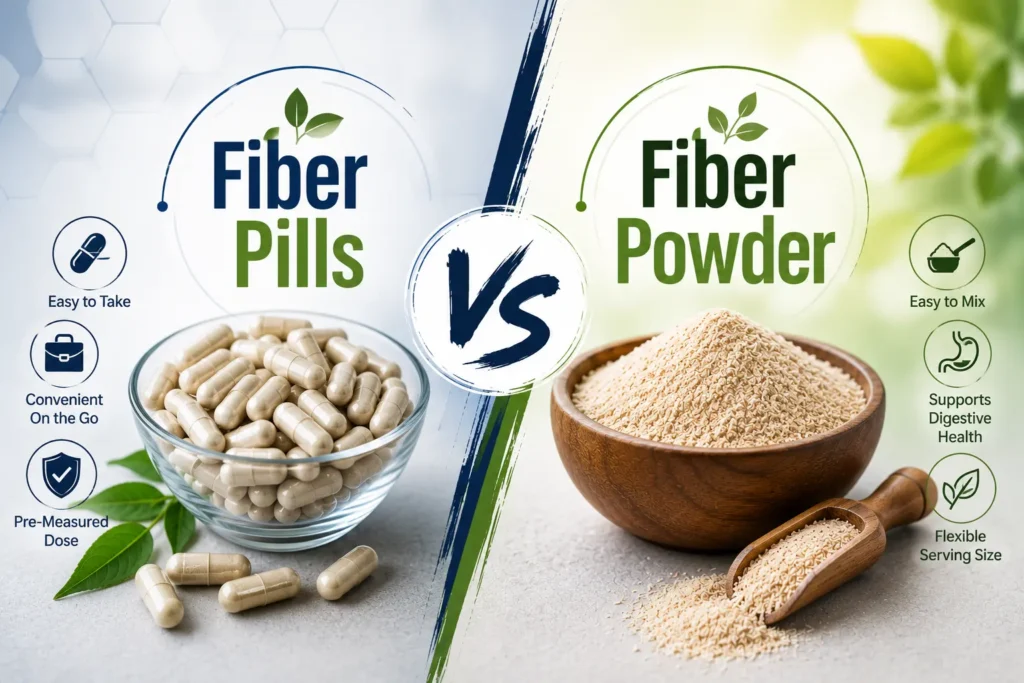
Fiber pills and fiber powder can deliver the same ingredient — often psyllium husk — but the format changes how much fiber you actually get per dose, how well it works, and how convenient it is day to day. Fiber powder dissolves fully in liquid before you drink it, which allows soluble fibers to hydrate completely and form the gel responsible for most of their cholesterol, blood sugar, and regularity benefits. Fiber pills are more portable and don’t require mixing, but they pack far less fiber per unit — often around 0.5 grams per capsule versus roughly 3 grams per teaspoon of powder — meaning you may need five or six pills to match a single serving of powder.
If your priority is maximum effectiveness per dose and lower cost, powder is generally the stronger choice. If your priority is portability, no mixing, and no taste or texture to deal with, pills are the more practical option, provided you’re willing to take enough of them to reach an equivalent dose.
Table of Contents
What Is Fiber Powder?
Fiber powder is a loose, granulated form of fiber — most commonly psyllium husk, though also available as acacia, wheat dextrin, or other fiber sources — meant to be mixed into water, juice, or another beverage before drinking.
Key characteristics:
- Fully dissolves and hydrates in liquid before you consume it, which matters a great deal for gel-forming fibers
- Flexible dosing — you can measure a precise amount based on your needs
- Typically delivers a meaningfully higher fiber content per serving than an equivalent volume of pills
- Requires mixing, drinking promptly (viscous powders thicken quickly), and carrying liquid with you
- Often more cost-effective per gram of fiber than capsule or tablet versions
Powder is the format most fiber research is based on, since it’s the easiest to standardize in clinical trials. For more on dosing, see psyllium husk dosage and our psyllium husk powder guide.
What Are Fiber Pills?
Fiber pills — whether capsules or tablets — deliver a pre-measured, compressed or encapsulated dose of fiber that you swallow whole with water, without any mixing.
Key characteristics:
- Convenient and portable; no mixing, no taste, no texture to manage
- Deliver a much smaller amount of fiber per unit than powder — a single capsule typically contains a fraction of a gram
- Must break down and hydrate inside the digestive tract, which can delay the onset of action compared to powder
- Some capsule products use different active ingredients altogether, such as calcium polycarbophil, rather than psyllium
- Tend to cost more per gram of fiber than an equivalent amount of powder
Pills are popular for travel, work, or anyone who dislikes the texture of a gel-forming drink. See our fiber pills and psyllium husk capsules guides for specific product considerations.
Fiber Pills vs Fiber Powder: Side-by-Side Comparison
| Factor | Fiber Pills | Fiber Powder |
| Fiber per unit | Low — often ~0.5g per capsule | High — often ~3g per teaspoon |
| Doses needed for a full serving | Often 5-6+ pills | 1 measured scoop or teaspoon |
| Hydration/gel formation | Delayed — must dissolve inside the digestive tract | Immediate — fully hydrated before swallowing |
| Onset of effect | Slower | Faster |
| Convenience/portability | High — no mixing, easy to carry | Lower — requires liquid and mixing |
| Taste/texture | None | Some texture or thickness, depending on the fiber |
| Cost per gram of fiber | Generally higher | Generally lower |
| Dosing flexibility | Fixed per pill; adjust by number taken | Fully adjustable by scoop/spoon amount |
| Best for | Travel, work, discreet daily use | Maximum effectiveness, cost efficiency, flexible dosing |
The Dosage Math Most Articles Skip
This is the single most important — and most overlooked — practical difference between the two formats. A typical psyllium powder serving delivers around 3 grams of fiber per teaspoon, while a typical capsule delivers roughly 0.5 grams. That means matching one teaspoon of powder can require five to six capsules, and reaching a commonly recommended dose of 5-10 grams per day could mean 10 to 20 capsules.
This isn’t a criticism of pills — it’s simply the reality of the format, and it explains why people who switch from powder to pills sometimes feel like their fiber supplement “stopped working.” In most cases, it isn’t that pills are less effective on a gram-for-gram basis; it’s that the number of pills taken doesn’t actually match the fiber dose the person was getting from powder. If you switch formats, doing the gram math first — checking the label on both products — is the single best way to avoid an accidental drop in your effective dose.
How Format Affects the Way Fiber Works
For non-viscous fibers like wheat dextrin, the pill-versus-powder distinction matters less, since these fibers don’t rely on forming a gel to work — see our wheat dextrin guide for more on how non-viscous fibers behave.
For viscous, gel-forming fibers like psyllium, format matters more. Powder is mixed directly into liquid, allowing it to fully hydrate and form its characteristic gel before you even swallow it. Some research comparing psyllium formats has found that fully hydrated powder can produce a notably thicker gel than the equivalent amount taken as capsules, since compressed pills have less surface area for liquid to penetrate quickly and may pass partially intact through part of the digestive tract before fully dissolving. This is one reason powder tends to be the format used in most clinical research behind fiber’s cholesterol and blood sugar benefits — see our soluble vs insoluble fiber guide for how viscosity drives those effects.
Benefits: Where Each Format Actually Wins
Effectiveness Per Dose
Powder wins here, mainly because it’s easier to hit an actual therapeutic dose without swallowing a large handful of pills, and because full hydration before consumption supports better gel formation for viscous fibers like psyllium.
Convenience and Consistency
Pills win clearly for travel, work, or anyone who struggles to remember to mix and drink a powder consistently. A pre-measured capsule taken with a glass of water is simpler to build into a routine, especially for seniors or anyone managing multiple daily supplements.
Cost
Powder is typically more economical per gram of fiber, since you’re not paying for encapsulation, compression, or the packaging needed to portion out dozens of small pills.
Taste and Texture Tolerance
Pills win decisively if you dislike the gritty or thickening sensation some fiber powders create when mixed into liquid. If taste and texture are the main obstacle, pills — or a well-flavored fiber gummies option — may be worth exploring.
Onset of Action
Powder tends to act faster, since it’s already dissolved and partially gelled by the time it reaches your stomach. Pills need to break down first, which can add a delay before you notice an effect.
Common Mistakes People Make Comparing These Two Formats
- Assuming “one pill equals one scoop.” As covered above, most fiber pills contain a small fraction of the fiber found in a single serving of powder — check both labels before comparing doses.
- Switching from powder to pills without adjusting the count. Taking the same number of “doses” (e.g., one pill instead of one scoop) rather than matching total grams of fiber is the most common reason people feel pills “don’t work as well.”
- Not drinking enough water with pills. Fiber pills still need adequate fluid to hydrate properly in the digestive tract; skipping water can reduce effectiveness and, for viscous fibers, increase discomfort.
- Assuming all fiber pills contain psyllium. Some capsule products use other ingredients, like calcium polycarbophil, which work differently. Always check the active ingredient, not just the word “fiber” on the label.
- Increasing either format too quickly. Both can cause gas or bloating if you jump to a full dose right away — see how to choose a fiber supplement for a gradual approach.
Can You Combine Pills and Powder?
There’s no issue using both — for example, powder at home in the morning and pills during the day when mixing isn’t practical. The main thing to track is your total daily fiber gram count across both formats, so you don’t unintentionally under- or overshoot your target. If you’re building a broader daily fiber routine, our when should I take fiber supplements guide covers timing across multiple doses.
Decision Framework: Which One Should You Choose?
Choose fiber powder if:
- You want the most effective, best-hydrated dose for cholesterol, blood sugar, or regularity goals
- Cost per gram of fiber matters to you
- You don’t mind mixing a drink as part of your routine
Choose fiber pills if:
- Portability and convenience are your top priority — travel, work, or a busy schedule
- You dislike the taste or gel-like texture of mixed fiber drinks
- You’re willing to take multiple pills to reach an effective total dose
Choose based on tolerance if:
- You’ve experienced bloating with one format — sometimes switching from powder to pills (or vice versa) changes how quickly the fiber hydrates and how your gut responds; see fiber supplement that doesn’t cause gas for more
Frequently Asked Questions
Are fiber pills as effective as fiber powder? Gram for gram, most research suggests they can be comparably effective when the total dose is matched and taken with enough water. In practice, though, pills often deliver much less fiber per unit, so people frequently end up with a lower effective dose unless they account for the difference.
How many fiber pills equal one scoop of fiber powder? It depends on the product, but a common ratio is roughly five to six capsules to match one teaspoon of powder, since capsules often contain around 0.5 grams of fiber compared to about 3 grams per teaspoon of powder. Always check both labels, since this varies by brand.
Why do fiber pills seem to work slower than powder? Because powder is already dissolved and beginning to gel before you swallow it, while pills must first break down and hydrate inside your digestive tract, which adds a delay before the fiber becomes active.
Is fiber powder better for cholesterol than fiber pills? Powder has a practical advantage because full hydration supports the gel formation responsible for cholesterol-related benefits, and it’s easier to reach a full therapeutic dose. Pills can still work for cholesterol support if enough are taken with adequate water to match the same total gram amount.
Do all fiber capsules contain psyllium? No. Some fiber capsules use other ingredients, such as calcium polycarbophil, which work through a different mechanism than psyllium. Always check the active ingredient on the label rather than assuming.
Can I switch from fiber powder to pills without any issues? Yes, as long as you match the total fiber gram amount and increase gradually if you’re adjusting your dose. Some people notice a difference in bloating or onset speed when switching formats, which usually settles as the gut adjusts.
Final Verdict
Fiber pills and fiber powder aren’t fundamentally different fibers — they’re different delivery systems for often the same active ingredient, and the right choice usually comes down to how much you value convenience versus how much you value squeezing the most effect out of each dose. Powder delivers more fiber per serving, hydrates fully before you drink it, and is generally the more cost-effective and clinically representative format. Pills trade some of that dosing efficiency for genuine convenience — no mixing, no taste, easy to carry — but only work as well as powder when you take enough of them to match an equivalent gram amount. For most people focused on measurable digestive or cardiovascular benefits, powder is the more dependable choice. For people who simply won’t take a powder consistently, a correctly dosed set of pills is far better than no fiber supplement at all.
To compare specific delivery formats further, see fiber powder vs fiber capsules, or browse our full best fiber supplement rankings.
This article is for educational purposes only and is not a substitute for medical advice. Speak with a healthcare provider before starting any new fiber supplement, especially if you have a digestive condition or take medication.