
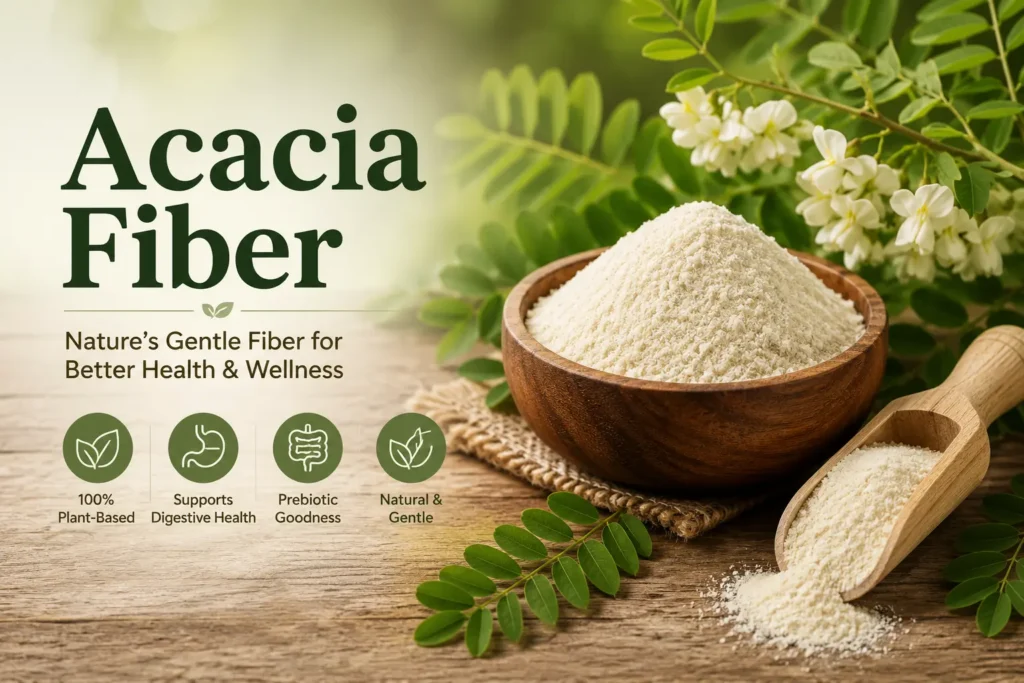
Acacia fiber is a soluble, non-viscous dietary fiber made from the hardened sap of the acacia tree, most often Acacia senegal or Acacia seyal. It’s also sold as gum arabic, gum acacia, or acacia gum powder. Unlike psyllium, acacia fiber dissolves completely in water without thickening into a gel, which makes it gentler on digestion. Research links it to improved gut bacteria balance, more comfortable bowel movements, better blood sugar response, and modest support for weight and cholesterol management. A typical starting dose is 5–10 grams a day, working up to 20–30 grams if needed. It’s one of the few fibers considered low FODMAP, which makes it a common recommendation for people with sensitive digestion, including those managing IBS.
Table of Contents
What Is Acacia Fiber?
Acacia fiber comes from a surprisingly simple source: tree sap. When cuts are made in the bark of certain acacia trees growing across the Sahel region of Africa — mainly Sudan, Chad, and Nigeria — the tree exudes a sticky resin. That resin hardens in the sun, is collected by hand, then cleaned, dried, and milled into a fine powder. That powder is acacia fiber.
You’ll see it marketed under several overlapping names, which is one of the biggest sources of confusion for shoppers:
- Acacia fiber — the common supplement-industry name
- Gum arabic / gum acacia — the traditional food-industry name for the same substance
- Acacia senegal fiber — named for the specific tree species most commonly harvested
- E414 — the food additive code used on ingredient labels in the EU and UK
These aren’t different products pretending to be one thing — they genuinely are the same fiber, just labeled differently depending on whether it’s sold as a food additive or a standalone supplement. This is one of the most useful facts a shopper can know, and it’s something competitor pages tend to gloss over.
Chemically, acacia fiber is a complex mix of polysaccharides and glycoproteins. It’s classified as a soluble fiber, meaning it dissolves in water. But it behaves differently from most soluble fibers you’re probably familiar with.
Why acacia fiber doesn’t feel like other fibers
Psyllium husk, one of the most popular fiber supplements, absorbs water and swells into a thick gel. That’s what gives it a bulking, laxative-like effect. Acacia fiber does the opposite: it dissolves fully and stays a thin liquid, closer in texture to sugar water than to a gel. It doesn’t add noticeable bulk to stool the way psyllium or wheat dextran do.
Instead of bulking, acacia fiber’s main mode of action is fermentation. It travels largely intact to the large intestine, where resident gut bacteria break it down and use it as fuel. This is the same basic mechanism behind inulin and other prebiotic fibers, though acacia tends to ferment more slowly and gently, which is a major reason it produces less gas than inulin for most people.
How Acacia Fiber Works in the Body
Understanding the mechanism helps explain why acacia fiber shows up in such a wide range of health claims — gut health, blood sugar, weight, and cholesterol — without acting like a single-purpose fiber.
- It passes through the small intestine largely undigested. Human digestive enzymes can’t break down its polysaccharide structure.
- It reaches the colon intact, where it becomes food for gut bacteria — functioning as a prebiotic.
- Bacteria ferment it into short-chain fatty acids (SCFAs), including butyrate, which is the preferred fuel source for cells lining the colon and is associated with a stronger gut barrier and lower inflammation.
- Fermentation gradually shifts the bacterial population, generally favoring increases in beneficial genera such as Bifidobacteria and Lactobacilli.
- Because it’s slow-fermenting rather than fast-fermenting (unlike inulin or FOS), it tends to produce less rapid gas buildup, which is why people often tolerate acacia better than other prebiotic fibers.
This is a fundamentally different mechanism from bulk-forming fibers, which is why acacia fiber is often paired with — rather than used as a replacement for — fibers like psyllium. One softens and bulks stool; the other feeds the microbiome. For a deeper breakdown of that distinction, see our guide to soluble vs. insoluble fiber.
Acacia Fiber Benefits: What the Research Actually Shows
It’s worth being upfront about something most competitor pages don’t say clearly: acacia fiber has a genuinely encouraging body of clinical research behind it compared to many trendy fiber ingredients, but the evidence is still modest in scale — most trials involve dozens to a couple hundred participants, not thousands. Below is what’s actually been studied, without overstating it.
1. Gut microbiome and digestive comfort
Multiple human trials have found that daily acacia fiber intake increases populations of beneficial bacteria such as Bifidobacteria and Lactobacilli, in some studies matching or exceeding the effect of inulin at equivalent doses. Because it’s low FODMAP, it’s also one of the few prebiotic fibers that can be used during the strict elimination phase of a low-FODMAP diet, making it a practical option for people managing IBS symptoms who still need to hit their daily fiber target. If you’re building a broader digestive strategy, our guide on fiber supplements for gut health covers how acacia compares to other prebiotic options.
2. Blood sugar and insulin response
Several controlled studies in people with type 2 diabetes and metabolic syndrome have found that 20–30 grams of gum arabic daily, taken over 12 weeks, was associated with reduced fasting blood glucose and improvements in related metabolic markers. This is one reason the FDA has moved toward recognizing acacia gum as a qualifying dietary fiber, based partly on its documented effect on post-meal blood sugar and insulin.
3. Weight and body composition
A randomized, placebo-controlled trial in healthy adult women tested 30 grams of gum arabic daily for six weeks and found a small but statistically significant reduction in BMI and body fat percentage compared to placebo. Increased satiety appears to be the main driver — soluble fiber slows gastric emptying and can reduce overall calorie intake by roughly 100–200 kcal per day in some studies. These effects are real but modest; acacia fiber is not a stand-alone weight-loss tool, and anyone specifically focused on that goal may get more comprehensive guidance from our fiber supplement for weight loss guide.
4. Blood pressure and cardiovascular markers
In a 12-week randomized trial in adults with type 2 diabetes, participants taking 30 g of gum arabic daily saw a significantly greater drop in systolic blood pressure compared to a placebo group. A separate trial in adults at risk of metabolic syndrome reported improvements in both systolic and diastolic blood pressure alongside reduced fasting glucose after 20 g/day for 12 weeks. Effects on cholesterol are less consistent — some earlier trials in healthy or hypercholesterolemic adults found no meaningful change in blood lipids, while more recent trials in diabetic and sickle cell anemia populations found reductions in total cholesterol, triglycerides, and LDL. In short: the blood pressure signal is more consistent across studies than the cholesterol signal.
5. Inflammatory and gut barrier support
Preliminary research, including a small trial in rheumatoid arthritis patients, has found that gum arabic supplementation was associated with reduced inflammatory markers and disease severity scores. Separate laboratory and animal research suggests acacia fiber may help support the gut barrier and reduce intestinal inflammation. This research is early-stage and shouldn’t be read as acacia fiber treating any inflammatory condition — but it does help explain the broader gut-health story.
What acacia fiber does NOT have strong evidence for
To stay balanced: acacia fiber is not proven to treat, cure, or prevent any disease. Evidence for cholesterol-lowering is mixed rather than settled. Long-term studies beyond about 12 weeks are limited, so what happens with years of daily use is not well characterized. Anyone using acacia fiber for a specific medical condition should treat it as a dietary addition to discuss with a healthcare provider, not a replacement for treatment.
Acacia Fiber Nutrition Facts
| Nutrient (per 1 tbsp / ~10g serving) | Approximate Amount |
| Calories | ~35–40 |
| Total carbohydrates | ~10g |
| Dietary fiber | ~9–10g |
| Sugar | 0g |
| Protein | 0g |
| Fat | 0g |
| Solubility | Fully soluble |
| Viscosity | Non-viscous (does not gel) |
| FODMAP status | Low FODMAP |
Values vary slightly by brand and purity; always check the specific product label.
Acacia Fiber vs. Other Common Fiber Supplements
This is where most competitor articles fall short — they explain what acacia fiber is, but not how to decide between it and the fiber you’re already considering. Here’s a direct comparison.
| Fiber | Type | Gels/Bulks Stool? | Gas/Bloating Risk | Best Known For | FODMAP |
| Acacia fiber | Soluble, non-viscous | No | Low–moderate | Gut bacteria balance, gentle prebiotic effect | Low |
| Psyllium husk | Soluble, viscous | Yes, strongly | Low–moderate | Bulking stool, regularity, cholesterol | Moderate |
| Inulin | Soluble, fermentable | No | High | Fast prebiotic fermentation | High |
| Methylcellulose | Soluble, viscous | Yes | Very low | Regularity without gas | N/A (synthetic) |
| Wheat dextran | Soluble, non-viscous | Minimal | Low | Easy mixing, mild taste | Low |
In practical terms:
- If your main issue is irregularity or needing bulkier, easier-to-pass stool, psyllium husk is usually the better first choice.
- If your main goal is feeding beneficial gut bacteria with minimal digestive drama, acacia fiber is one of the gentlest prebiotic options available.
- If you’ve tried inulin and found it too gassy, acacia fiber is a common and reasonable substitute with a similar prebiotic goal but a slower fermentation curve.
- Many people use acacia fiber and psyllium together, since one bulks and one feeds bacteria — they address different mechanisms rather than competing with each other.
For a deeper look at how soluble fibers differ from insoluble ones in general, see our soluble fiber and insoluble fiber guides.
Types and Forms of Acacia Fiber
Acacia fiber supplements come in a few different forms, and the right one usually comes down to convenience and how it fits your routine.
- Acacia fiber powder — the most common and most versatile form. Mixes into water, smoothies, coffee, or oatmeal. Because it’s flavorless and dissolves clearly (it won’t turn liquid cloudy or thick), it’s easy to add to almost anything. See our full fiber powder comparison guide for how it stacks up against other powders.
- Acacia capsules — convenient for travel or for people who dislike mixing powders, though you’ll need several capsules to reach an effective gram dose, which can get expensive. Compare with our fiber capsules guide.
- Acacia gummies — less common, typically lower in fiber per serving, and best thought of as a supplemental boost rather than a primary fiber source. See our fiber gummies guide for realistic dosing expectations.
- Food-grade gum arabic — used as a thickener/stabilizer in food manufacturing; the same substance, but not intended or dosed as a supplement.
How to Take Acacia Fiber: A Practical Framework
Most competitor content lists a single dosage number without explaining how to actually build up to it. Here’s a more useful framework.
Step 1: Start low
Begin with 5 grams (roughly 1–1.5 teaspoons) once daily, mixed into water or a beverage. This lets your gut bacteria adjust gradually.
Step 2: Increase slowly over 1–2 weeks
If well tolerated, increase to 10 grams daily, then reassess after another week.
Step 3: Reach your target dose
Most clinical studies showing meaningful benefits use 20–30 grams per day, often split into two doses (morning and evening) rather than taken all at once. Splitting the dose tends to reduce gas and bloating compared to taking the full amount in one sitting.
Step 4: Maintain and monitor
Once at your target, stick with a consistent daily amount — prebiotic fibers work through cumulative changes to gut bacteria over weeks, not single doses.
Practical tips:
- Take with plenty of water.
- It mixes best into liquids; it won’t thicken smoothies or coffee the way psyllium would.
- If you’re combining it with other fiber sources, count total daily fiber intake so you don’t overshoot too quickly. Our guide on when to take fiber supplements covers timing in more depth.
Side Effects and Safety
Acacia fiber has a solid safety track record — the FDA classifies it as Generally Recognized As Safe (GRAS) for food use, and clinical trials have used doses up to 30 g/day for periods of 6–12 weeks without serious adverse events. That said, it isn’t side-effect-free.
Common, usually mild side effects
- Bloating
- Gas/flatulence
- Loose stools or, less often, constipation
- These are most likely when starting at too high a dose too quickly
Less common
- Allergic reactions (skin reactions, conjunctivitis, or rhinitis) in people sensitive to acacia
- Nausea if taken in excess
Who should be more cautious
- Pregnant or breastfeeding women — there isn’t enough research to confirm safety in this group, so a healthcare provider should weigh in first.
- People taking oral medications — soluble fiber can interfere with drug absorption if taken too close together. One study found gum arabic reduced absorption of the antibiotic amoxicillin when taken simultaneously; a general rule of thumb (used broadly for fiber supplements, not specific to acacia) is to separate fiber and medication doses by at least 2–4 hours.
- People with known plant-based allergies, particularly to legumes or related plant gums.
Bottom line
For most healthy adults, acacia fiber is well tolerated when introduced gradually. If you experience persistent digestive discomfort, cut back to your last comfortable dose and increase more slowly, or speak with a healthcare provider.
Pros and Cons of Acacia Fiber
| Pros | Cons |
| Gentle, low FODMAP prebiotic fiber | Doesn’t bulk stool like psyllium — not ideal as a stand-alone constipation remedy |
| Flavorless and dissolves clearly in liquids | Effective doses (20–30g) can be a large volume of powder |
| Well-studied for blood sugar and gut bacteria support | Cholesterol benefit evidence is mixed, not conclusive |
| Long history of safe food use (GRAS status) | Can interfere with absorption of some oral medications if taken together |
| Fewer reported gas/bloating issues than inulin | Not enough safety data for pregnancy/breastfeeding |
Common Mistakes People Make With Acacia Fiber
- Jumping straight to 20–30 grams on day one. This is the single biggest cause of bloating complaints. Start at 5g and build up.
- Expecting it to work like psyllium. If your goal is bulkier, more regular stools, acacia alone likely won’t deliver that — it’s a feeder for gut bacteria, not a bulking agent.
- Taking it at the same time as medication. Give a gap of at least a couple of hours to avoid absorption issues.
- Judging results after a few days. Prebiotic effects on the microbiome typically take 2–4 weeks of consistent use to show up.
- Not drinking enough water alongside it. Like all fiber, adequate fluid intake supports comfortable digestion.
Who Might Consider Acacia Fiber?
- People wanting a gentle, low-FODMAP way to increase daily fiber intake
- People managing IBS who need fiber without triggering symptoms
- People looking to support a more balanced gut microbiome alongside a probiotic
- People who’ve found inulin or other prebiotics too gassy
- People interested in modest, evidence-supported support for post-meal blood sugar
Who Might Want a Different Fiber
- Anyone whose primary goal is relieving constipation through bulkier stool — psyllium husk is generally more effective for that specific goal
- Anyone pregnant or breastfeeding, without first checking with a healthcare provider
- Anyone on medications requiring precise absorption timing, without a dosing plan in place
Frequently Asked Questions
What is acacia fiber made from? It’s the dried, hardened sap of acacia trees — primarily Acacia senegal and Acacia seyal — harvested mainly across Sudan, Chad, and Nigeria, then cleaned and milled into powder.
Is acacia fiber the same as gum arabic? Yes. Acacia fiber, gum arabic, and gum acacia all refer to the same substance. “Gum arabic” is the more common name in food manufacturing; “acacia fiber” is the more common name in the supplement industry.
Does acacia fiber cause bloating? It can, especially at high doses introduced too quickly, since it’s fermented by gut bacteria. Most people tolerate it better than inulin because it ferments more slowly. Starting low and increasing gradually minimizes this.
How much acacia fiber should I take per day? Most research uses 20–30 grams daily, but it’s best to start at 5 grams and build up over 1–2 weeks to assess tolerance.
Can acacia fiber help with weight loss? Some evidence suggests modest reductions in BMI and body fat when combined with a normal diet, likely due to increased fullness. It isn’t a weight-loss treatment on its own.
Is acacia fiber good for IBS? It’s one of the few prebiotic fibers considered low FODMAP, which makes it a reasonable option for people managing IBS. Individual tolerance still varies, so introducing it slowly is important.
Can I take acacia fiber every day? Yes, daily use is how it’s studied and how it’s typically recommended, since prebiotic effects build up gradually with consistent intake.
Does acacia fiber interact with medications? It can reduce absorption of certain oral medications if taken at the same time. A general precaution is to separate fiber and medication by a few hours, and to check with a pharmacist or doctor for specific drugs.
Is acacia fiber safe during pregnancy? There isn’t enough research to confirm safety during pregnancy or breastfeeding. Speak with a healthcare provider before use.
What’s the difference between acacia fiber and psyllium husk? Acacia fiber is non-viscous and dissolves without thickening, acting mainly as a prebiotic. Psyllium husk absorbs water and gels, acting mainly as a stool bulking agent. They serve different purposes and are often used together.
Final Verdict
Acacia fiber earns its growing popularity honestly. It’s one of the gentler prebiotic fibers available, with real — if modest — clinical support for gut bacteria balance, blood sugar response, and digestive comfort, backed by a long history of safe use in food. It isn’t a bulking laxative, it isn’t a proven weight-loss solution, and its cholesterol benefits remain unsettled in the research. Used with realistic expectations — starting low, building up gradually, and pairing it with a bulking fiber like psyllium if regularity is your main goal — acacia fiber is a well-supported, low-drama way to close the gap between the fiber you eat and the fiber your gut actually needs.
If you’re still deciding which fiber format fits your routine, our guide on how to choose a fiber supplement walks through the decision step by step.
This article is for educational purposes only and is not a substitute for professional medical advice. Speak with a healthcare provider before starting any new supplement, particularly if you are pregnant, breastfeeding, managing a chronic condition, or taking medication.