
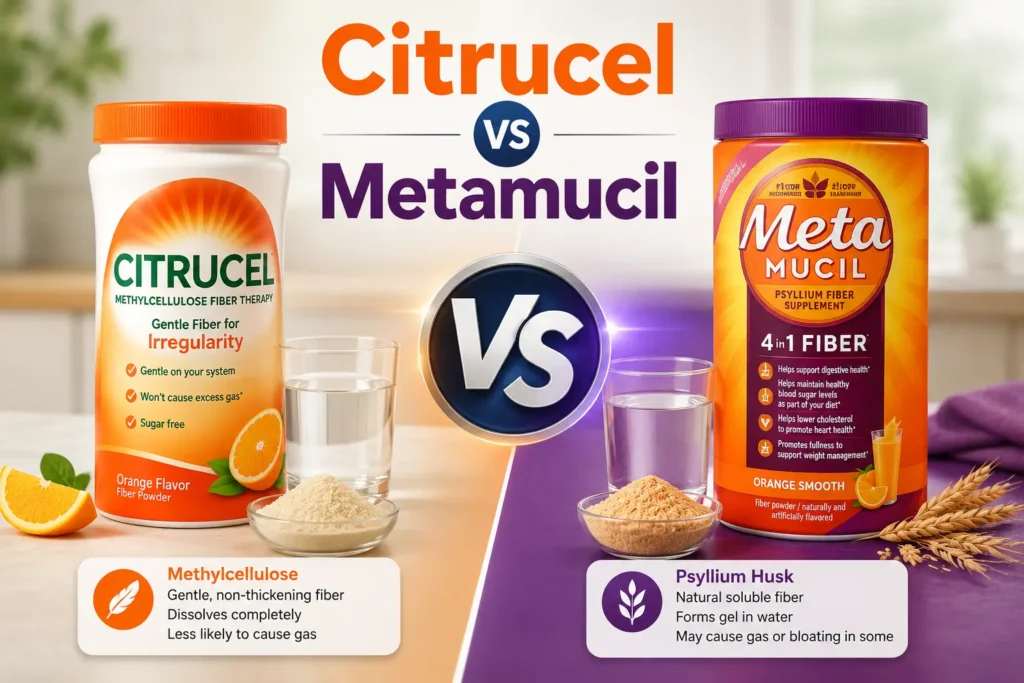
Citrucel and Metamucil are both over-the-counter bulk-forming fiber supplements, but they’re built from fibers that behave very differently in your gut. Citrucel uses methylcellulose, a non-fermentable fiber that adds bulk to stool with minimal gas. Metamucil uses psyllium husk, a fermentable, gel-forming fiber with a much longer research history — including an FDA-recognized cholesterol-lowering claim that methylcellulose doesn’t share.
If gas and bloating are your main worry, or you have IBS or a sensitive gut, Citrucel is usually the more comfortable choice. If you want the strongest evidence for constipation relief and you’re also interested in cholesterol support, Metamucil is the better-studied option, even though it’s more likely to cause gas at first. No peer-reviewed studies have directly compared the two head-to-head for constipation relief, so the honest answer is that both work — the real decision comes down to tolerance and goals.
Table of Contents
Citrucel vs Metamucil: The Fast Comparison
| Feature | Citrucel | Metamucil |
| Active fiber | Methylcellulose | Psyllium husk |
| Fermentable? | No | Yes |
| Gas/bloating risk | Low | Moderate to higher, especially early on |
| Texture in water | Dissolves clear, mild thickness | Thickens into a gel |
| Cholesterol claim | No FDA-recognized claim | FDA-recognized LDL cholesterol claim |
| Prebiotic effect | Minimal | Some, from fermentation |
| Onset | 12–72 hours | 12–72 hours |
| Available forms | Powder, caplets | Powder, capsules, wafers |
| Best known for | Gentle constipation relief with less gas | Stronger evidence base, cholesterol support |
| Best for | IBS, gas-sensitive users | People prioritizing proven results over comfort |
This table settles the question most searchers actually have: “which one won’t make me gassy, and which one has better long-term evidence?”
What Is Citrucel?
Citrucel’s active ingredient is methylcellulose, a semi-synthetic fiber made from plant cellulose. It’s classified as a bulk-forming laxative: it absorbs water in the intestine and adds soft, consistent bulk to stool, helping it move through more predictably.
The defining trait of methylcellulose is that it’s non-fermentable — gut bacteria largely can’t break it down. That means it passes through mostly intact, which is exactly why it tends to produce less gas than fermentable fibers. Citrucel is available in powder form and in caplets, giving people who dislike mixing powders a pill-based option.
For more on this ingredient specifically, see methylcellulose fiber.
What Is Metamucil?
Metamucil’s active ingredient is psyllium husk, the outer coating of Plantago ovata seeds. Psyllium is soluble and largely non-fermented compared to some other soluble fibers, but it does undergo partial fermentation by gut bacteria, unlike methylcellulose.
Psyllium’s signature trait is that it gels when mixed with water, forming a thick, viscous substance that adds significant bulk and moisture to stool. This gel-forming action is also behind psyllium’s most researched benefit: its FDA-recognized ability to help lower LDL cholesterol as part of a diet low in saturated fat.
Because psyllium partially ferments, it can cause more gas than methylcellulose, especially during the first one to two weeks of use.
See our dedicated guide to psyllium husk for a full breakdown of this ingredient.
The Core Difference: Fermentable Gel-Forming Fiber vs Non-Fermentable Bulking Fiber
Most competitor articles mention that Citrucel uses methylcellulose and Metamucil uses psyllium, then stop there. The deeper story is what those two properties — fermentability and gel formation — actually do:
- Methylcellulose (Citrucel) doesn’t ferment and doesn’t gel strongly, so it adds bulk quietly, with low gas and a milder texture, but without a cholesterol claim.
- Psyllium (Metamucil) ferments partially and gels strongly, so it adds more dramatic bulk and moisture, supports cholesterol, but is more likely to cause gas — particularly early on.
This tradeoff — comfort vs. evidence depth — is really what “Citrucel vs Metamucil” comes down to. Neither fiber is more “natural” or automatically superior; they’re built for slightly different priorities.
If you want the fundamentals of fiber classification before comparing brands, see soluble vs. insoluble fiber.
Effectiveness for Constipation
Both Citrucel and Metamucil are recognized bulk-forming laxatives, and both are commonly recommended for occasional constipation. Notably, there are no peer-reviewed studies directly comparing the two products head-to-head for constipation relief — most of the evidence for each comes from studies on their individual fiber types rather than brand-versus-brand trials.
Metamucil has a longer, broader research history behind psyllium, covering constipation relief, stool consistency in both directions (firming loose stools and softening hard ones), and cholesterol management.
Citrucel has solid evidence supporting methylcellulose as an effective bulk-forming agent for constipation, with the added benefit of a gentler side-effect profile, though its evidence base doesn’t extend to cholesterol or blood sugar claims the way psyllium’s does.
Practical takeaway: if you want the fiber with the deepest, most varied research record — including heart-health benefits — Metamucil has the edge. If you want a fiber that’s just as effective for regularity with meaningfully less gas, Citrucel is a strong, evidence-backed alternative.
For supplement options built specifically around constipation, see best fiber supplement for constipation.
Gas, Bloating, and IBS Considerations
This is usually the deciding factor for people choosing between these two products.
- Citrucel is the gentler option for gas-sensitive users because methylcellulose isn’t fermented by gut bacteria — there’s little for bacteria to feed on and turn into gas.
- Metamucil can cause noticeable gas and bloating, especially in the first one to two weeks, because psyllium partially ferments in the colon.
- For IBS specifically, non-fermentable fibers like methylcellulose are often better tolerated, since fermentation byproducts can aggravate bloating and discomfort in sensitive digestive systems.
If you’ve tried Metamucil and stopped because of gas, switching to Citrucel is one of the most common and reasonable next steps — you don’t need to taper or wean off one fiber before starting another.
Cholesterol and Heart Health: A Real Point of Difference
This is one area where the two products genuinely aren’t interchangeable. Psyllium husk (Metamucil) has an FDA-recognized claim for helping lower LDL cholesterol when used daily as part of a diet low in saturated fat and cholesterol. This benefit comes from psyllium’s gel-forming property, which binds bile acids in the gut.
Methylcellulose (Citrucel) does not carry this same recognized cholesterol claim. If cholesterol management is one of your goals alongside regularity, that’s a meaningful point in Metamucil’s favor — one worth discussing with your doctor if you’re deciding between the two for that reason specifically.
For more on fiber and cardiovascular health, see best fiber supplement for cholesterol.
A Better Decision Framework Than “Just Pick One”
Run through these four questions instead of guessing:
1. Is gas or bloating your top concern?
- Yes → Citrucel’s non-fermentable fiber is the more comfortable starting point.
- Not a big deal → Either product works.
2. Do you have IBS or a known sensitive gut?
- Yes → Methylcellulose (Citrucel) is generally easier to tolerate.
- No → Psyllium (Metamucil) is worth trying for its stronger evidence base.
3. Is cholesterol management part of your goal?
- Yes → Metamucil’s FDA-recognized claim makes it the more relevant choice.
- No → Either fiber can support general regularity.
4. Do you prefer powder or pills?
- Want pill options → Citrucel offers caplets; Metamucil offers capsules and wafers too.
- Fine with powder → Both mix into liquid, though Metamucil forms more of a gel texture.
These four questions get most people to a confident choice faster than comparing ingredient labels alone.
Common Mistakes People Make With Either Supplement
- Jumping straight to the full dose. Starting at the maximum labeled amount — especially with Metamucil — is the most common cause of early gas and bloating with any fiber supplement.
- Not drinking enough water. Both fibers rely on water to bulk stool properly; skimping on fluids reduces effectiveness and, with psyllium in particular, can worsen constipation or create a choking risk if taken too dry.
- Expecting overnight relief. Both products typically take 12 to 72 hours to produce a bowel movement, with fuller benefits building over one to two weeks of consistent use.
- Assuming “less gas” means “instant comfort.” Citrucel usually causes less gas than Metamucil, but some adjustment period is normal with any new fiber supplement.
- Taking fiber at the same time as medications. Both fibers can interfere with how well certain medications absorb; spacing doses by one to two hours is a simple, commonly recommended fix.
Frequently Asked Questions
Which is better for constipation, Citrucel or Metamucil? There’s no direct head-to-head clinical evidence proving one is stronger for constipation. Both are effective bulk-forming laxatives; the practical difference comes down to gas tolerance and whether you also want cholesterol support.
Which causes less gas, Citrucel or Metamucil? Citrucel typically causes less gas because methylcellulose is non-fermentable. Metamucil’s psyllium partially ferments, which can produce more gas, especially in the first couple of weeks.
Does Citrucel help with cholesterol like Metamucil does? No. Metamucil’s psyllium has an FDA-recognized claim for helping lower LDL cholesterol. Methylcellulose, the fiber in Citrucel, does not carry this same claim.
Can I switch from Metamucil to Citrucel without tapering? Yes. Both are fiber supplements with different active ingredients, so there’s no dependency or withdrawal concern when switching between them. It’s still smart to start at a lower dose when trying a new fiber source.
Is Citrucel or Metamucil better for IBS? Non-fermentable methylcellulose (Citrucel) is often better tolerated by people with IBS, since fermentation byproducts from psyllium can sometimes worsen bloating in sensitive guts. Tolerance still varies from person to person.
How fast do Citrucel and Metamucil work? Both typically produce a bowel movement within 12 to 72 hours, with more complete benefits building over one to two weeks of daily use.
Final Verdict
Citrucel and Metamucil are both legitimate, evidence-supported bulk-forming fiber supplements, but they’re built around different priorities. Citrucel’s methylcellulose is non-fermentable, making it the gentler, lower-gas option — a common choice for people with IBS or anyone who’s struggled with bloating on other fibers. Metamucil’s psyllium husk has a deeper research history and an FDA-recognized cholesterol benefit, but it’s more likely to cause gas, especially early on.
If comfort and tolerability are your priority, start with Citrucel. If you want the most-studied option and cholesterol support matters to you, Metamucil is worth the adjustment period. For a broader comparison that includes wheat dextrin as a third option, see our guide to Benefiber vs Citrucel or Metamucil vs Benefiber, and check how to choose a fiber supplement for the full decision process.
This article is for educational purposes only and does not replace personalized medical advice. Talk to a healthcare provider before starting any new supplement, especially if you have IBS, a diagnosed digestive condition, or take regular medication.