
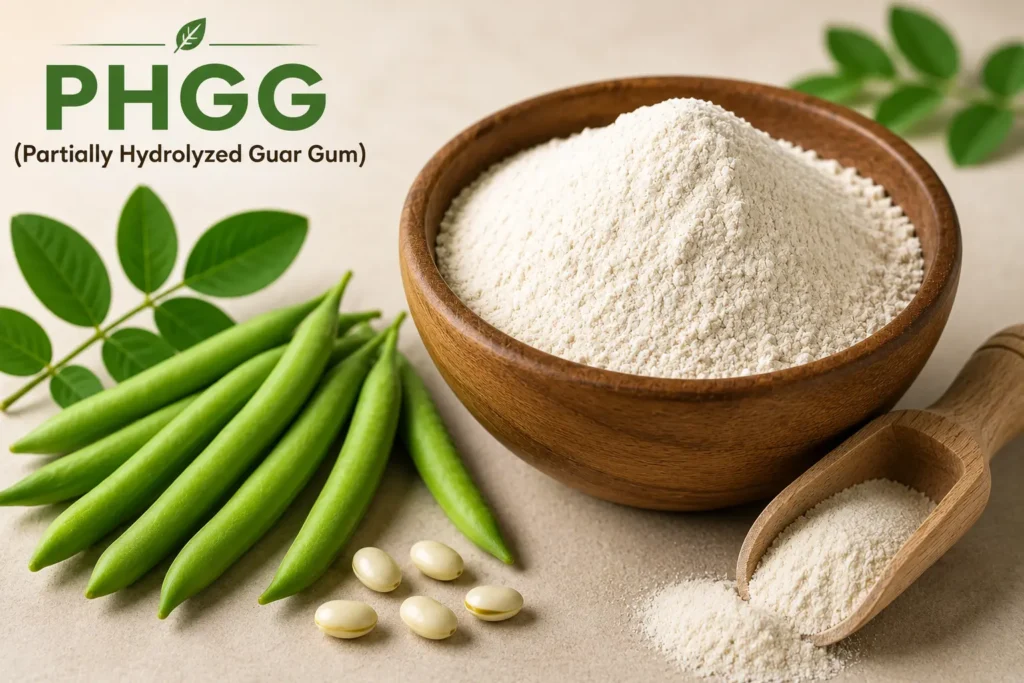
PHGG, or partially hydrolyzed guar gum, is a soluble fiber made by breaking down guar bean gum into much smaller, low-viscosity fragments. Unlike regular guar gum, which thickens into a heavy gel, PHGG dissolves clearly and is easy on digestion. It’s one of the more clinically studied fibers for irritable bowel syndrome (IBS), with research showing meaningful reductions in bloating and gas, along with prebiotic effects on gut bacteria, improved stool regularity, and support for post-meal blood sugar control. It’s sold as a standalone supplement (most notably under the brand Sunfiber) and used as a food ingredient because of its neutral taste and mild texture.
If IBS management is your main reason for researching fiber, our guide to the best fiber supplement for IBS covers how PHGG compares to other options built for that specific goal.
Table of Contents
What Is PHGG (Partially Hydrolyzed Guar Gum)?
Guar gum comes from the seeds of the guar plant (Cyamopsis tetragonoloba), a legume traditionally grown in India and Pakistan. In its natural form, guar gum is extremely viscous — it’s the same thickener used in salad dressings, yogurt, and gluten-free baking. That thick, gel-forming texture makes regular guar gum difficult to consume in fiber-supplement amounts and prone to causing significant bloating.
PHGG solves that problem through enzymatic hydrolysis: manufacturers use enzymes to break the long guar gum molecule chains down to roughly a tenth of their original size. The result is a fiber that keeps guar gum’s soluble fiber content but loses almost all of its viscosity. PHGG dissolves into a clear liquid, has no noticeable taste or smell, and is far better tolerated than the thickening agent it comes from.
The most recognized branded version is Sunfiber, which has been used in the majority of the published clinical research on PHGG, though generic and store-brand versions of partially hydrolyzed guar gum also exist.
How PHGG Works in the Body
PHGG’s effects come from a combination of gentle bulking and slow fermentation:
- It’s fermented gradually by gut bacteria. As PHGG reaches the colon, resident bacteria break it down slowly, producing short-chain fatty acids (SCFAs) and increasing populations of beneficial bacteria such as Lactobacilli and Bifidobacteria.
- It normalizes stool consistency in both directions. Unlike fibers that mainly treat constipation, PHGG has shown benefit for both constipation-predominant and diarrhea-predominant IBS in clinical trials, likely because it helps regulate transit time rather than simply adding bulk.
- It’s low viscosity but still soluble. This is the key distinction from regular guar gum. PHGG retains the water-holding, fermentable qualities of a soluble fiber without the thick gel texture that causes discomfort in concentrated doses.
- It may reduce visceral hypersensitivity. Some research, including animal studies, suggests PHGG and its fermentation byproducts may help calm gut motility disturbances and support the intestinal lining, which may partly explain its specific benefit for bloating and abdominal discomfort.
This mechanism is why PHGG shows up so often in IBS-focused research rather than general “daily fiber” marketing — its documented strength is specifically in reducing bloating, gas, and abdominal discomfort while still delivering fiber’s broader digestive and prebiotic benefits.
PHGG vs. Other Common Fiber Types
| Fiber Type | Viscosity | FODMAP Status | Best-Documented Use | Fermentation |
| PHGG | Very low | Low-FODMAP certified (Monash) | IBS symptom relief, bloating/gas reduction | Slow, gradual |
| Psyllium husk | High (gels) | Low-FODMAP in typical doses | Constipation, cholesterol | Slow to moderate |
| Inulin | Low | High-FODMAP | Prebiotic feeding | Fast |
| Acacia fiber | Low | Low-FODMAP | Gentle daily fiber | Slow |
| Wheat dextrin | Very low | Generally lower-FODMAP | Invisible daily fiber | Slow |
For comparison against fibers built for different goals, see our guides to psyllium husk, inulin fiber, and acacia fiber.
Benefits of PHGG (Partially Hydrolyzed Guar Gum)
Reduces bloating and gas in IBS. This is PHGG’s best-documented benefit. A randomized, placebo-controlled trial using 6 grams of PHGG daily for 12 weeks found a significant improvement in bloating and combined bloating-and-gas scores compared to placebo, with the effect lasting at least four weeks after stopping supplementation.
Improves stool regularity and consistency. Clinical research has shown that 5–10 grams of PHGG per day over 8–12 weeks improves stool regularity and consistency, with good tolerance even among people with IBS.
Works for both constipation and diarrhea-predominant IBS. Unlike many fibers that lean toward one direction, research has documented PHGG decreasing symptoms in both constipation-predominant and diarrhea-predominant forms of IBS, along with reduced abdominal pain and improved quality of life.
Supports beneficial gut bacteria. As a prebiotic fiber, PHGG has been shown to increase colonic short-chain fatty acids and populations of Lactobacilli and Bifidobacteria, both associated with a healthier gut environment.
May support healthier blood sugar and cholesterol. Because it shares its origin with regular guar gum, research has associated PHGG with reduced blood cholesterol and improved blood sugar control, along with a lower glycemic impact when consumed with meals.
Certified low-FODMAP. Sunfiber-brand PHGG carries Monash University Low-FODMAP certification, making it one of the few fiber supplements specifically vetted for people managing FODMAP sensitivity, a detail competitors covering PHGG often leave out despite it being one of the more useful, decision-relevant facts for IBS sufferers.
Well tolerated, even at therapeutic doses. Multiple clinical trials have reported no significant side effects associated with PHGG ingestion, including in populations sensitive to fiber-related digestive discomfort.
If cholesterol or blood sugar support is part of your goal alongside digestive comfort, our guide to the best fiber supplement for cholesterol puts PHGG’s evidence in context against other options.
Pros and Cons of PHGG
| Pros | Cons |
| Extensively studied specifically for IBS symptom relief | Fewer brands carry it compared to psyllium or inulin |
| Low viscosity — no thickening or gel texture | Full benefits generally take 8–12 weeks of consistent use |
| Certified low-FODMAP (Sunfiber brand) | Can be pricier per serving than generic fiber powders |
| Effective for both constipation and diarrhea-type symptoms | Derived from a legume — a consideration for legume allergies |
| Tasteless, odorless, easy to mix into food or drinks | Less brand recognition means more label-reading to confirm quality |
Types and Forms of PHGG Supplements
- Unflavored powder — the most common and researched form, dissolves into water, juice, coffee, or soft foods without changing taste or texture.
- Capsules — a less common but available option for people who prefer not to mix a powder.
- Food-fortified products — PHGG’s neutral taste means it’s increasingly used as an added-fiber ingredient in some packaged foods and beverages, similar to resistant dextrin.
If you’d rather compare fiber formats broadly before choosing a specific ingredient, see best fiber powder and fiber capsules.
How to Use PHGG Correctly
Start around 5 grams per day and adjust from there. Clinical trials generally used doses between 5 and 10 grams daily, with some studies using slightly lower amounts and still observing meaningful symptom improvement.
Be patient — this is a weeks-long commitment, not a same-day fix. The strongest clinical evidence for symptom improvement comes from 8- to 12-week trials. PHGG is a maintenance fiber, not an acute remedy.
Mix it into anything you’re already eating or drinking. Its lack of taste, smell, and thickening makes it one of the easier fibers to use consistently — stir it into coffee, water, soup, or oatmeal without noticing a difference.
Take it daily rather than sporadically. The prebiotic and IBS-symptom benefits documented in research depend on regular, sustained intake, not occasional use.
Combine with adequate water intake, as with any fiber supplement, to support how comfortably it moves through the digestive tract.
For more general guidance on integrating a new fiber into your routine, see how to choose a fiber supplement and when should I take fiber supplements.
Common Mistakes People Make With PHGG
- Expecting fast results. Because the clinical evidence is built on 8- to 12-week trials, judging PHGG after a few days undersells what it’s actually designed to do.
- Confusing PHGG with regular guar gum. Regular guar gum is highly viscous and can cause significant bloating in supplement-level amounts. PHGG is a specifically processed, low-viscosity version — they are not interchangeable for supplement purposes.
- Assuming any “guar gum” product is low-FODMAP. Only specific PHGG products, notably Sunfiber, carry Monash University Low-FODMAP certification. Not all guar-derived fiber products meet that standard.
- Stopping right when symptoms improve. Since research shows benefits can persist for weeks after stopping, some people quit too early and don’t realize maintenance intake is what sustains the effect long-term.
- Overlooking it for legume sensitivities. Guar is a legume. While PHGG is heavily processed, anyone with a legume allergy should check with a doctor before use.
Who Should Be Cautious With PHGG
- People with a known legume allergy, since guar is derived from a legume plant
- Anyone with a bowel obstruction or a condition requiring fluid restriction, since fiber supplements generally aren’t appropriate in those situations
- People starting any new fiber supplement while managing IBS, who may benefit from guidance on dose and timing from a gastroenterologist or dietitian, even though PHGG has one of the better safety profiles among fiber types studied for IBS
This is educational information, not medical advice. If you have a diagnosed digestive condition, are pregnant or breastfeeding, or are managing a chronic illness, talk to a doctor or registered dietitian before starting PHGG.
Side Effects of PHGG
Across the clinical research reviewed for this article, PHGG stands out for how consistently it’s reported as well tolerated:
Common (when reported):
- Mild, temporary bloating, generally less pronounced than with other fermentable fibers
- Occasional soft stools when starting
Notable finding: In the largest placebo-controlled IBS trial reviewed, researchers explicitly reported no significant side effects associated with PHGG ingestion, and dropout rates were actually higher in the placebo group than the PHGG group.
Rare:
- Allergic reaction in people with a legume sensitivity or guar allergy
Because PHGG is such a low-viscosity fiber, the choking or blockage risk associated with high-viscosity fibers taken without enough water is considered lower, though drinking adequate fluids is still good practice with any fiber supplement.
PHGG vs. Psyllium Husk for IBS
Since both are commonly recommended for IBS, a direct comparison helps clarify which fits which situation.
| Feature | PHGG | Psyllium Husk |
| Texture | Dissolves clear, no gel | Forms a thick gel |
| FODMAP status | Certified low-FODMAP (Sunfiber) | Generally low-FODMAP in typical doses |
| IBS subtype studied | Both constipation- and diarrhea-predominant | Primarily constipation-predominant |
| Onset of benefit | Gradual, over 8–12 weeks | Can be faster for regularity |
| Taste/texture tolerance | Very easy — tasteless and thin | Some find the gel texture unpleasant |
If you specifically deal with diarrhea-predominant symptoms or gel textures bother you, PHGG’s profile may fit better. If constipation and a faster bulking effect are the priority, psyllium remains the more established option. See psyllium husk side effects for a fuller comparison of tolerability.
Frequently Asked Questions
Is PHGG the same as Sunfiber? Sunfiber is the most widely researched and recognized brand of PHGG, but “PHGG” itself refers to the fiber type — partially hydrolyzed guar gum — regardless of brand.
How long does PHGG take to work? Clinical trials showing meaningful symptom improvement generally ran 8 to 12 weeks. Some people notice earlier changes in stool regularity, but the strongest evidence supports consistent use over a couple of months.
Is PHGG safe for people with IBS? Yes — it’s one of the more specifically studied fibers for IBS, with trial data showing improvement in bloating, gas, and abdominal discomfort with minimal reported side effects.
Is PHGG low-FODMAP? Sunfiber-brand PHGG is certified low-FODMAP by Monash University, making it one of the more IBS-friendly fiber choices on the market. Always check the specific product’s certification rather than assuming all guar-derived fibers qualify.
Can PHGG help with both constipation and diarrhea? Research suggests yes. Clinical trials have shown improvement in both constipation-predominant and diarrhea-predominant IBS symptoms, which is somewhat unusual compared to fibers that lean toward one direction.
Does PHGG cause gas like other fibers? Generally less than many fermentable fibers. Multiple trials have reported PHGG as well tolerated with minimal side effects, and its low viscosity likely contributes to easier digestion compared to more viscous fiber sources.
Is PHGG gluten-free? Yes. PHGG is derived from the guar plant, a legume, and contains no wheat or gluten-containing ingredients.
Final Verdict
PHGG occupies a genuinely useful niche among soluble fibers: it’s one of the few options with real clinical trial data specifically for IBS-related bloating, gas, and mixed bowel symptoms, backed by a certified low-FODMAP status that many competing fibers can’t claim. Its low viscosity and neutral taste make it easy to use consistently, which matters given that its benefits build over weeks rather than days.
It’s not the fastest-acting fiber for occasional constipation, and it isn’t as widely available as psyllium or wheat dextrin. But for people specifically managing IBS symptoms or looking for a gentle, well-tolerated daily fiber backed by real research, PHGG is one of the stronger evidence-based choices available.
To see how PHGG fits into a broader IBS management plan, visit our guides to best fiber supplement for IBS and best fiber supplement for bloating.