
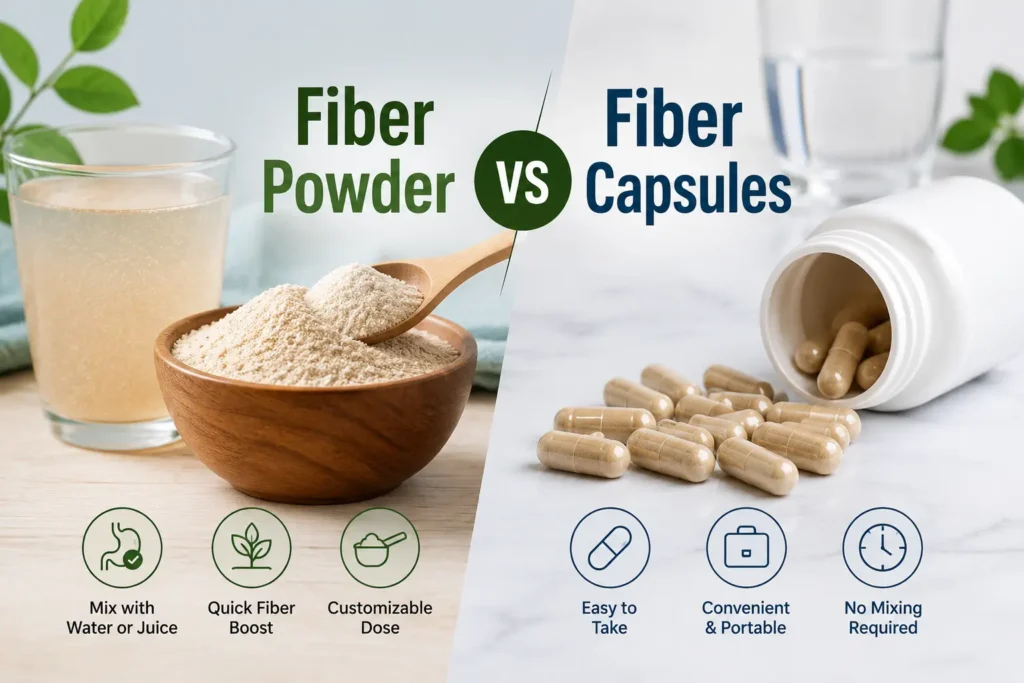
Fiber powder and fiber capsules can contain the exact same fiber — often psyllium husk — so the ingredient itself isn’t usually what’s different. The real difference is dose per serving. A typical teaspoon of fiber powder delivers around 3 to 5 grams of fiber, while a single capsule usually delivers only 0.4 to 0.75 grams. That means it can take 7 to 10 capsules to match one powder serving, which most people don’t realize until they’re already refilling the bottle far faster than expected.
If your main goal is convenience and you don’t mind taking several capsules at once, capsules work fine. If your goal is reaching a specific clinical dose — for cholesterol support, for example — powder is almost always the more practical way to get there.
Table of Contents
Fiber Powder vs Fiber Capsules: The Fast Comparison
| Feature | Fiber Powder | Fiber Capsules |
| Fiber per serving | ~3–5 g per teaspoon/scoop | ~0.4–0.75 g per capsule |
| Pills/servings to match a typical dose | 1 scoop | 7–10 capsules |
| Mixing required | Yes — must be stirred into liquid | No — swallow with water |
| Taste/texture | Varies by ingredient; psyllium thickens into a gel | None — no taste, no texture |
| Portability | Bulkier, needs water and a container | Easy to carry and take anywhere |
| Cost per gram of fiber | Generally lower | Generally higher |
| Best for reaching clinical doses (e.g., cholesterol) | Yes — practical at recommended amounts | Difficult — often requires many capsules daily |
| Best for simple daily convenience | Less convenient | More convenient |
This table answers the question most people actually have but rarely see spelled out: how many capsules does it really take to equal one scoop of powder?
What Is Fiber Powder?
Fiber powder is a fiber supplement — psyllium husk, wheat dextrin, methylcellulose, inulin, acacia, and others are all sold this way — designed to be mixed into water, juice, or a smoothie before drinking. Because it’s measured by the scoop or teaspoon, powder allows for a relatively concentrated dose of fiber in a single serving.
The tradeoff is texture. Gel-forming fibers like psyllium husk need to be stirred quickly and consumed right away, before they thicken. Non-gel fibers like wheat dextrin or methylcellulose mix more invisibly, but powder in general still requires measuring, mixing, and drinking with a full glass of water.
What Are Fiber Capsules?
Fiber capsules contain the same active fiber ingredients as powders, just compressed or encapsulated into a pre-measured pill. You swallow them with water instead of mixing anything, which is the main appeal — no texture, no taste, no prep.
The tradeoff is dose. Because a capsule can only hold so much material, each one delivers a relatively small amount of fiber compared to a scoop of powder. A typical psyllium capsule contains roughly 500 to 750 mg of psyllium husk, while a standard powder serving is closer to 5 grams. That means matching one powder dose often requires 7 to 10 capsules, not just 1 or 2.
The Core Difference: It’s About Dose, Not Ingredient Quality
This is the single most important thing most comparison articles skip. Fiber powder and fiber capsules aren’t usually different fibers — they’re the same fiber in different delivery formats. What actually changes is how much of that fiber you get per serving.
- Powder concentrates a meaningful dose (often 3–5 grams) into one scoop, making it easier to hit specific targets, like the amounts used in cholesterol research.
- Capsules spread that same total dose across many small pills, which is convenient to swallow but means the “one capsule” mental model most people have is misleading.
This is why some people take “a couple of fiber pills” expecting the same effect as a full powder serving and don’t understand why they’re not seeing results — they may be getting a fraction of the dose they think they are.
For the ingredient-level details behind this, see our guide to psyllium husk dosage.
Effectiveness: Are They Equally Good?
When the total fiber dose is actually matched, capsules and powder of the same fiber type generally deliver comparable benefits — there’s no evidence that the capsule format itself makes the fiber less effective once you account for quantity.
The practical problem is that most people don’t do that math. Someone switching from “2 teaspoons of powder daily” to “I’ll just take a couple of capsules instead” is very likely taking a much smaller total dose than before, even though it feels like an equivalent swap.
Practical takeaway: capsules aren’t inferior fiber — they’re just a smaller unit of measurement. If you want capsule convenience without underdosing, you need to know the milligrams of fiber per capsule and do the math against your target dose, not just count pills.
For dose-specific goals like cholesterol or constipation, see best fiber supplement for cholesterol and best fiber supplement for constipation.
Convenience, Taste, and Real-World Usability
Powder requires a scoop, a glass, mixing, and drinking promptly — especially with gel-forming fibers. This isn’t difficult, but it’s a routine that doesn’t travel well and can be easy to skip when you’re busy or away from home.
Capsules solve all of that. There’s no taste, no texture, no mixing, and they travel easily in a bag or pocket. For people who find powder textures unpleasant or who need something portable for work trips and travel, capsules remove the biggest barrier to consistent daily use.
Practical takeaway: if the reason you’ve struggled to stick with a fiber supplement in the past is texture or inconvenience, capsules solve that problem directly — you just need to take enough of them.
Cost Comparison
Fiber powder is generally the more cost-effective option per gram of fiber, since you’re paying for bulk material rather than the manufacturing and packaging that goes into individual capsules. Capsules typically cost more per gram of actual fiber delivered, which becomes more noticeable once you factor in that you may need 7 to 10 capsules to match a single powder serving.
Practical takeaway: if cost matters and you don’t mind mixing a drink, powder stretches your budget further for the same total fiber intake.
A Better Decision Framework Than “Just Pick One”
Run through these four questions:
1. Are you trying to hit a specific clinical dose (like 7+ grams daily for cholesterol)?
- Yes → Powder is the more practical way to get there without swallowing a handful of pills.
- No, just general fiber support → Either form works.
2. Is taste or texture the main reason you’ve quit fiber supplements before?
- Yes → Capsules remove that barrier entirely.
- No, texture doesn’t bother you → Powder is usually more cost-effective.
3. Do you travel often or need something portable?
- Yes → Capsules are easier to carry and take without water prep.
- No, you’re mostly at home → Powder is just as convenient in that setting.
4. Is cost per gram of fiber a priority?
- Yes → Powder generally costs less per gram.
- Not a major factor → Choose based on convenience and taste preference instead.
Common Mistakes People Make With Either Form
- Assuming “a few capsules” equals “a scoop of powder.” This is the most common and consequential mistake — it can lead to significantly underdosing fiber without realizing it.
- Not checking the milligrams per capsule on the label. Capsule fiber content varies by brand; some deliver more per pill than others, so the “7 to 10 capsules” estimate is a general guide, not a universal number.
- Not drinking enough water with capsules. People sometimes assume capsules don’t need the same water intake as powder, but adequate fluid still matters for how fiber works in the digestive tract.
- Expecting powder to taste like plain water. Flavored powders are common, but unflavored versions of gel-forming fibers do have a noticeable texture; going in with that expectation avoids disappointment.
- Switching forms without adjusting the dose. If you switch from powder to capsules (or vice versa), recalculate your total daily fiber intake rather than assuming a 1-to-1 swap.
Frequently Asked Questions
How many fiber capsules equal one scoop of powder? It depends on the brand, but for psyllium husk specifically, it typically takes about 7 to 10 capsules to match one standard powder serving (roughly 5 grams of fiber). Always check the milligrams per capsule on the label to calculate your specific brand’s equivalent.
Is fiber powder more effective than fiber capsules? Not inherently — when the total fiber dose is matched, both forms generally work the same way. The practical issue is that capsules make it easy to underdose without realizing it, since each pill contains a relatively small amount of fiber.
Which is better for cholesterol management, powder or capsules? Powder is usually more practical for reaching clinical cholesterol-lowering doses, since most trials use amounts in the 5 to 10 gram range daily — a dose that would require a large number of capsules to match.
Do fiber capsules need to be taken with water? Yes. Fiber, regardless of form, works by absorbing water in the digestive tract. Capsules should be taken with a full glass of water, the same as powder.
Is one form better for gas or bloating? The fiber ingredient itself, not the format, determines gas risk. A gel-forming fiber like psyllium behaves the same way whether it’s swallowed as a capsule or mixed as a powder; fermentable fibers like inulin behave the same either way too.
Can I switch between powder and capsules of the same fiber? Yes, as long as you match the total grams of fiber rather than assuming the same number of “doses.” Recalculating based on the label is the safest way to avoid an accidental increase or decrease in your intake.
Final Verdict
Fiber powder and fiber capsules usually contain the same active fiber — the real difference is how concentrated that fiber is per serving. Powder delivers a larger, more clinically relevant dose in one scoop, making it the more practical choice for specific health goals like cholesterol management. Capsules deliver a much smaller amount per pill, but they remove the taste, texture, and mixing hassle that stops some people from taking fiber consistently.
If you’re chasing a specific dose or want the most cost-effective option, powder is generally the better fit. If convenience and portability matter more than precision, capsules work well, as long as you take enough of them to actually reach your intended dose. For more on choosing the right form and ingredient together, see best fiber powder, best fiber pills, or how to choose a fiber supplement.
This article is for educational purposes only and does not replace personalized medical advice. Talk to a healthcare provider before starting any new supplement, especially if you have a diagnosed digestive condition or take regular medication.