
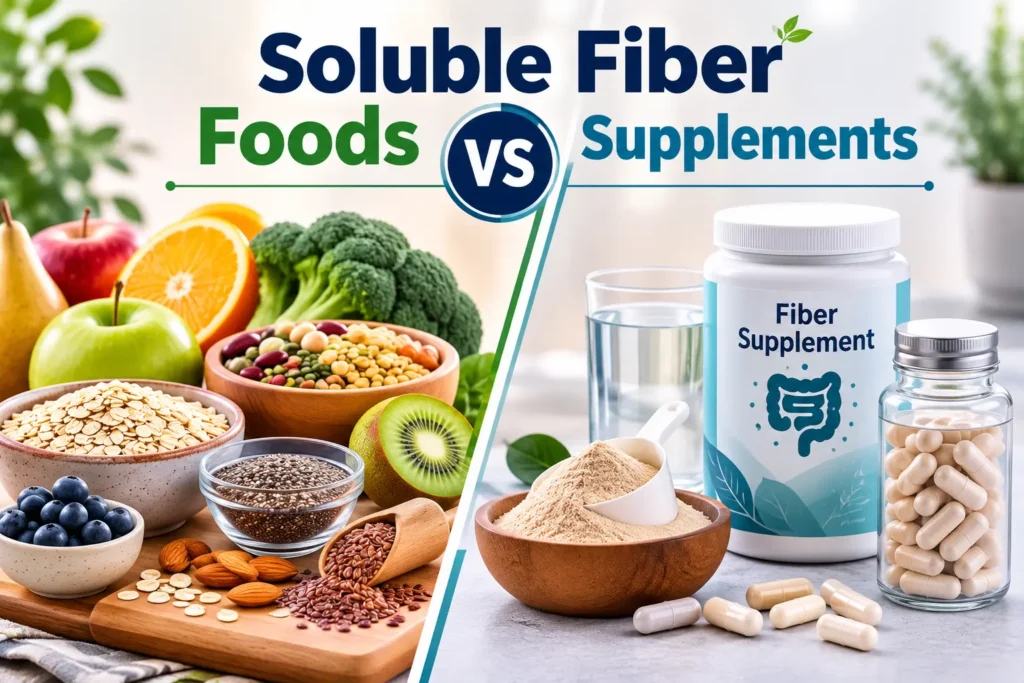
Soluble Fiber Foods vs Supplements: Soluble fiber foods—oats, beans, avocado, Brussels sprouts, and apples—deliver fiber alongside vitamins, minerals, antioxidants, and other plant compounds that work together in ways a supplement can’t fully replicate. Soluble fiber supplements, like psyllium husk, give you a precise, concentrated, easy-to-track dose without added calories or prep. Most people don’t need to pick one permanently. The most realistic approach is building your diet around fiber-rich foods first, then using a soluble fiber supplement to close the gap on days your diet falls short, since most adults still fall well below their daily fiber target even when they’re trying.
Neither option is “wrong.” The right mix depends on how consistent your diet already is, whether you have a specific medical target to hit, and how much effort you’re realistically willing to put into meal planning.
Table of Contents
Why This Question Actually Matters
Search “soluble fiber foods vs supplements” and most results give you a flat answer: food is better, full stop. That’s true in a general sense, but it skips the more useful question — better for what, exactly, and is it realistic for your actual week?
A supplement can outperform food on precision and consistency. A diet built around real food can outperform a supplement on the broader health outcomes tied to fiber, because whole foods bring more to the table than fiber alone. This guide walks through both sides honestly, with the numbers competitors tend to leave out.
What Is Soluble Fiber, Quickly
Soluble fiber dissolves in water and forms a thick gel in your digestive tract. That gel slows digestion, which helps smooth out blood sugar spikes, softens stool for easier bowel movements, and binds to bile acids in a way that can lower LDL (“bad”) cholesterol over time.
It’s different from insoluble fiber, which doesn’t dissolve and instead adds bulk that helps move waste through the gut. Most plant foods contain a mix of both types, just in different ratios — see our full breakdown of soluble vs insoluble fiber if you want the complete picture.
Soluble Fiber From Food: What You’re Actually Getting
Whole foods rarely give you soluble fiber in isolation. An apple isn’t just fiber — it’s fiber plus vitamin C, potassium, and polyphenols that appear to work together in ways researchers are still mapping out. That combination is the core argument for a food-first approach: the fiber and the surrounding nutrients seem to produce better long-term outcomes than fiber alone.
Soluble fiber content of common foods:
| Food | Serving | Soluble fiber |
| Black beans, cooked | ¾ cup | ~5.4 g |
| Lima beans, cooked | ¾ cup | ~5.3 g |
| Brussels sprouts, cooked | 1 cup | ~4 g |
| Avocado | ½ avocado | ~2.1 g |
| Sweet potato, cooked | ½ cup | ~1.8 g |
| Oats, cooked | ¾ cup | ~1.9 g |
| Pear | 1 medium | ~1.5 g |
| Broccoli, cooked | ½ cup | ~1.5 g |
| Apple | 1 medium | ~1 g |
| Flaxseed, ground | 1 tbsp | ~1 g |
Values are approximate and vary by preparation method and variety.
The practical takeaway: a single meal built around beans, oats, or Brussels sprouts can realistically deliver 4 to 6 grams of soluble fiber, and a full day of varied plant foods can get most people to a meaningful soluble fiber intake without any supplement at all — provided the meals actually happen.
Soluble Fiber Supplements: What You’re Actually Getting
Fiber supplements isolate one type of fiber and deliver it in a known, fixed amount. Psyllium husk is the clearest example: it’s almost entirely soluble fiber, and a single tablespoon of whole psyllium husk provides roughly 5 grams of soluble fiber — more concentrated than nearly any single food source.
That precision is the whole appeal. You know exactly how much you’re getting, it doesn’t depend on your cooking that day, and it travels well. The tradeoff is that you’re getting fiber and little else — no vitamins, no antioxidants, none of the “food matrix” effects nutrition researchers increasingly point to when explaining why whole-food eating patterns outperform isolated-nutrient approaches in long-term studies.
Supplements also aren’t limited to psyllium. Inulin, acacia fiber, oat fiber, and glucomannan are other common soluble fiber sources used in powders, capsules, and gummies, each with slightly different effects on gas, gel strength, and fermentation speed.
Side-by-Side Comparison
| Factor | Soluble Fiber Foods | Soluble Fiber Supplements |
| Nutrient package | Fiber + vitamins, minerals, antioxidants | Fiber only, isolated |
| Dosing accuracy | Estimated, varies by preparation | Precise, labeled per serving |
| Convenience | Requires planning, cooking, prep | Fast, portable, minimal effort |
| Calorie load | Comes with food calories | Often low to zero calories |
| Long-term research | Strong links to lower chronic disease risk | Strong evidence for specific outcomes (e.g., psyllium and cholesterol) |
| Cost | Varies, often lower per gram for staples like oats and beans | $0.15–$0.65 per serving depending on form |
| Best for | Building a sustainable, well-rounded diet | Closing a specific fiber gap or hitting a therapeutic dose |
| Consistency risk | Depends on meal planning | Depends on remembering to take it |
Where Supplements Genuinely Win
It’s worth being fair here, because “food is always better” oversimplifies a real tradeoff.
- Predictable dosing. If a healthcare provider recommends a specific gram target — say, 7 to 10 grams of psyllium daily for cholesterol support — a supplement makes that target easy to hit consistently. Matching that exact number from food alone, every day, is harder than it sounds.
- Travel and busy schedules. A capsule or a scoop of powder takes seconds. A fiber-rich meal takes planning, shopping, and time you may not always have.
- Specific digestive symptoms. For people managing constipation or IBS, a concentrated, gel-forming fiber like psyllium can be easier to titrate carefully than trying to eat your way to the same effect. See our guide to the best fiber supplement for IBS for more on this.
- Low appetite or restrictive diets. Some people, including many older adults, simply can’t eat the volume of food needed to hit fiber targets. A supplement fills a real gap here — see best fiber supplement for seniors.
Where Food Genuinely Wins
- Broader health outcomes. Fiber intake from whole plant foods is consistently linked to lower rates of heart disease, type 2 diabetes, and certain cancers in long-term population studies — associations that are harder to demonstrate for isolated fiber supplements alone.
- A mix of fiber types. Most fiber-rich foods provide both soluble and insoluble fiber together, along with resistant starch in some cases. Supplements almost always isolate a single fiber type, so relying on them exclusively can leave other fiber types underrepresented.
- Micronutrients you’d otherwise miss. A cup of beans doesn’t just add fiber — it adds folate, potassium, iron, and plant protein. A capsule doesn’t replace any of that.
- Satiety and appetite regulation. Whole foods add volume and chewing time, both of which play into fullness in ways a small supplement dose typically doesn’t match.
Common Mistakes People Make
- Assuming a supplement replaces a healthy diet. A fiber capsule fills a gap; it doesn’t substitute for the broader nutritional value of fruits, vegetables, whole grains, and legumes.
- Not tracking actual soluble fiber intake from food. Total fiber and soluble fiber aren’t the same number — a food can be “high fiber” on the label while being mostly insoluble.
- Increasing intake too quickly from either source. Sudden jumps in fiber, whether from a bean-heavy dinner or a full supplement dose, are the most common cause of gas and bloating. Increase gradually and drink enough water.
- Choosing a supplement based on marketing instead of the fiber type inside. Not all fiber supplements behave the same way in the gut — check our guide on types of dietary fiber ingredients before choosing one.
- Ignoring food entirely once a supplement is added. The goal of a supplement should be closing a gap, not becoming the only fiber source in your day.
Decision Framework: Which Should You Choose?
- Your diet is already fairly consistent, with regular meals including produce, whole grains, and legumes → You likely don’t need a daily supplement; focus on maintaining variety.
- You have a specific health target (cholesterol, blood sugar, constipation) recommended by a provider → A measured supplement dose, most often psyllium, makes hitting that target far more reliable than food alone.
- You struggle to eat consistently due to a busy schedule, low appetite, or dietary restrictions → A supplement is a practical way to avoid falling far short, while you build better food habits over time.
- You want the broadest long-term health benefit and have the time to plan meals → Prioritize soluble fiber foods and treat a supplement as a backup, not a replacement.
- You’re not sure which fiber type fits your symptoms → Start with our guide on how to choose a fiber supplement.
Frequently Asked Questions
Can a soluble fiber supplement fully replace fiber-rich foods? Not for overall health. Supplements deliver isolated fiber, while whole foods provide fiber alongside vitamins, minerals, and plant compounds linked to broader long-term health benefits. Supplements are best used to close a gap, not as a full substitute for a fiber-rich diet.
Is it safe to take a soluble fiber supplement every day? For most healthy adults, yes, when taken as directed and with adequate water. People with certain digestive conditions, or those taking medications that fiber can interfere with absorption of, should check with a healthcare provider first.
Which soluble fiber source is best for lowering cholesterol, food or supplements? Both can help. Oats and other soluble-fiber foods have a recognized cholesterol-lowering effect at consistent intake, and psyllium husk supplements have similarly strong evidence, including an FDA-authorized heart health claim at higher daily doses.
Why do I get more bloating from supplements than from food? It often comes down to dose and speed, not source. A concentrated supplement delivers several grams of fiber in one moment, which can hit the gut harder than the same amount spread across food eaten throughout the day. Starting with a smaller dose and increasing gradually usually helps.
How much soluble fiber do I actually need per day? There’s no single official target for soluble fiber alone, but most guidance suggests soluble fiber should make up a meaningful portion of your total daily fiber intake, which falls between roughly 25 and 38 grams for most adults, depending on age and sex.
Are soluble fiber supplements only useful for people with a poor diet? No. Even people who eat well can benefit from a supplement when they need a specific, higher gram target for a health goal, or when travel, appetite changes, or a busy stretch make consistent food-based fiber harder to maintain.
Final Verdict
Soluble fiber foods and soluble fiber supplements aren’t really competing for the same job. Food builds the foundation — variety, micronutrients, and the broader health benefits tied to real eating patterns. Supplements fill in the gaps with precision when food alone doesn’t consistently get you where you need to be.
If you’re choosing one approach to lean on daily, prioritize food. If you have a specific gram target to hit, a busy schedule, or a digestive symptom that needs a more predictable dose, a supplement like psyllium is a reasonable, well-supported addition rather than a replacement. For most people, the most effective plan is both: real food as the base, and a fiber supplement as backup on the days that base falls short.
This article is for educational purposes only and is not a substitute for medical advice. Talk to a healthcare provider before starting any new supplement, especially if you take other medications or have a digestive condition.