
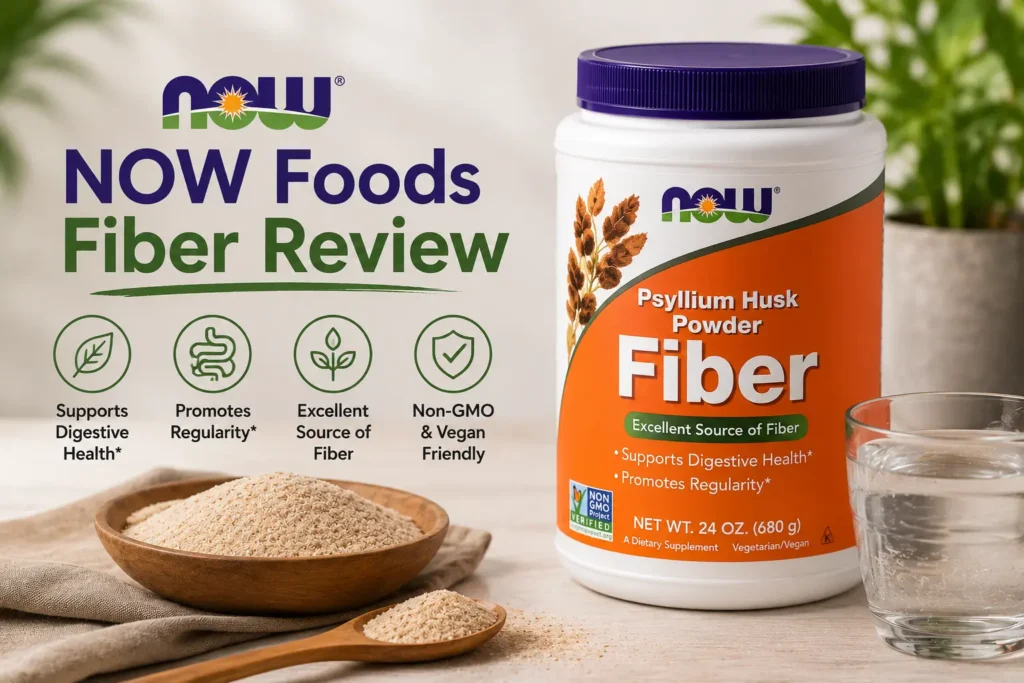
NOW Foods makes several fiber products, but its two most relevant are Psyllium Husk Powder (a single-ingredient soluble fiber) and Apple Fiber Pure Powder (a mostly insoluble fiber from apple pomace). Both are simple, additive-free, and priced lower than most name-brand competitors, but they trade convenience for a plainer experience — no flavoring, no fillers, and a texture that takes some getting used to. This review covers both, tells you which one fits which goal, and where NOW’s fiber line falls short.
Most searches for “NOW Foods fiber review” are really about one specific product — NOW Psyllium Husk Powder — since it’s the company’s flagship fiber supplement and the one most frequently compared to Metamucil. But NOW also sells psyllium in capsule and whole-husk form, plus a completely different fiber, Apple Fiber Pure Powder, that gets confused with psyllium by first-time buyers. This guide breaks down what NOW actually offers, what’s in each product, and which one (if any) is the right fit for you.
Table of Contents
What Is NOW Foods, and What Fiber Products Do They Sell?
NOW Foods (also sold as NOW Supplements) is a family-owned supplement manufacturer that has been operating since 1968, known for stripped-down, no-frills formulas at a lower price point than most competing brands. Its fiber lineup includes:
- Psyllium Husk Powder — finely ground psyllium seed husk, available in regular and certified organic versions
- Whole Psyllium Husks — the same fiber source but coarsely ground rather than powdered
- Psyllium Husk Caps — 500 mg vegetable capsules for people who don’t want to mix a powder
- Apple Fiber, Pure Powder — ground apple pomace (the fibrous leftover material from pressing apples), delivering a mostly insoluble fiber with a small amount of natural apple pectin
This review focuses mainly on the powder version of psyllium husk, since it’s the product most people mean when they search “NOW Foods fiber review,” with a full comparison against Apple Fiber further down.
NOW Foods Psyllium Husk Powder: What’s Inside
The ingredient list is about as short as it gets: Psyllium (Seed Husk) — full stop. The organic version simply swaps in Certified Organic Psyllium. There’s no added stevia, no flavoring, no anti-caking agent, and no fillers, which is unusual even among competitors who otherwise market themselves as “clean.”
Supplement Facts (per 1 tablespoon, ~7g)
| Nutrient | Amount |
| Calories | ~20-25 |
| Total Fiber | 6g soluble fiber |
| Other Ingredients | None (organic version: none) |
| Allergens | May contain traces of sesame; produced in a facility that also processes wheat, soy, milk, egg, fish, shellfish, and tree nuts |
Psyllium husk is almost entirely soluble fiber. When it hits liquid, it absorbs water and swells to many times its original volume, forming a thick gel. That’s the mechanism behind both its main benefit (softer, easier-to-pass stool and a heart-health effect tied to soluble fiber) and its main downside (it can feel gluey if you don’t drink it fast enough).
How Psyllium Husk Works
Psyllium’s gel-forming action does two things at once. In the intestines, it adds soft, bulky mass that makes stool easier to pass — useful for both constipation and, at controlled doses, loose stool, since it can absorb excess water in the gut. Separately, that same soluble fiber binds to cholesterol-carrying bile acids in the digestive tract, which is the basis for the FDA-recognized heart health claim printed on the label: soluble fiber from psyllium, as part of a diet low in saturated fat and cholesterol, may reduce the risk of heart disease.
This isn’t just marketing language. Psyllium’s fiber type, arabinoxylan, has been studied specifically for this effect. A Stanford Medicine study tracking how different fibers affect the body found that <cite index=”54-1″>higher arabinoxylan intake was linked to a reduction in LDL, or “bad,” cholesterol for many participants</cite>, and that this effect appeared to be <cite index=”54-1″>driven by how the gut microbiome responded to the fiber</cite>. The same research is a useful reality check, though: <cite index=”54-1″>the researchers found that individual responses to fiber varied significantly from person to person</cite>, so results with any fiber supplement, psyllium included, aren’t guaranteed to look the same for everyone.
Benefits of NOW Psyllium Husk Powder
- Single ingredient, no additives. For people trying to avoid stevia, natural flavors, or gums found in flavored fiber products, this is about as clean as fiber supplements get.
- Strong soluble fiber dose. At 6g of soluble fiber per tablespoon, it delivers close to the full 7g/day threshold associated with cholesterol benefits in one serving.
- Lower cost per serving than flavored, brand-name psyllium products.
- Format flexibility. Available as fine powder, whole husk, or capsules depending on your preference for texture and convenience.
- Non-GMO Project Verified, and the organic line is Certified Organic.
Drawbacks
- Gels fast. Multiple users report that if you don’t drink it within a minute or two of stirring, it thickens into something closer to a pudding than a drink.
- Texture and taste are polarizing. With nothing to mask the flavor, some people find it earthy or “grassy,” and the fine powder version in particular can feel slippery going down.
- Choking risk if underdosed on liquid. Like all psyllium products, it must be taken with enough liquid — the label specifically warns against taking it without at least 12 oz of water or juice, and people with swallowing difficulties should avoid it entirely.
- No flavor options. If you strongly dislike the taste of plain psyllium, there’s no built-in way around it — you’ll need to blend it into juice or a flavored drink yourself.
- Needs a gradual ramp-up. Jumping to a full dose right away is a common cause of gas and bloating with this fiber type.
Pros & Cons at a Glance
| Pros | Cons |
| Single-ingredient, no additives or sweeteners | Gels quickly — must be drunk right after mixing |
| 6g soluble fiber per tablespoon | Plain, earthy taste with no flavor options |
| Available as powder, whole husk, or capsules | Requires drinking with plenty of water to avoid choking risk |
| Non-GMO Project Verified; organic option available | Can cause gas/bloating if increased too quickly |
| Budget-friendly per-serving cost | Not suitable for anyone with swallowing difficulties |
NOW Foods Psyllium Husk vs. NOW Foods Apple Fiber
This is a comparison most competitor pages skip entirely, and it matters because these two NOW products solve different problems despite both being labeled “fiber.”
| Feature | Psyllium Husk Powder | Apple Fiber, Pure Powder |
| Fiber type | ~100% soluble | 25% soluble / 75% insoluble |
| Fiber per serving | 6g (1 tbsp) | 5g (1 tbsp) |
| Texture in liquid | Gels into a thick, drinkable mass if consumed quickly | Doesn’t dissolve well; sits on top of liquid, better mixed into food |
| Taste | Plain, earthy, no flavor masking | Mild natural apple flavor and light sweetness |
| Primary effect | Softens stool, supports cholesterol levels | Adds bulk, supports regularity |
| Best for | People wanting a strong soluble-fiber, heart-health-focused supplement | People who want a milder-tasting fiber to blend into food, or a mostly insoluble option |
| Choking caution | Yes — must drink promptly with enough liquid | Lower risk, but still needs adequate fluid |
In practice: if your priority is cholesterol support or classic psyllium-style bulk-forming relief, the Psyllium Husk Powder is the more clinically-backed option. If you dislike psyllium’s texture or want something to stir into oatmeal, rice, or a smoothie without drinking it as a beverage, Apple Fiber is the gentler-tasting alternative — though its insoluble-heavy profile makes it less suited for the heart-health angle. For a deeper breakdown of the fiber type itself, see our guides on apple pectin and psyllium husk powder.
What Real Users Say
Reviews across retailers show a consistent split. People who follow the “mix and drink immediately” instruction tend to report good results with minimal complaints — regularity improves, and several mention it working better than Metamucil for gas and bloating specifically. People who let it sit, or who try to sip it slowly, report a gluey, unpleasant texture that’s hard to get down.
For Apple Fiber, the pattern is different: users consistently say it doesn’t dissolve well in water and is much better folded into yogurt, oatmeal, or a smoothie, but the mild apple flavor gets more positive mentions than the plain-tasting psyllium powder does.
A recurring theme across both product lines, and worth calling out since most reviews don’t: NOW’s pricing is a genuine differentiator. A 24 oz container of the Psyllium Husk Powder typically runs well under a dollar per ounce, meaningfully cheaper per serving than flavored, brand-name fiber powders — the trade-off being that you’re buying the plain ingredient with none of the flavoring infrastructure built in.
Who NOW Psyllium Husk Powder Is a Good Fit For
- Anyone who wants a no-additive, single-ingredient fiber supplement
- People specifically targeting the cholesterol-related benefits of soluble fiber
- Budget-conscious buyers who don’t need flavoring
- People comfortable mixing and drinking a supplement quickly, rather than sipping it slowly
Who Should Consider a Different Option
- Anyone who dislikes the taste or texture of plain psyllium and won’t reliably drink it fast enough — a flavored option may lead to better long-term consistency; see our psyllium husk vs. Metamucil comparison
- People with a history of swallowing difficulties or esophageal narrowing, who should avoid psyllium products altogether and speak with a doctor about alternatives
- Anyone wanting a primarily insoluble fiber for bulk rather than soluble fiber for cholesterol support — worth comparing against insoluble fiber supplement options
- People who prefer capsules over powder — NOW’s own psyllium husk capsules avoid the mixing step entirely, as does our broader fiber capsules guide
How to Use It
The label directs adults to vigorously mix one level tablespoon into at least 12 oz of water or juice and drink it right away, followed by additional fluids throughout the day. Starting with a smaller amount — roughly half the suggested dose — and increasing gradually over one to two weeks is the label’s own recommendation, and it’s the single most effective way to avoid the gas and bloating that come with any sudden fiber increase.
For Apple Fiber, the same “mix and drink quickly” instruction applies for the water-based method, though most users get better results stirring it into food instead. See our guide on when should I take fiber supplements for timing relative to meals and medications.
Common Mistakes People Make With This Product
- Sipping it slowly instead of drinking it right after mixing. This is the single biggest cause of the “gluey” complaints in reviews — psyllium gels within minutes.
- Not drinking enough water. The product’s own warning label is explicit about this: insufficient liquid intake can cause the fiber to swell in the throat.
- Jumping straight to a full tablespoon. Starting low and increasing slowly avoids most of the early bloating people report.
- Buying psyllium when they actually wanted a bulking, mild-tasting fiber — Apple Fiber or a comparable oat fiber product would likely be a better fit for that goal.
- Assuming all NOW fiber products work the same way. Psyllium and apple fiber have very different soluble-to-insoluble ratios and serve different purposes.
Frequently Asked Questions
Is NOW Foods Psyllium Husk Powder good quality? Yes — it’s a single-ingredient product (just psyllium seed husk), Non-GMO Project Verified, and the organic version is certified organic. The main quality trade-off isn’t purity, it’s convenience: there’s no flavoring or format engineering to make it easier to drink.
How does NOW Psyllium Husk Powder compare to Metamucil? Both use psyllium as the active fiber source. NOW’s version is unflavored and unsweetened, while Metamucil is typically flavored and sometimes contains added sugar or sweeteners. NOW tends to cost less per serving, but Metamucil’s flavoring makes it easier for some people to drink consistently. See our full psyllium husk vs. Metamucil breakdown.
Does NOW Foods Apple Fiber count as the same thing as psyllium? No. Apple Fiber is a different fiber source made from apple pomace, and it’s mostly insoluble fiber (about 75%), while psyllium is almost entirely soluble fiber. They support digestion in different ways and aren’t interchangeable if you’re targeting a specific benefit like cholesterol support.
Can NOW psyllium husk cause bloating? It can, especially if you start with a full dose right away. Ramping up gradually and drinking plenty of water throughout the day significantly reduces this risk, which is consistent with how most soluble fiber supplements behave.
Is NOW Foods fiber safe to take every day? For most healthy adults, yes, when taken as directed with adequate fluids. As with any fiber supplement, check with a doctor first if you have a swallowing disorder, a bowel obstruction, or are on medications that fiber can interfere with absorption of, since psyllium should generally be taken a couple of hours apart from other medications.
Which NOW fiber product should I start with? If your main goal is regularity and heart-health-related soluble fiber, start with the Psyllium Husk Powder or Caps. If you dislike psyllium’s texture or want a milder-tasting option to blend into food, Apple Fiber Pure Powder is the better starting point.
Final Verdict
NOW Foods’ fiber line delivers exactly what it promises: simple, single-ingredient fiber supplements at a lower price than most competitors, without flavoring or fillers to soften the experience. The Psyllium Husk Powder is a genuinely solid, research-backed choice for soluble fiber and cholesterol support, provided you’re willing to drink it quickly after mixing and build up your dose gradually. Apple Fiber is a useful, milder-tasting alternative for people who want a mostly insoluble fiber to stir into food rather than drink.
Where NOW falls short is convenience — there’s no flavored version, no gummy or capsule-first marketing, and the plain taste isn’t for everyone. If you know you need the reliability of a flavored, easy-to-take product to stay consistent, it’s worth comparing this against our best psyllium husk roundup. But for anyone comfortable with a straightforward, no-extras supplement and looking to save money per serving, NOW Foods’ fiber products are a dependable, well-priced option.
For more on choosing between fiber types generally, see our guides on soluble vs. insoluble fiber and how to choose a fiber supplement.
This article is for educational purposes only and is not medical advice. Talk to your doctor before starting any new supplement, especially if you’re pregnant, nursing, on medication, or managing a digestive or swallowing condition.