
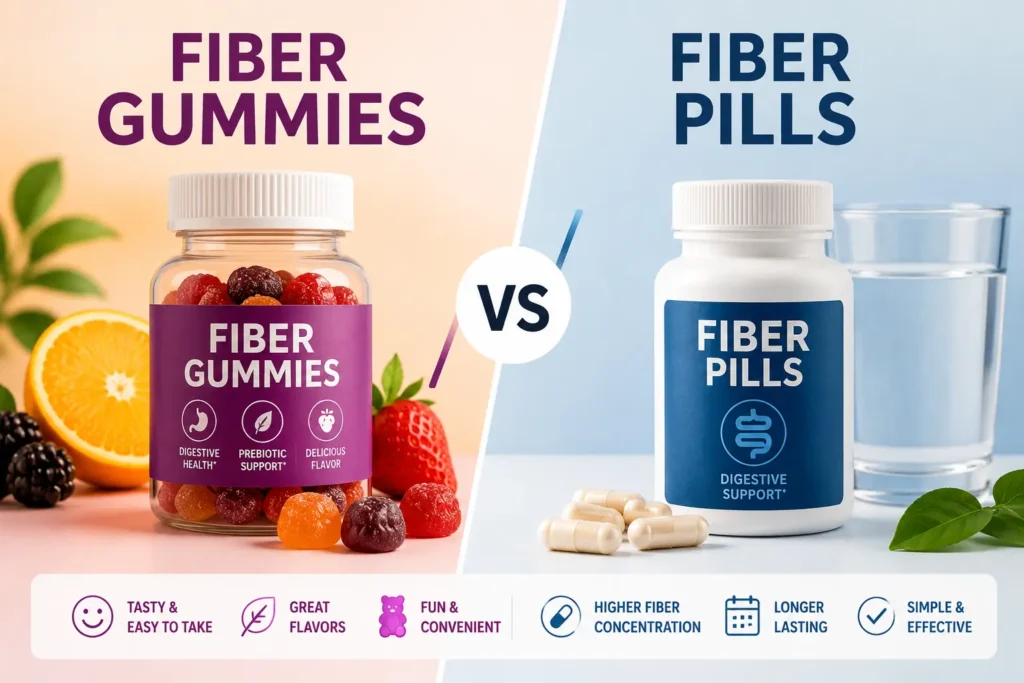
Fiber Gummies vs Fiber Pills: Fiber gummies are easier to take but supply less fiber per serving—usually 3 to 5 grams, often from prebiotic fibers like inulin or chicory root. Fiber pills (capsules or tablets) are easier to swallow than powder but still require several capsules to match a real dose, since most contain only 0.4 to 1 gram of fiber each. If your main goal is convenience and you only need a small daily boost, gummies work fine. If you need meaningful, evidence-backed fiber — for constipation, cholesterol, or blood sugar support — fiber powder or a higher dose of capsules will get you there faster than either gummies or a handful of pills.
Neither gummies nor pills are automatically “better.” The right choice depends on how much fiber you actually need, what type of fiber is inside, and how consistent you’ll be with taking it.
Table of Contents
Why This Comparison Trips People Up
Walk down any supplement aisle and you’ll see fiber gummies sitting next to fiber capsules, both promising “digestive support” on the label. They look like interchangeable products solving the same problem. They’re not.
Gummies and pills differ in three ways that actually matter: how much fiber you get per dose, what kind of fiber is inside, and what else comes along for the ride — sugar, sugar alcohols, binders, or coatings. Most articles compare taste and convenience and stop there. That’s not enough to make a real decision, so this guide breaks down the numbers competitors usually skip.
What Are Fiber Gummies?
Fiber gummies are chewable, flavored supplements built around a gelatin or pectin base, sweetened, and dosed with a soluble fiber source — most commonly inulin or chicory root fiber, sometimes blended with other prebiotic fibers. They’re marketed as a candy-like alternative for people who dislike swallowing pills or mixing powder into water.
A typical serving is 2 to 4 gummies, delivering roughly 3 to 5 grams of fiber. Some newer formulas use green banana fiber or tapioca fiber syrup instead of inulin, and a growing number are sugar-free, sweetened with allulose or sugar alcohols instead of added sugar.
What Are Fiber Pills?
Fiber pills is a catch-all term for capsules, tablets, and caplets containing compressed or encapsulated fiber. The most common type by far is psyllium husk, though you’ll also find methylcellulose and calcium polycarbophil caplets. Unlike gummies, pills are essentially flavorless and swallowed whole with water.
The catch: capsules can only hold so much material. A single psyllium capsule typically contains 500 to 750 mg of psyllium husk, which works out to somewhere between 0.4 and 1 gram of usable fiber. That’s why label directions for fiber capsules often call for 2 to 6 capsules per dose, sometimes taken multiple times a day.
Fiber Gummies vs Fiber Pills: Side-by-Side Comparison
| Factor | Fiber Gummies | Fiber Pills (Capsules) |
| Fiber per serving | 3–5 g (typical) | 0.4–1 g per capsule; 2–3 g per typical 5–6 capsule dose |
| Common fiber source | Inulin, chicory root, green banana fiber | Psyllium husk, methylcellulose, polycarbophil |
| Number needed for a full dose | 2–4 gummies | 5–10 capsules to match one powder scoop |
| Added sugar | Often present, though sugar-free versions exist | Usually none |
| Ease of swallowing | Chewed, no water required | Must be swallowed with a full glass of water |
| Taste | Flavored, candy-like | Neutral, no taste |
| Gel-forming action in the gut | Limited to none | Strong with psyllium; helps soften stool |
| Best suited for | Light, daily fiber “top-up” | Moderate fiber needs without mixing powder |
| Typical cost per serving | $0.30–$0.65 | $0.15–$0.40 |
The Fiber Math Nobody Explains Clearly
This is where most comparisons fall short. The number on the front of the bottle isn’t always the number that matters.
With gummies: A label claiming “5 grams of fiber” almost always means the full serving size — often 2 to 4 gummies together, not per gummy. Check the Supplement Facts panel, not the front-of-bottle marketing copy.
With pills: The gap is bigger than people expect. One teaspoon of psyllium husk powder provides about 3.4 grams of fiber. A single psyllium capsule provides roughly 0.4 grams. That means it can take 7 to 10 capsules to match one scoop of powder — a detail brands rarely put front and center, because “take 8 capsules” sells less well than “take 1 scoop.”
If you’re counting on fiber pills to meaningfully move the needle on daily intake — most U.S. adults fall well short of the recommended 25 to 38 grams a day — check the actual milligram count per capsule and multiply it out before assuming a bottle will cover your needs.
Ingredients: What’s Actually Inside Each
The fiber type matters as much as the amount, because different fibers behave differently in your gut.
- Gummies typically use inulin or chicory root fiber — fermentable prebiotic fibers that feed gut bacteria but don’t form the same viscous gel that eases constipation. These fibers are also more likely to cause gas or bloating in sensitive people, especially if you increase your dose too quickly.
- Pills most often use psyllium husk, a soluble, gel-forming fiber with the strongest clinical evidence behind it — including an FDA-authorized health claim for reducing coronary heart disease risk. Methylcellulose and polycarbophil capsules are non-fermenting alternatives, useful for people who get gassy with psyllium or inulin.
If your priority is relief from constipation or a documented cholesterol benefit, the fiber type in a capsule usually has more research behind it than the fiber type in a typical gummy. For a full breakdown of how fiber types differ, see our guide to soluble vs insoluble fiber.
Sugar, Additives, and Sensitive Stomachs
This is one of the biggest blind spots in fiber gummy marketing. A product built to improve digestive health shouldn’t work against that goal — but some do.
- Added sugar: Traditional fiber gummies can contain several grams of added sugar per serving. If you’re managing blood sugar or simply don’t want the calories, look specifically for a sugar-free formula.
- Sugar alcohols: Sugar-free gummies often swap sugar for sorbitol or maltitol, which ferment quickly in the gut and can cause more gas and bloating than the fiber itself.
- Capsule fillers: Pills are generally free of sugar, but check for unnecessary binders, artificial colors, or excessive magnesium stearate if you’re trying to keep the ingredient list minimal.
Neither format is automatically “cleaner” — you have to read the label either way.
Pros and Cons at a Glance
Fiber Gummies
| Pros | Cons |
| Easy to chew, no water needed | Lower fiber per serving than powder or high-dose capsules |
| Pleasant taste improves consistency | Often contains added sugar or sugar alcohols |
| Good for people who hate swallowing pills | Weaker gel-forming effect for constipation relief |
| Portable, no mixing | Easy to overeat since they taste like candy |
Fiber Pills
| Pros | Cons |
| No taste, no texture issues | Requires several capsules for a real dose |
| Often uses well-researched psyllium husk | Must swallow with a full glass of water |
| Usually sugar-free | Large pill count can feel inconvenient |
| Lower cost per gram of fiber | Choking risk if not taken with enough liquid |
Effectiveness: Which One Actually Moves the Needle?
For general “I want a little more fiber in my day” maintenance, either format can help, provided you take it consistently. Consistency is the real variable — a supplement you actually take beats a theoretically superior one sitting unused in a cabinet.
For specific, evidence-backed goals, the picture changes:
- Constipation relief: Psyllium-based capsules have stronger evidence and a more reliable gel-forming effect than most gummy formulas. If constipation is your main concern, see our guide to the best fiber supplement for constipation.
- Cholesterol support: Psyllium again leads here, with an FDA-recognized heart health claim at doses of roughly 7 grams or more per day — a dose gummies rarely reach without eating a large handful.
- Light daily gap-filling: If your diet is only slightly short of target fiber intake, gummies can reasonably close a 3–5 gram gap without much friction.
- Weight management or fullness: Neither format provides enough bulk or volume to meaningfully increase fullness compared to fiber-rich whole foods; see high-fiber foods if satiety is your goal.
Common Mistakes People Make With Both
- Assuming the front label reflects the per-piece dose. Always check the Supplement Facts panel for grams of fiber per serving, not the marketing claim.
- Not increasing water intake. Both soluble fiber gummies and bulk-forming capsules need adequate fluid to work properly and to avoid worsening constipation.
- Increasing the dose too fast. Jumping straight to the full serving of either format is the most common cause of gas, bloating, and cramping. Start with a partial dose and increase gradually over one to two weeks.
- Expecting gummies to replace a therapeutic dose. If a healthcare provider has recommended a specific fiber target for a condition like high cholesterol, gummies alone are unlikely to get you there.
- Ignoring the sugar count on gummies. A “wellness” product with several grams of added sugar per serving works against the same goals it claims to support.
Fiber Gummies vs Fiber Pills: Decision Framework
Use this quick framework to match the format to your actual situation:
- You dislike swallowing pills and don’t mind a small amount of sugar → Fiber gummies are a reasonable fit.
- You want a sugar-free option with real digestive benefits → Sugar-free fiber capsules, particularly psyllium-based ones.
- You need a meaningful daily fiber increase (5g+) → Neither gummies nor a small handful of pills will fully get you there — consider fiber powder instead.
- You’re targeting a specific health outcome (cholesterol, constipation) → Choose capsules with a clinically studied fiber type and dose, and confirm the target amount with a healthcare provider.
- You want the lowest cost per gram of fiber → Capsules typically edge out gummies on a cost-per-gram basis.
Frequently Asked Questions
Are fiber gummies as effective as fiber pills? Not usually gram for gram. Most fiber gummies provide 3 to 5 grams per serving using fermentable prebiotic fibers like inulin, while fiber capsules — especially psyllium-based ones — often deliver a stronger gel-forming effect for constipation and cholesterol support, provided you take enough capsules to reach a comparable dose.
Do fiber gummies have side effects? Yes, the same general side effects as any fiber supplement: gas, bloating, and cramping, especially when starting at a full dose or when the gummy contains sugar alcohols. These effects usually settle as your gut adjusts.
How many fiber pills equal one fiber gummy serving? It depends on the brand, but as a rough guide, a standard psyllium capsule provides about 0.4 to 1 gram of fiber, so it typically takes 5 to 10 capsules to match a 4 to 5 gram gummy serving.
Can I take fiber gummies and fiber pills together? You can combine formats, but track the total grams of fiber from both so you don’t exceed a comfortable daily amount too quickly. Increase total fiber intake gradually and drink plenty of water.
Which is cheaper, fiber gummies or fiber pills? Capsules are generally cheaper per gram of fiber than gummies, since gummy production and flavoring add cost. Powder is usually the cheapest option of all per gram.
Do fiber gummies cause less bloating than fiber pills? Not necessarily. Bloating depends more on the type of fiber and how quickly you increase your dose than on whether it’s a gummy or a pill. Sugar alcohols in some gummies can actually increase gas compared to a plain psyllium capsule.
Final Verdict
Fiber gummies win on convenience and taste, which genuinely matters if that’s what keeps you from taking any fiber supplement at all. Fiber pills win on dose efficiency, ingredient simplicity, and clinical backing, particularly when they contain psyllium husk. Neither is a wholesale replacement for fiber-rich foods, and neither delivers a large therapeutic dose as easily as fiber powder does.
If you’re simply trying to close a small daily fiber gap and taste matters to you, gummies are a fine choice — just pick a low-sugar formula with at least 3 grams of fiber per serving. If you’re managing constipation, cholesterol, or another specific concern, fiber capsules — taken at the dose your body actually needs — are the more reliable option. When in doubt, our guide on how to choose a fiber supplement walks through the decision in more depth.
This article is for educational purposes only and is not a substitute for medical advice. Talk to a healthcare provider before starting any new supplement, especially if you take other medications or have a digestive condition.