
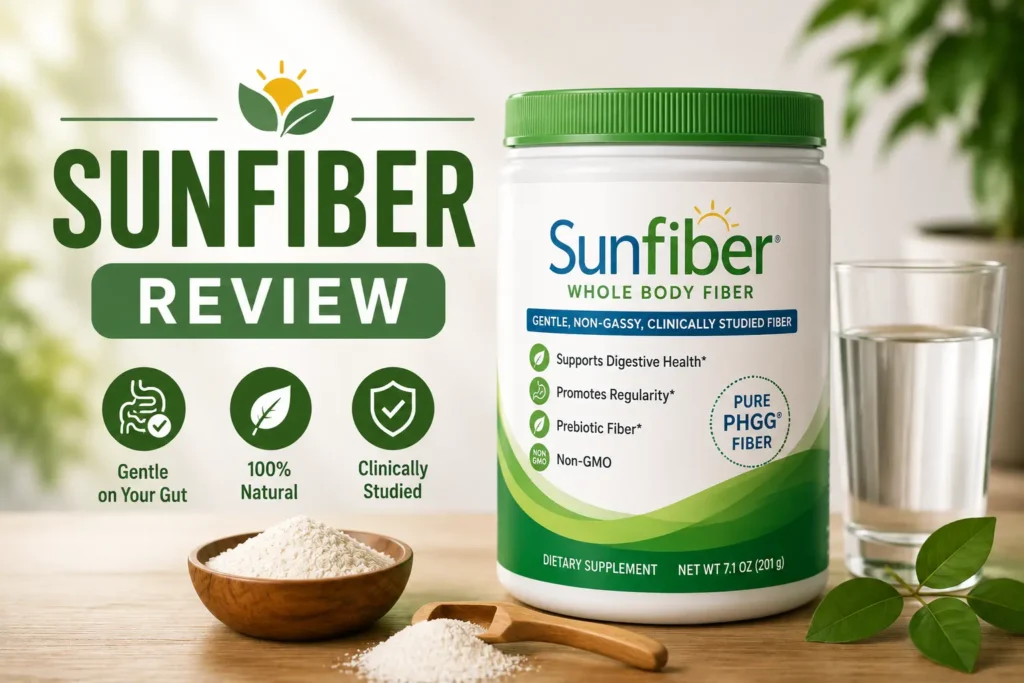
Sunfiber is a branded form of partially hydrolyzed guar gum (PHGG), a soluble prebiotic fiber that’s become one of the most researched fiber ingredients on the market. This Sunfiber review finds that it stands out for a specific reason: it’s genuinely tasteless, dissolves completely clear in liquid, and has a growing body of published research behind it — something most consumer fiber brands can’t claim.
Unlike psyllium husk, Sunfiber is fully soluble and low-viscosity, so it doesn’t gel or thicken the way Metamucil or Konsyl does. It’s also Low-FODMAP certified, which makes it one of the few fiber options that’s genuinely appropriate for people with IBS who need to be careful about fermentable carbohydrates. If you want a fiber supplement that disappears into your coffee, supports gut bacteria, and has actual clinical trials behind it, Sunfiber is one of the strongest options available. If you specifically want fiber with strong cholesterol-lowering evidence, psyllium still has the deeper track record there.
Table of Contents
What Is Sunfiber?
Sunfiber is a proprietary ingredient brand owned by Taiyo International, made from partially hydrolyzed guar gum. <cite index=”40-1″>PHGG is derived from guar beans grown in arid regions such as India and Pakistan, produced by hydrolyzing the high-viscosity gum extracted from the seed’s endosperm, which makes it easy to add to food products as a supplement.</cite>
Unlike whole guar gum, which is thick and gel-forming, <cite index=”47-1″>Sunfiber is a low-viscosity form of guar gum that dissolves completely rather than thickening.</cite> That single trait is why Sunfiber shows up in everything from standalone fiber powders to protein shakes and meal-replacement products — it adds fiber without changing texture.
You’ll find Sunfiber sold two ways:
- As a standalone supplement under brands like Tomorrow’s Nutrition, CAVU, Essential Stacks, and NutriKey
- As an added ingredient inside other supplements, shakes, and foods, where it’s listed as “Sunfiber®” or “PHGG” on the label
How Sunfiber Works
Sunfiber is a soluble, highly fermentable fiber. <cite index=”40-1″>Structurally composed of galactomannan, PHGG exhibits high fermentability by intestinal bacteria, which promotes the production of short-chain fatty acids and contributes to maintaining intestinal barrier function.</cite>
This fermentation process is where PHGG’s prebiotic reputation comes from. <cite index=”35-1″>A randomized, double-blind, placebo-controlled crossover study found significantly higher levels of Akkermansia — a bacteria linked to metabolic health — in groups taking 3 g or 6 g of Sunfiber daily compared with placebo, after just 14 days.</cite> <cite index=”32-1″>The lead researcher, a fiber expert at the University of Minnesota, noted this as a novel finding showing prebiotic effects even at low doses.</cite>
What makes PHGG somewhat unusual among fibers is that <cite index=”49-1″>it’s shown in research to help with both occasional constipation and diarrhea</cite> — most fiber supplements are marketed for one or the other, not both. <cite index=”38-1″>Research has also shown PHGG improves bloating and IBS-related symptoms and quality of life compared to placebo.</cite>
Sunfiber Ingredients
This is refreshingly simple compared with most fiber supplements.
| Component | Detail |
| Active ingredient | <cite index=”50-1″>Sunfiber® Guar Fiber (PHGG), 7 g per scoop</cite> |
| Dietary fiber content | <cite index=”50-1″>6 g per serving</cite> |
| Sugar | <cite index=”50-1″>0 g</cite> |
| Other ingredients | <cite index=”50-1″>None</cite> |
| Certifications | <cite index=”49-1″>Non-GMO Project Verified, Low FODMAP certified, Certified Glyphosate Residue Free, Kosher, Vegan, Gluten-Free</cite> |
| Allergen profile | <cite index=”49-1″>No dairy, soy, sugar, salt, wheat, eggs, artificial flavors, or other common allergens</cite> |
A detail most competitor pages don’t explain clearly: not all “grams” on a Sunfiber label mean the same thing. A 7 g scoop typically delivers 6 g of actual dietary fiber, since a small amount is metabolized differently during processing. If you’re tracking fiber intake precisely, check the “Dietary Fiber” line on the nutrition panel, not just the total scoop weight.
One more point worth flagging clearly, since evidence here is more preliminary than PHGG’s prebiotic research: <cite index=”37-1″>some studies suggest PHGG may support mineral absorption, including iron</cite>, unlike many other fibers, which can interfere with mineral uptake. This is a promising and differentiating area of research, but it’s still an emerging finding rather than an established clinical benefit — treat it as an interesting data point, not a reason to use Sunfiber for mineral deficiency.
Sunfiber Dosage
| Use Case | Typical Dose | Liquid Needed |
| General prebiotic support | <cite index=”32-1″>As little as 3 g per day</cite> | 6–8 oz |
| Standard daily serving | <cite index=”42-1″>1 scoop (7 g)</cite> | <cite index=”42-1″>6–8 oz of water or non-carbonated beverage</cite> |
| Clinical research dose (glycemic support studies) | <cite index=”33-1″>12.5 g per day</cite> | Taken before meals |
<cite index=”44-1″>Stir well for about 60 seconds until completely dissolved</cite>, and it can be taken <cite index=”44-1″>once or twice daily as part of a routine.</cite> <cite index=”42-1″>Carbonated beverages aren’t recommended, simply because the carbonation makes it harder for the powder to dissolve</cite> — not because it’s unsafe with them.
A genuinely useful, competitor-missed tip: because Sunfiber is odorless and tasteless, it’s one of the few fibers that works well mixed into hot foods like oatmeal, soup, or coffee without anyone noticing — most psyllium products either thicken unpleasantly or leave a gritty texture when added to hot liquids.
Pros and Cons of Sunfiber
| Pros | Cons |
| Genuinely tasteless and dissolves crystal clear | Costs more per gram than psyllium or wheat dextrin |
| Backed by a growing body of published clinical research | Sold under many different retail brand names, which can be confusing |
| Low FODMAP certified — safe for many IBS diets | Less established cholesterol-lowering evidence than psyllium |
| <cite index=”47-1″>Side effects like gas, bloating, or diarrhea are virtually nonexistent at recommended doses</cite> | Requires checking labels carefully since “Sunfiber” often appears as one ingredient among several |
| Helps with both constipation and diarrhea | Fewer flavored/ready-to-drink options than mainstream brands |
| Doesn’t interfere with mineral absorption the way some fibers do | Evidence for benefits beyond digestion (mood, sleep, glycemic control) is still emerging |
Sunfiber Side Effects
Sunfiber has one of the cleanest safety profiles among fiber supplements reviewed on this site. <cite index=”47-1″>At recommended dosages, side effects like gas, bloating, or diarrhea are virtually nonexistent</cite>, and <cite index=”45-1″>it’s specifically formulated to ferment slowly in the gut, avoiding the excess gas and bloating that faster-fermenting fibers can cause.</cite>
That said, “virtually nonexistent” isn’t “impossible.” As with any fiber supplement:
- Introducing it too quickly at a high dose can still cause mild bloating in sensitive individuals
- Adequate hydration remains important for any bulk-adding fiber
- People with a guar or legume allergy should avoid it, since PHGG is derived from guar beans, a legume
This article is for educational purposes only and isn’t a substitute for medical advice. If you have IBS, SIBO, or another chronic digestive condition, or take medications that could interact with fiber, talk to your doctor before starting Sunfiber, even though its side-effect profile is generally mild.
Who Sunfiber Is a Good Fit For
- People with IBS who need a Low-FODMAP-certified fiber option
- Anyone who’s struggled with the taste or texture of psyllium-based fibers
- People interested in prebiotic, gut-microbiome-focused fiber supplementation
- Anyone who wants to add fiber to hot or cold foods without altering taste
Who Should Consider a Different Fiber Supplement
- Anyone specifically supplementing for cholesterol management, where psyllium husk has more established evidence
- Budget-conscious buyers, since PHGG typically costs more per gram than wheat dextrin or plain psyllium
- People who want a single, easily recognizable retail brand rather than an ingredient sold under multiple product names
- Anyone with a known guar or legume allergy
Sunfiber vs. Other Fiber Supplements
| Feature | Sunfiber (PHGG) | Psyllium Husk | Wheat Dextrin |
| Solubility | Fully soluble, low viscosity | Soluble, gel-forming | Fully soluble |
| Taste/texture | <cite index=”49-1″>No taste, odor, or grit</cite> | Gritty, thickens | Mild, dissolves clear |
| Fermentability | <cite index=”40-1″>Highly fermentable</cite> | Partially fermentable | <cite index=”34-1″>Highly bifidogenic</cite> |
| FODMAP status | <cite index=”47-1″>Low-FODMAP certified</cite> | Not certified | Not certified |
| Constipation relief | Yes | Yes | Yes |
| Diarrhea relief | <cite index=”49-1″>Yes — uniquely helps with both</cite> | Limited | Limited |
| Cholesterol evidence | Emerging | Well established | Limited |
For related reading, see our guides on PHGG (partially hydrolyzed guar gum) and psyllium husk vs. inulin to understand how different soluble fibers compare on fermentability and FODMAP content.
Common Mistakes People Make With Sunfiber
- Not checking whether “Sunfiber” is the main ingredient or a minor addition. Since it’s sold both standalone and blended into other products, always check the Supplement Facts panel for the actual gram amount.
- Adding it to carbonated drinks and assuming it failed to dissolve. It’s not unsafe — it’s just harder to mix; a still beverage works better.
- Expecting it to feel like psyllium. Sunfiber has zero gelling or thickening effect, which surprises people who expect fiber supplements to feel “fibrous.”
- Assuming more is automatically better. <cite index=”32-1″>Research shows measurable prebiotic effects at doses as low as 3 g</cite> — there’s no need to over-supplement to see benefits.
- Ignoring the guar/legume allergy risk. It’s an easy detail to overlook since PHGG doesn’t “look” like a legume-derived product.
What Real Users Report
<cite index=”44-1″>User reviews consistently mention two things: the product genuinely dissolves without altering taste or texture, and it’s well tolerated even by people who reacted poorly to other fiber supplements.</cite> <cite index=”48-1″>Several reviewers specifically mention using it alongside GLP-1 medications without bloating or side effects</cite>, and multiple reviews describe recommendations from dietitians or doctors as the reason they started using it. Complaints are relatively rare and tend to focus on price rather than effectiveness or tolerability.
Sunfiber FAQs
What is Sunfiber made from? <cite index=”40-1″>Sunfiber is partially hydrolyzed guar gum (PHGG), derived from guar beans, a legume grown in arid regions like India and Pakistan.</cite>
Is Sunfiber the same as guar gum? Not exactly. <cite index=”47-1″>Regular guar gum is thick and gel-forming, while Sunfiber is a low-viscosity, fully soluble form that dissolves completely instead of thickening.</cite>
Does Sunfiber cause gas or bloating? <cite index=”47-1″>At recommended doses, side effects like gas, bloating, or diarrhea are virtually nonexistent</cite>, though as with any fiber, starting low and increasing gradually is still the safest approach.
Is Sunfiber good for IBS? <cite index=”47-1″>Sunfiber is Low-FODMAP certified by Monash University</cite>, and <cite index=”38-1″>research has shown PHGG improves bloating and IBS-related symptoms and quality of life compared to placebo</cite>, making it one of the more IBS-friendly fiber options available.
How much Sunfiber should I take per day? <cite index=”32-1″>Research shows measurable prebiotic effects starting at just 3 g daily</cite>, while <cite index=”42-1″>standard servings are typically 7 g mixed into 6–8 ounces of liquid.</cite> Higher clinical doses around 12.5 g have also been studied for specific outcomes like glycemic support.
Can Sunfiber help with both constipation and diarrhea? <cite index=”49-1″>Research indicates PHGG uniquely helps with both occasional constipation and diarrhea</cite>, returning stool to a more normal consistency rather than pushing in only one direction — a distinct advantage over many single-purpose fiber products.
Is Sunfiber a prebiotic? Yes. <cite index=”35-1″>Clinical research has demonstrated a significant prebiotic effect from Sunfiber, including increases in beneficial gut bacteria like Akkermansia.</cite>
Final Verdict
This Sunfiber review lands on a strong recommendation for a specific type of user: anyone who wants research-backed, genuinely tasteless prebiotic fiber that won’t upset a sensitive gut. PHGG’s combination of Low-FODMAP certification, dual constipation-and-diarrhea benefit, and a real, growing base of published clinical research sets it apart from most fiber ingredients on the market — most of which lean on decades-old psyllium data or no independent research at all.
It’s not the cheapest fiber option, and it’s not the first choice if cholesterol management is your primary goal. But as an everyday, gut-friendly soluble fiber that disappears into food and drink, Sunfiber is one of the most well-supported options covered on this site. If you’re comparing it against a psyllium-based alternative, our psyllium husk guide is a useful next read.
This article is for educational purposes only and does not constitute medical advice. Always consult a healthcare professional before starting a new supplement, especially if you have an existing health condition or take medication.