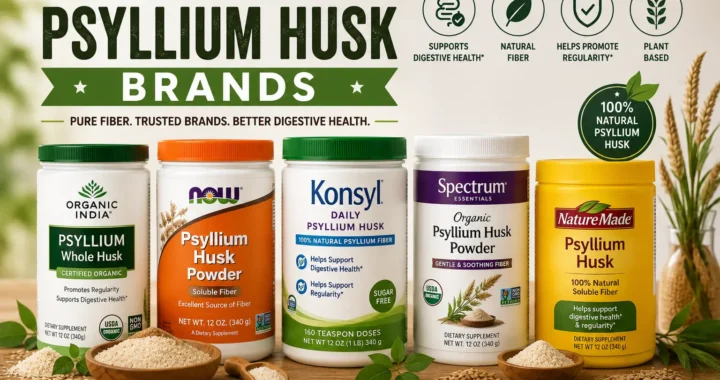

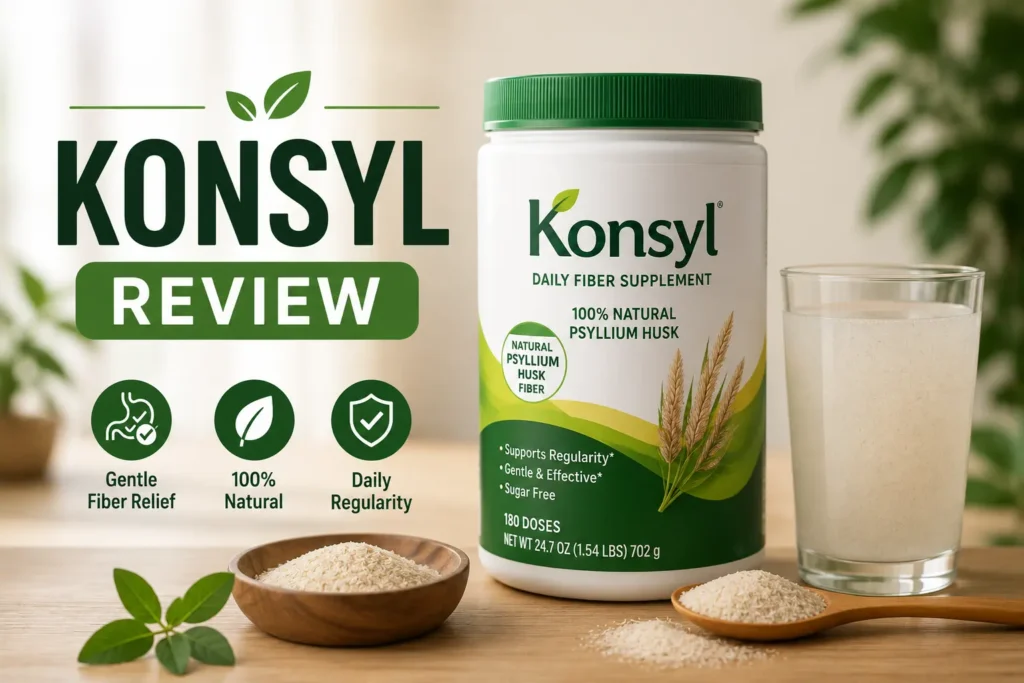
Konsyl is a psyllium husk fiber supplement built around one idea: no fillers, no flavors, no dyes, just psyllium. In this Konsyl review, that simplicity is the whole story. Compared with Metamucil, which is also psyllium-based but includes added sugar or sweeteners in most of its flavored lines, Konsyl’s original formula is sugar-free and additive-free by default. That makes it a strong pick for diabetics, people on low-additive diets, or anyone who’s sensitive to artificial sweeteners.
The tradeoff is texture and taste. Because there’s nothing added to mask it, Konsyl has a more grainy, distinctly “psyllium” mouthfeel that some people need time to adjust to. If you want effective, evidence-backed soluble fiber without extras, Konsyl earns its reputation. If you want something more palatable out of the gate, you may prefer a flavored psyllium product or a gentler fiber like methylcellulose.
Table of Contents
What Is Konsyl?
Konsyl is a fiber supplement brand built entirely around psyllium husk, a natural soluble and insoluble fiber derived from the seeds of the Plantago ovata plant. Konsyl Pharmaceuticals has manufactured psyllium-based products for decades, and the brand’s core positioning is “no additives” — its flagship Original Formula contains psyllium husk and nothing else.
<cite index=”19-1″>Konsyl Original Formula Psyllium Fiber contains 6 grams of psyllium hydrophilic mucilloid as the active ingredient in each teaspoon.</cite>
Konsyl’s product line includes:
- Konsyl Original Formula — unflavored granules, no additives, no sugar
- Konsyl Daily Psyllium Fiber Powder — <cite index=”13-1″>a single-ingredient, unflavored, fine-ground psyllium husk powder</cite>
- Konsyl-D — a version <cite index=”14-1″>sweetened with dextrose, containing about 48% sugar</cite>, aimed at people who want a milder taste and don’t need to avoid sugar
- Konsyl Organic Psyllium Fiber — <cite index=”16-1″>USDA Organic-certified psyllium husk</cite>
- Konsyl Daily Psyllium Fiber Capsules — <cite index=”13-1″>1,500 mg of psyllium husk per serving in capsule form</cite>
This range matters more than most reviews acknowledge — “Konsyl” isn’t one product, it’s a family, and the right pick depends heavily on whether you need to avoid sugar.
How Konsyl Works
Psyllium husk is a soluble fiber that absorbs water and forms a gel-like substance in the digestive tract. This gel adds bulk to stool, softens it, and helps it move through the intestines more efficiently — the same basic mechanism behind most bulk-forming laxatives.
What sets psyllium apart from methylcellulose (used in Citrucel) is that psyllium is partially fermentable. Gut bacteria break down some of it, which is why psyllium has a reputation for being more likely to cause gas in the first week or two, but also why it has better-documented benefits for gut bacteria and heart health.
<cite index=”19-1″>Konsyl generally produces a bowel movement within 12 to 72 hours of use</cite>, in line with other bulk-forming fiber products.
Konsyl Ingredients
Here’s what’s actually in Konsyl’s core products, based on product labeling.
| Product | Active Ingredient | Inactive Ingredients | Sugar Content |
| Konsyl Original Formula | <cite index=”19-1″>Psyllium hydrophilic mucilloid, 6 g per teaspoon</cite> | None | Sugar-free |
| Konsyl Daily Psyllium Fiber Powder | Psyllium husk powder | <cite index=”13-1″>None — single ingredient</cite> | Sugar-free |
| Konsyl-D | <cite index=”14-1″>Psyllium hydrophilic mucilloid, 3.4 g per teaspoon</cite> | <cite index=”14-1″>Dextrose</cite> | <cite index=”14-1″>~48% sugar</cite> |
| Konsyl Organic | Organic psyllium husk powder | <cite index=”16-1″>None</cite> | Sugar-free |
| Konsyl Daily Capsules | <cite index=”13-1″>1,500 mg psyllium husk powder</cite> | Capsule shell | Sugar-free |
A detail worth highlighting that competitor review pages tend to bury: Konsyl-D is not the same product as unflavored Konsyl, and mixing them up is an easy mistake for diabetics or low-sugar dieters to make when shopping. Always check the label for “D” before buying if sugar content matters to you.
Konsyl Dosage: How to Take It Correctly
| Product Type | Typical Dose | Frequency | Liquid Required |
| Original Formula / Powder | <cite index=”17-1″>1 teaspoon (6 g)</cite> | <cite index=”14-1″>1–3 times daily</cite>, before or after meals | 8 oz |
| Konsyl-D | <cite index=”14-1″>1 rounded teaspoon (3.4 g)</cite> | <cite index=”14-1″>2 times daily</cite> | 8 oz |
| Capsules | Per label, typically several capsules per dose | As directed | 8 oz |
<cite index=”16-1″>Start with a small dose and gradually increase it to allow your digestive system to adjust</cite>, and <cite index=”14-1″>if minor gas or bloating occurs, begin with a half-dose and slowly increase over several days.</cite>
A practical detail most reviews skip: mix and drink Konsyl immediately. <cite index=”21-1″>The mixture starts to thicken if left sitting</cite>, so this isn’t a “make it and sip later” supplement. Stir briskly in at least 8 oz of cool water, juice, or a smoothie, and drink right away.
Pros and Cons of Konsyl
| Pros | Cons |
| Original Formula is 100% psyllium, zero additives | Grainy texture takes some getting used to |
| Sugar-free options available (important for diabetics) | Konsyl-D contains significant added sugar — easy to buy the wrong one |
| Some evidence for cholesterol support at adequate doses | More likely to cause initial gas/bloating than non-fermentable fibers |
| Available in powder, granule, and capsule forms | Must be consumed immediately after mixing — thickens fast |
| Organic and non-GMO options exist | Choking risk if taken without enough liquid |
| Long manufacturing history and doctor familiarity | Multiple product variants can confuse first-time buyers |
Konsyl Side Effects
Psyllium-based products like Konsyl are generally safe when taken as directed, but side effects are worth knowing:
- Gas or bloating, especially in the first 1–2 weeks
- Stomach cramping if the dose increases too quickly
- Choking or throat blockage if taken without adequate liquid
<cite index=”19-1″>The label specifically warns that taking this product without adequate fluid may cause it to swell and block the throat or esophagus, which can cause choking, and advises against use for anyone who has difficulty swallowing.</cite> <cite index=”19-1″>Seek immediate medical attention if chest pain, vomiting, or difficulty swallowing or breathing occurs after taking it.</cite>
<cite index=”15-1″>Psyllium can also affect how other medications are absorbed, so it’s generally recommended to wait 1–2 hours before or after taking other medicines.</cite>
This article is for educational purposes only and isn’t a substitute for medical advice. If you take prescription medication, have a swallowing disorder, or manage a chronic digestive condition, talk to your doctor or pharmacist before adding Konsyl to your routine.
Who Konsyl Is a Good Fit For
- People who want a fiber supplement with zero additives, dyes, or artificial sweeteners
- Diabetics or low-sugar dieters, provided they choose the unflavored (not “D”) formula
- People specifically interested in psyllium’s cholesterol-support evidence
- Anyone who prefers mixing fiber into a beverage over swallowing capsules
Who Should Consider a Different Fiber Supplement
- People who found psyllium gassy in the past and want a gentler option — see our Citrucel review for a non-fermentable alternative
- Anyone who dislikes gritty texture and wants a smoother-mixing fiber, such as wheat dextrin
- People who want fiber in capsule or gummy form for convenience rather than mixing a drink
- Anyone who accidentally reaches for Konsyl-D but actually needs to avoid added sugar
Konsyl vs. Other Fiber Supplements
Most competitor reviews only rate Konsyl against generic “psyllium.” Here’s how it actually compares to the two brands people cross-shop it with most.
| Feature | Konsyl (Original) | Metamucil (Psyllium) | Citrucel (Methylcellulose) |
| Fiber source | Psyllium husk | Psyllium husk | Methylcellulose |
| Added ingredients | None | Sugar or sweeteners in most flavors | Dye, fillers (caplets) |
| Fermentable by gut bacteria | Yes | Yes | No |
| Gas/bloating risk | Moderate–higher | Moderate–higher | Low |
| Cholesterol-lowering evidence | Yes, at adequate doses | Yes, at adequate doses | Limited |
| Taste/texture | Plain, gritty | Flavored, smoother | Neutral, dissolves cloudy |
| Best for | Additive-free preference | Flavor variety | Gas-sensitive users |
For more detail, see our psyllium husk vs. Metamucil and Citrucel vs. Metamucil comparisons.
Common Mistakes People Make With Konsyl
- Buying Konsyl-D by accident when trying to avoid sugar. Always check for the “D” on the label.
- Letting the mixed drink sit too long. It thickens quickly — drink it right after stirring.
- Not drinking enough water. This affects both results and choking risk.
- Increasing the dose too fast. <cite index=”14-1″>Starting with a half-dose and increasing gradually over several days</cite> significantly reduces gas and bloating.
- Expecting it to taste like a flavored product. Original Formula is intentionally plain — that’s the tradeoff for having no additives.
What Real Users Report
Across pharmacy and retailer review sections, a consistent theme emerges: long-time users tend to be loyal specifically because of the clean ingredient list, especially people managing diabetes or watching sugar intake closely. The most common criticism is texture — some describe it as grittier than flavored competitors, particularly on the first few uses before they adjust their mixing ratio or beverage choice. Complaints about effectiveness are rare when dosage and hydration instructions are followed; most negative reviews trace back to under-dosing, inadequate water, or expecting overnight results.
Konsyl FAQs
Is Konsyl the same as Metamucil? Both use psyllium husk as the active fiber, but Konsyl’s original formula skips added sugars, flavors, and dyes entirely, while most Metamucil products include sweeteners or flavoring. If you want the plainest possible psyllium, Konsyl is the more minimal option.
What is the difference between Konsyl and Konsyl-D? <cite index=”14-1″>Konsyl-D contains added dextrose (sugar)</cite> for a milder taste, while the standard Original Formula and Daily Psyllium Fiber Powder contain no sugar or additives at all. Check the label carefully if sugar content matters to you.
Does Konsyl help lower cholesterol? <cite index=”14-1″>Diets that include about 7 grams of soluble fiber daily from psyllium husk may help reduce the risk of coronary heart disease by lowering cholesterol</cite>, as part of a diet already low in saturated fat and cholesterol. This is a general dietary claim tied to psyllium as an ingredient, not a guarantee for any individual.
How long does Konsyl take to work? <cite index=”19-1″>Generally between 12 and 72 hours.</cite> Give it a few consistent doses before judging effectiveness.
Can diabetics take Konsyl? The sugar-free Original Formula and Daily Psyllium Fiber Powder are formulated without added sugar, which is why they’re commonly used by people managing blood sugar. Konsyl-D is not sugar-free. As always, confirm with your doctor before making changes to a diabetes management routine.
Why does my Konsyl drink thicken so fast? <cite index=”21-1″>This is expected — the psyllium starts absorbing water and gelling almost immediately after mixing</cite>, which is why it’s meant to be drunk right away rather than prepared in advance.
Is Konsyl safe to take daily? Many people use psyllium fiber supplements daily as part of a regular fiber routine, and Konsyl products are commonly used this way. If you plan to use it long-term rather than for occasional constipation, it’s still worth confirming with your doctor, especially if you take other medications.
Final Verdict
This Konsyl review comes down to a simple tradeoff: you get one of the cleanest, most additive-free psyllium husk fiber supplements on the market, in exchange for a plainer taste and texture than flavored competitors. For anyone managing sugar intake, sensitive to artificial ingredients, or simply wanting to know exactly what they’re putting in their body, Konsyl delivers on that promise consistently.
If gas and bloating from psyllium have been a problem for you in the past, it’s worth reading our Citrucel review as a gentler alternative. Otherwise, for straightforward, no-nonsense psyllium fiber, Konsyl is one of the most trustworthy options available — just make sure you’re grabbing the right variant off the shelf.
This article is for educational purposes only and does not constitute medical advice. Always consult a healthcare professional before starting a new supplement, especially if you have an existing health condition or take medication.