
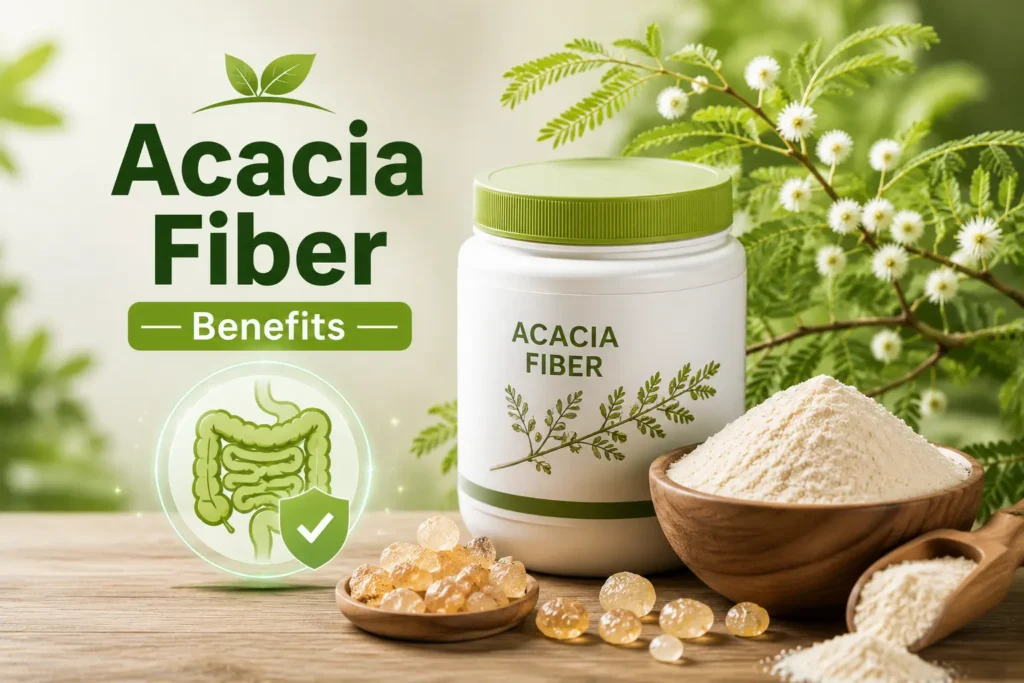
Acacia Fiber Benefits: Acacia fiber (also called gum arabic or gum acacia) is a soluble, slow-fermenting prebiotic fiber that supports gut bacteria, softens stool, and is gentler on the digestive system than fibers like inulin. Clinical trials link it to better bowel regularity, modest blood sugar improvements, and increased Bifidobacteria—making Acacia Fiber Benefits some of the best-supported among fiber supplements, with one of the best safety and tolerability profiles, including for people with IBS.
If you’ve spent any time comparing fiber supplements, you’ve probably noticed that most of them come with a trade-off. Psyllium works but can feel gluey. Inulin feeds good bacteria but leaves some people bloated for days. Acacia fiber is one of the few ingredients that seems to sidestep most of those complaints, which is exactly why it keeps showing up in low-FODMAP product lines and gut-health formulas.
This guide breaks down what acacia fiber actually is, how it behaves differently in your body compared to other fibers, and what the clinical evidence says about its benefits for gut health, IBS, constipation, blood sugar, and weight management. We’ll also cover realistic dosing, side effects, and how to decide if it’s the right fiber for you.
Table of Contents
What Is Acacia Fiber?
Acacia fiber is a natural gum harvested from the hardened sap of Acacia senegal and Acacia seyal trees, grown mainly across the Sahel region of Africa. It’s also sold under the names gum arabic, gum acacia, or acacia gum — these are all the same ingredient.
People have used it for thousands of years, originally as a food thickener and stabilizer (it’s still in a lot of sodas, gummy candies, and printing inks). More recently, researchers have taken a closer interest in it as a functional fiber, and the FDA has recognized acacia fiber as a dietary fiber based on evidence of physiological benefit.
What makes it structurally different from most fiber supplements is that it’s a soluble, non-viscous fiber. That single detail explains almost everything else on this page.
- Psyllium husk absorbs water and forms a thick gel that bulks up stool.
- Inulin ferments quickly and aggressively in the colon, which is why it tends to cause gas.
- Acacia fiber dissolves completely in water, doesn’t gel, and ferments slowly and steadily across the entire length of the colon.
That slow fermentation is the reason acacia fiber has earned a reputation as the “gentle” prebiotic.
How Acacia Fiber Works in the Gut
Acacia fiber passes through your stomach and small intestine largely undigested. Once it reaches the large intestine, gut bacteria begin breaking it down gradually — a process that can continue over many hours, rather than the rapid burst of fermentation you get from fibers like inulin or FOS (fructooligosaccharides).
This slow, extended fermentation does two useful things:
- It feeds beneficial bacteria over a longer stretch of the colon, rather than concentrating fermentation (and gas production) in one area.
- It produces short-chain fatty acids (SCFAs), including butyrate, which help maintain the gut lining and support a healthy inflammatory response in the colon.
Because acacia doesn’t gel the way psyllium does, it doesn’t dramatically bulk up stool on its own. Instead, its main mechanical effect on bowel movements comes from increasing fecal water content and feeding bacteria that add to stool mass — a softer, more gradual effect than a bulk-forming laxative fiber.
Acacia Fiber Benefits: What the Evidence Shows
1. Prebiotic Support for Gut Bacteria
This is where acacia fiber has the strongest research behind it. Multiple studies have found that daily acacia fiber intake increases populations of Bifidobacteria and Lactobacilli — two bacterial groups associated with digestive and immune health. In head-to-head comparisons, acacia has performed on par with inulin for boosting these bacteria, without the same level of gas and bloating.
2. Acacia Fiber for IBS
IBS is a difficult condition to manage with fiber, because many prebiotic fibers make symptoms worse before they make them better. Acacia fiber is one of the exceptions.
It carries a low-FODMAP certification from Monash University, meaning it’s one of the few prebiotic fibers that can be used throughout a low-FODMAP elimination diet, including the strict phase, without commonly triggering symptoms.
A randomized, double-blind, placebo-controlled trial in people with constipation-predominant IBS (IBS-C) found that acacia fiber supplementation over four weeks improved stool frequency and trended toward better constipation symptom scores, without worsening overall IBS symptom severity — a meaningful finding, since fiber trials in IBS populations often report the opposite.
That said, it’s worth being honest here: evidence for direct symptom relief in IBS is still described by researchers as promising but limited, since most trials are small. The clearer, better-supported benefit is tolerability — acacia is simply less likely than inulin, FOS, or wheat dextrin to trigger IBS flares in the first place.
3. Acacia for Constipation
Older research found that acacia gum, taken at 10–15 g per day, increased stool weight by roughly 30% through greater fecal water content. Combined with the IBS-C trial findings above, this supports acacia as a reasonable option for occasional or mild constipation — particularly for people who find psyllium too thick or gel-forming.
It’s important to set expectations correctly, though. Acacia is not a strong bulk-forming laxative the way psyllium is. If you’re dealing with severe or chronic constipation, it’s likely to help as a gentler, supportive option rather than a primary fix.
4. Blood Sugar and Post-Meal Glucose Response
Several trials have tested acacia fiber’s effect on post-meal (“postprandial”) blood glucose and insulin. Doses in the 10–40 g range, taken alongside a carbohydrate-containing meal, have been shown to blunt the glucose and insulin spike that normally follows eating. The proposed mechanism is a combination of slowed gastric emptying and delayed carbohydrate absorption.
These effects are real but modest — acacia fiber should be thought of as a supportive habit for people managing blood sugar, not a substitute for medical treatment or a prescribed diabetes management plan.
5. Satiety and Weight Management Support
Because acacia fiber slows digestion slightly and stabilizes post-meal blood sugar, several studies report increased feelings of fullness after doses in the 20–40 g range. One randomized trial in healthy adult women found modest reductions in BMI and body fat percentage after six weeks of daily acacia fiber supplementation, compared to placebo, with no other dietary changes required.
These numbers are small and shouldn’t be mistaken for a weight-loss treatment. The honest takeaway is that acacia fiber may make it slightly easier to manage appetite as part of a broader approach to a natural fiber supplement routine — not that it burns fat on its own.
6. Gut Barrier and Inflammation Support
Preliminary research suggests acacia fiber may help support the gut lining and reduce markers of intestinal inflammation, partly through the SCFAs produced during fermentation. This research is earlier-stage than the prebiotic and IBS-tolerability findings, so it’s fair to treat it as promising rather than settled.
Acacia Fiber vs. Psyllium vs. Inulin
Since most people researching acacia fiber are comparing it against other options, here’s how the three most common soluble fibers stack up.
| Feature | Acacia Fiber | Psyllium Husk | Inulin |
| Solubility | Soluble, non-gelling | Soluble, gel-forming | Soluble, non-gelling |
| Fermentation speed | Slow, gradual | Partially fermented | Fast, aggressive |
| Gas/bloating risk | Low | Low-moderate | Moderate-high |
| Low-FODMAP | Yes (Monash certified) | Yes, in typical doses | No — high FODMAP |
| Best for | Gut bacteria support, IBS-friendly regularity | Bulking stool, cholesterol, stronger laxative effect | Prebiotic boost (if well tolerated) |
| Stool bulking effect | Mild | Strong | Mild |
| Typical daily dose | 5–30 g | 5–15 g | 2.5–10 g |
If your main goal is a stronger laxative effect for constipation, psyllium husk is still the better-studied option. If your priority is feeding gut bacteria without gas, or you’re managing IBS and need a low-FODMAP option, acacia fiber usually wins. If you tolerate inulin well, it’s a cheaper prebiotic — but it’s a poor first choice for anyone with a sensitive gut.
For a deeper breakdown of how soluble and insoluble fibers differ more broadly, see our guide on soluble vs. insoluble fiber.
Acacia Fiber Dosage: How Much to Take
Clinical trials have used doses ranging from 5 g to 40 g per day. Based on the research, here’s a practical breakdown:
| Goal | Typical Dose | Notes |
| General prebiotic/gut bacteria support | 5–10 g/day | Minimum effective dose in most studies |
| Bowel regularity / mild constipation | 10–15 g/day | Supported by fecal water content studies |
| Blood sugar support | 10–40 g/day, taken with meals | Larger doses show stronger glucose blunting |
| Satiety / appetite support | 20–40 g/day | Higher end of the studied range |
Practical tip: Start at the low end (around 5 g) for the first week, especially if you’re not used to fiber supplements, then increase gradually. This “start low, go slow” approach is standard advice across fiber types and applies just as much to acacia, even though it’s one of the gentler options. For more on timing, see our guide on the best time to take a fiber supplement.
Side Effects and Safety
Acacia fiber has one of the cleaner safety profiles among fiber ingredients. High-quality randomized trials have not reported serious adverse events directly linked to it, and doses up to the high end of the studied range (around 40 g) have been tolerated in short-term trials.
Still, no fiber is entirely side-effect-free. Things to know:
- Mild gas or bloating can occur, especially at higher doses or if you increase intake too quickly — though this is generally milder and less frequent than with inulin or FOS.
- Allergic reactions are rare but have been reported, mainly in people with existing sensitivities to legumes or the Fabaceae plant family.
- Medication timing: Fiber can slow the absorption of some oral medications. As a general rule, take fiber supplements at least 2 hours apart from prescription medications, and check with a pharmacist if you’re on medications with a narrow therapeutic window.
- Pregnancy and medical conditions: If you’re pregnant, breastfeeding, or managing a chronic digestive or metabolic condition, talk to a healthcare provider before starting any new fiber supplement, including acacia.
This article is for educational purposes and isn’t a substitute for personalized medical advice.
Common Mistakes People Make With Acacia Fiber
- Expecting it to work like psyllium. Acacia won’t bulk your stool the same way. If you need a stronger mechanical laxative effect, pair expectations accordingly or consider a fiber supplement for constipation built around psyllium instead.
- Jumping straight to a high dose. Even a gentle fiber can cause temporary bloating if you go from 0 g to 30 g overnight.
- Not drinking enough water. Fiber needs fluid to do its job well, regardless of type.
- Assuming “prebiotic” means “probiotic.” Acacia feeds existing gut bacteria; it doesn’t add new bacteria strains the way a probiotic and fiber supplement combination would.
Who Might Benefit Most From Acacia Fiber
- People with IBS who react badly to inulin, FOS, or other fast-fermenting prebiotics
- Anyone following a low-FODMAP diet who still needs adequate fiber intake
- People who find psyllium too thick, gritty, or gel-like
- Anyone looking for a gentle, well-tolerated way to support gut bacteria long-term
- People interested in mild support for post-meal blood sugar or appetite control
Who Might Want a Different Fiber
- Anyone needing strong relief from chronic constipation (psyllium is better studied for this)
- People wanting a cholesterol-lowering fiber specifically, where psyllium again has stronger evidence
- Anyone with a known legume allergy, who should approach acacia cautiously
FAQs
Is acacia fiber good for daily use? Yes — most studies use it daily for periods of 4 weeks to 3 months without safety concerns, at doses between 5 g and 30 g per day.
Does acacia fiber cause bloating like inulin? Less often. Its slow fermentation profile spreads gas production out over time and across the colon, rather than in one fast burst, which is why it’s typically better tolerated than inulin or FOS.
Can I take acacia fiber if I have IBS? Generally, yes, and it’s one of the more IBS-friendly prebiotic fibers available due to its low-FODMAP status. Start with a small dose and increase gradually, and speak with a healthcare provider if you have a diagnosed digestive condition.
How long does it take to see benefits? Prebiotic effects on gut bacteria have been observed in as little as 2–4 weeks of daily use in clinical trials. Digestive regularity benefits are often noticed within the first couple of weeks.
Is acacia fiber the same as gum arabic? Yes. Acacia fiber, gum arabic, and gum acacia all refer to the same substance — dried sap from Acacia senegal or Acacia seyal trees.
Can acacia fiber replace psyllium husk? It depends on your goal. For gut bacteria support and IBS tolerability, acacia is often the better choice. For stronger stool-bulking or cholesterol benefits, psyllium husk still has the stronger evidence base.
Final Verdict
Acacia fiber earns its growing reputation as one of the most tolerable prebiotic fibers available. The clinical evidence is strongest for feeding beneficial gut bacteria and for being genuinely IBS- and low-FODMAP-friendly — areas where most other prebiotics struggle. Its effects on constipation, blood sugar, and weight are real but modest, and best viewed as supportive rather than primary treatments.
If you’re choosing between fiber types, acacia fiber makes the most sense when gentleness and gut bacteria support matter more to you than raw laxative strength. For a broader comparison across fiber types before you decide, see our guide on how to choose a fiber supplement, or explore our full breakdown of acacia fiber as a standalone ingredient.