
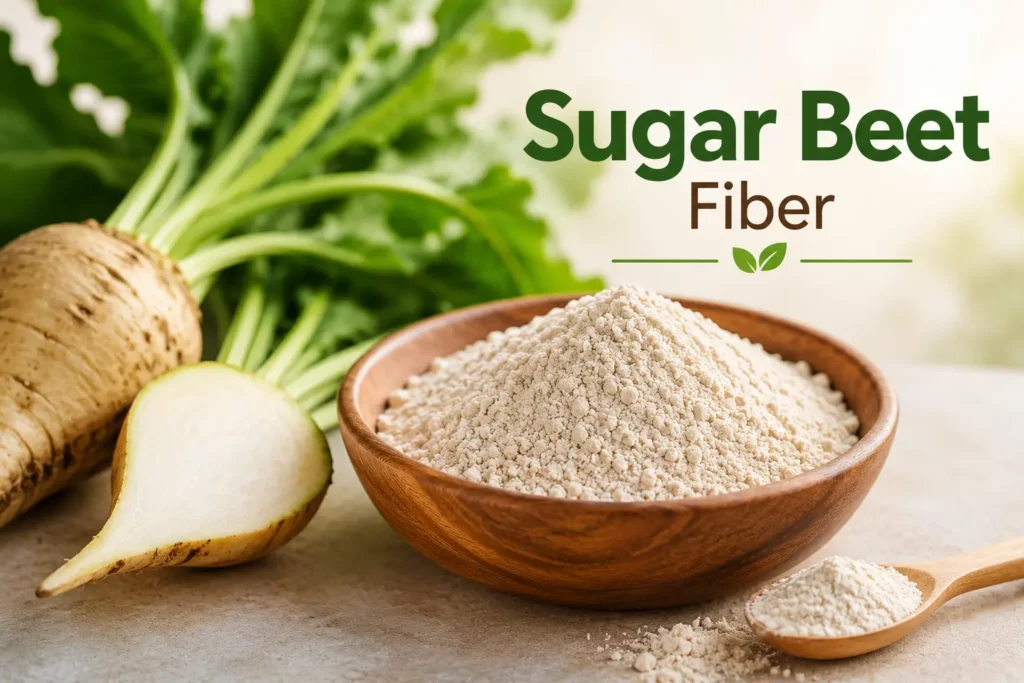
Sugar beet fiber comes from the pulp left over after sugar is extracted from sugar beets — a byproduct that turns out to have a genuinely useful fiber profile of its own. It contains a mix of both soluble and insoluble fiber, along with pectin-like compounds, and is known for an unusually high water-holding capacity. This makes it different from purely bulking fibers or purely gel-forming ones, giving it a role in both food manufacturing and standalone fiber supplements.
If you’ve come across sugar beet fiber on a supplement or food label and want to know what it actually does — and whether it has anything to do with sugar itself — this guide covers it in full.
Table of Contents
What Is Sugar Beet Fiber?
Sugar beet fiber is derived from the pulp remaining after sucrose (table sugar) has been extracted from sugar beets during processing. Despite its name, sugar beet fiber contains virtually none of the sugar itself — the sucrose is removed during processing, leaving behind the beet’s structural fiber content.
This fiber pulp is dried and processed into a powder or granulated product used in both food manufacturing and standalone fiber supplements.
What Makes Its Composition Distinct
Sugar beet fiber contains a mix of:
- Cellulose — an insoluble structural fiber, similar to what’s found in cellulose fiber products.
- Hemicellulose — another insoluble structural component.
- Pectin — a soluble, gel-forming compound also found in fruit sources like apple pectin and citrus pectin.
This combination — insoluble bulk plus a meaningful soluble pectin fraction — is why sugar beet fiber behaves differently from single-category fibers. It isn’t purely a bulking agent, and it isn’t purely a gel-former; it does a bit of both.
How Sugar Beet Fiber Works in the Body
- High water-holding capacity. Sugar beet fiber is particularly well known for absorbing and retaining water, even compared to many other fiber sources, which helps keep stool soft.
- Insoluble fraction adds bulk. The cellulose and hemicellulose components resist digestion and add volume to stool, supporting mechanical movement through the colon.
- Soluble pectin fraction ferments partially. Gut bacteria can break down a portion of the pectin content, offering some mild prebiotic activity without being as heavily fermented as fibers like inulin.
- Combined effect on stool consistency. Because it holds water well while also adding bulk, sugar beet fiber is often associated with producing a well-formed, soft stool rather than either a hard, dry stool or a loose one.
Sugar Beet Fiber vs. Other Fiber Sources
| Fiber | Soluble/Insoluble Mix | Water-Holding Capacity | Fermentability | Common Role |
| Sugar beet fiber | Mixed (mostly insoluble, some pectin) | Very high | Moderate | Bulk + moisture retention |
| Wheat bran | Mostly insoluble | Moderate | Low | Bulk |
| Cellulose | Insoluble | Low–Moderate | Low | Bulk only |
| Citrus/apple pectin | Mostly soluble | High (gel-forming) | Moderate–High | Gel formation, prebiotic |
| Psyllium husk | Mostly soluble | High (gel-forming) | Partial | Gel formation, regularity |
Sugar beet fiber’s high water-holding capacity puts it in a similar functional neighborhood to psyllium husk for stool softness, but its fiber matrix is structurally different — it doesn’t form the same thick, viscous gel that psyllium does. Instead, think of it as a fiber that combines the bulking behavior of insoluble fiber with some of the moisture-retaining benefit typically associated with soluble, gel-forming fibers.
Potential Benefits of Sugar Beet Fiber
Based on its composition and functional properties, sugar beet fiber is associated with:
- Supporting regular, well-formed bowel movements, due to its combination of bulk and water retention.
- Reducing hard, dry stool, since its moisture-holding capacity helps maintain softer stool consistency.
- Mild prebiotic activity, from the partial fermentation of its pectin fraction.
- Contributing fiber to food products without significantly altering taste, since it’s relatively neutral compared to some other fiber additives.
As with most fibers, specific health claims should be viewed with appropriate caution — sugar beet fiber’s research base, while supportive of its general fiber functions, is smaller and less extensive than long-studied fibers like psyllium husk or oat beta-glucan.
Where Sugar Beet Fiber Is Commonly Used
- Fiber supplements — sold as a standalone powder, sometimes combined with other fiber sources.
- Baked goods — used for its water-holding properties, which can improve moisture retention and shelf life.
- Animal feed — historically one of its largest uses, since beet pulp is a well-established fiber source in livestock and pet nutrition.
- Functional food products — added to boost fiber content in items like bread, cereal, and snack bars.
Its dual role in both human food and animal feed reflects how versatile the fiber’s water-holding and bulking properties are across different applications.
Side Effects and Safety Considerations
Sugar beet fiber is generally well tolerated, but a few points are worth noting:
- Adequate water intake still matters. Even though sugar beet fiber holds water well on its own, drinking enough fluid supports its intended softening effect rather than working against it.
- Gradual introduction reduces bloating risk. As with any fiber, a sudden large increase can cause temporary gas or discomfort.
- Beet-related sensitivities are uncommon but possible. Anyone with a known sensitivity to beets specifically should be cautious, though this is rare.
- Not a substitute for medical evaluation. Persistent or severe digestive symptoms should be assessed by a healthcare provider rather than managed with fiber alone.
This article is educational and does not replace personalized medical advice. If you have a diagnosed digestive condition or take medication, speak with a healthcare provider before adding a new fiber source to your routine.
Common Mistakes People Make With Sugar Beet Fiber
- Assuming it contains sugar. The sucrose is removed during processing — what remains is the beet’s fibrous pulp, not a sugar-containing ingredient.
- Expecting it to gel like psyllium. Its water-holding capacity is high, but its fiber structure doesn’t form the same thick viscous gel that psyllium husk does.
- Not drinking enough water. Even a naturally water-retentive fiber still benefits from adequate fluid intake to work as intended.
- Increasing intake too quickly. Sudden jumps in any fiber intake can cause temporary bloating, and sugar beet fiber is no exception.
- Overlooking it as a hidden ingredient. Because it’s commonly used in food manufacturing, people may already be consuming it without realizing it, especially in baked goods.
Frequently Asked Questions
Does sugar beet fiber contain sugar? No. The sucrose is extracted from the sugar beet during processing, and what remains as “sugar beet fiber” is the fibrous pulp, essentially free of the sugar itself.
Is sugar beet fiber soluble or insoluble? It’s a mix — mostly insoluble cellulose and hemicellulose, with a soluble pectin fraction, giving it a combined bulking and moisture-retaining effect.
What is sugar beet fiber used for? It’s used in fiber supplements, food manufacturing (for moisture retention in baked goods), and historically as a major component of livestock and pet feed.
Does sugar beet fiber cause bloating? It can, particularly with a rapid increase in intake, though its moderate fermentability generally makes it less gas-producing than highly fermentable fibers like inulin.
How is sugar beet fiber different from wheat bran? Both are largely insoluble bulking fibers, but sugar beet fiber’s additional soluble pectin content and notably higher water-holding capacity set it apart functionally.
Is sugar beet fiber a good option for constipation? Its combination of bulk and water retention makes it a reasonable option for supporting softer, more regular stool, though it’s less extensively studied for this specific use than fibers like psyllium husk.
Final Verdict
Sugar beet fiber is a practical, dual-function fiber — combining insoluble bulk with a soluble pectin fraction and a standout water-holding capacity. It occupies a useful middle ground between purely bulking fibers like cellulose and gel-forming fibers like psyllium, making it a solid, general-purpose fiber for supporting regularity and softer stool consistency.
It isn’t the most heavily researched fiber on the market, and its role is often more visible in food manufacturing than as a headline supplement ingredient. But for people looking for a balanced, well-tolerated fiber that isn’t dominated by one single mechanism, sugar beet fiber is a reasonable and versatile choice.
If you’re comparing it against other bulk-and-moisture fibers, our guide on soluble vs. insoluble fiber can help you decide which mechanism best matches your digestive goals.