
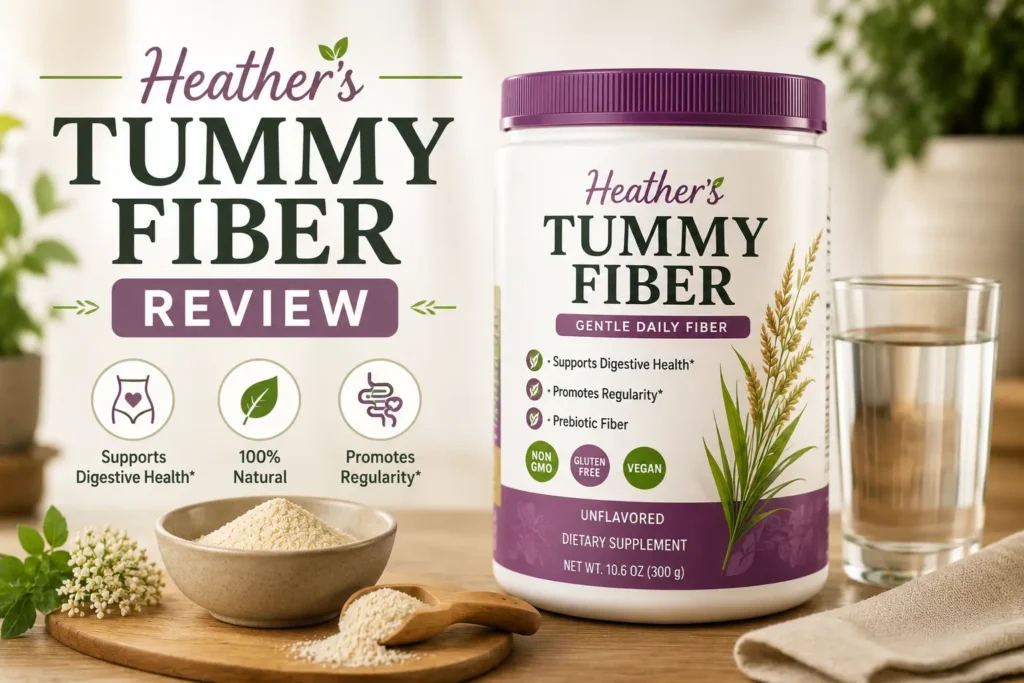
Heather’s Tummy Fiber is a single-ingredient, organic acacia senegal fiber supplement built specifically around the needs of people with Irritable Bowel Syndrome. This Heather’s Tummy Fiber review finds that its biggest differentiator isn’t the fiber source itself — acacia is available from several brands — but its formulation philosophy: <cite index=”57-1″>no psyllium, no citric acid, no insoluble fiber, no artificial sweeteners, and no FODMAPs</cite>, all ingredients known to trigger IBS symptoms in sensitive people.
Unlike psyllium or wheat dextrin, acacia senegal <cite index=”57-1″>never thickens on standing and carries no choking risk</cite>, which makes it one of the gentlest fiber options available for a reactive gut. It’s not a fast fix — constipation relief can take weeks of gradual dose increases — but for people whose IBS has been made worse by other fiber supplements, Heather’s Tummy Fiber is one of the most carefully engineered options on the market.
Table of Contents
What Is Heather’s Tummy Fiber?
Heather’s Tummy Fiber is a branded acacia senegal supplement made by Heather’s Tummy Care, a company built around IBS-specific dietary products. <cite index=”54-1″>It’s described as a medical food for the dietary management of Irritable Bowel Syndrome symptoms, intended to be used under a physician’s supervision.</cite> <cite index=”55-1″>The product is 100% acacia senegal — never the lower-grade acacia seyal used in some cheaper fiber products.</cite>
Acacia senegal is a natural gum harvested from the sap of the acacia senegal tree, primarily grown in parts of Africa. <cite index=”53-1″>Heather’s sources its acacia through partnerships with local farmers, and the product is grown and processed as 100% organic soluble fiber.</cite>
The product line includes:
- Tummy Fiber Powder — sold in pouch or canister form
- Tummy Fiber Travel Packets — pre-measured single-serving packets for use away from home
How Heather’s Tummy Fiber Works
Acacia senegal is a soluble, slowly fermenting prebiotic fiber. <cite index=”54-1″>Clinical research on soluble fiber shows it helps soothe and regulate bowel motility, relieves IBS-related abdominal pain and cramping by stabilizing intestinal contractions, and alleviates both diarrhea and constipation.</cite>
What sets acacia apart from other soluble fibers is its fermentation speed. <cite index=”55-1″>It slows colonic fermentation, which in turn decreases gas and bloating</cite> — a meaningful distinction from faster-fermenting fibers like inulin or psyllium, which can trigger more noticeable gas in sensitive individuals. <cite index=”55-1″>It’s also considered a prebiotic that increases beneficial gut flora and has excellent gastrointestinal tolerance.</cite>
Because it works on both ends of the bowel-motility spectrum, acacia is one of the few fiber types genuinely marketed to help <cite index=”58-1″>normalize stool consistency for both constipation and diarrhea</cite>, rather than being formulated for one direction only.
Heather’s Tummy Fiber Ingredients
This is about as simple as a fiber supplement’s ingredient list gets.
| Ingredient | Detail |
| Active ingredient | <cite index=”53-1″>Organic Acacia (100% Acacia Senegal)</cite> |
| Other ingredients | None |
| Sugar | <cite index=”52-1″>0 g</cite> |
| Fat | <cite index=”52-1″>0 g</cite> |
| Sodium | <cite index=”52-1″>0 g</cite> |
| Calories per serving | <cite index=”52-1″>10</cite> |
| Certifications | <cite index=”53-1″>Organic (Quality Assurance International), Sustainable Forestry Initiative Chain of Custody</cite> |
A detail worth flagging that most competitor reviews skip entirely: grade matters more than most people realize with acacia. <cite index=”55-1, 57-1″>Heather’s specifically uses acacia senegal rather than the lower-grade acacia seyal</cite> that shows up in some cheaper fiber products. If you’re comparing acacia brands, checking which species is used is a genuinely useful way to evaluate quality — seyal is a different tree gum with different solubility characteristics, and mixing them up is an easy way to end up with a lower-quality product without realizing it.
<cite index=”57-1″>The product is also naturally free of psyllium, citric acid, insoluble fiber, gluten, and FODMAPs</cite> — a deliberate design choice, since all of these are known IBS triggers for some people.
Heather’s Tummy Fiber Dosage
Dosage is where this product differs most from mainstream fiber brands — it’s built around gradual titration rather than a fixed daily amount.
| Format | Starting Dose | Maximum Dose | Frequency |
| Powder | <cite index=”52-1″>1/2 teaspoon, twice daily</cite> | <cite index=”52-1″>5 tablespoons per day</cite> | 2–3 divided doses |
| Packets | 1 packet | <cite index=”53-1″>15 packets per day</cite> | <cite index=”53-1″>2–6 packets per day on average</cite> |
| Typical adult range | <cite index=”52-1″>4 to 18 grams (2 teaspoons to 3 tablespoons) per day</cite> | — | Divided into two doses |
<cite index=”52-1″>Gradually increase your daily dose — try adding an extra half teaspoon every 4–5 days — and keep increasing until symptoms stabilize.</cite> <cite index=”52-1″>Diarrhea and spasms tend to resolve fairly quickly as the dose increases, while constipation, especially if chronic or severe, may take several weeks and require working up to the maximum dose.</cite>
A mixing tip that isn’t obvious from the label: <cite index=”52-1″>add the powder to an empty cup first, stir with a fork as you add liquid, let it rest a minute, then stir again</cite> — acacia dissolves slowly compared with something like Sunfiber, so a two-step stir prevents clumping.
Pros and Cons of Heather’s Tummy Fiber
| Pros | Cons |
| Single ingredient — 100% organic acacia senegal | Slower to dissolve than PHGG or wheat dextrin |
| <cite index=”57-1″>Never thickens, no choking risk</cite> | Full effect for constipation can take several weeks |
| Free of common IBS trigger ingredients (psyllium, citric acid, FODMAPs) | Requires careful, gradual dose titration for best results |
| Helps with both diarrhea and constipation | More expensive per serving than generic acacia powders |
| Uses higher-grade acacia senegal, not lower-grade seyal | Marketed as a “medical food,” so labeling and positioning differ from typical supplements |
| Tasteless, odorless, colorless, grit-free | Best results are described as requiring physician guidance for IBS management |
Heather’s Tummy Fiber Side Effects
Acacia senegal has one of the gentler side-effect profiles among fiber types, largely because of its slow fermentation rate.
<cite index=”53-1″>Heather’s Tummy Fiber contains no GI stimulants or irritants</cite>, and <cite index=”55-1″>it’s described as completely safe and healthy for daily, lifelong use, including in children.</cite> Even so, some general fiber precautions still apply:
- Starting at too high a dose can still cause temporary gas or bloating in sensitive individuals — this is why the label emphasizes gradual titration
- As with any fiber, adequate hydration supports better results
- <cite index=”54-1″>Because this product is positioned as a medical food for IBS management, it’s intended to be used under a physician’s supervision</cite>, not as a casual over-the-counter purchase
This article is for educational purposes only and isn’t a substitute for medical advice. If you have IBS or another chronic digestive condition, work with your doctor to determine whether Heather’s Tummy Fiber fits your treatment plan and how to titrate the dose appropriately.
Who Heather’s Tummy Fiber Is a Good Fit For
- People with IBS who’ve reacted poorly to psyllium, inulin, or other more fermentable fibers
- Anyone who needs a fiber that helps stabilize both diarrhea and constipation
- People sensitive to FODMAPs, citric acid, or artificial sweeteners in other fiber products
- Anyone who wants the highest-grade acacia senegal available, rather than a generic acacia blend
Who Should Consider a Different Fiber Supplement
- Anyone who wants a fiber that dissolves instantly — see our Sunfiber review for a faster-dissolving prebiotic alternative
- People looking for the lowest cost per gram of fiber, since specialty acacia costs more than generic psyllium
- Anyone who needs fast constipation relief rather than a gradual, weeks-long titration approach
- People without diagnosed IBS who just want a general daily fiber supplement — a simpler acacia fiber product may be more cost-effective
Heather’s Tummy Fiber vs. Other Fiber Supplements
| Feature | Heather’s Tummy Fiber (Acacia) | Sunfiber (PHGG) | Psyllium Husk |
| Fiber source | Acacia senegal | Partially hydrolyzed guar gum | Psyllium husk |
| Fermentation speed | Slow | Moderate–fast | Moderate |
| Gas/bloating risk | Low | Low | Moderate–higher |
| Thickens on standing | <cite index=”57-1″>No</cite> | No | Yes |
| Choking risk | <cite index=”57-1″>None noted</cite> | Low | Present, per label warnings |
| Designed specifically for IBS | Yes | Low-FODMAP certified, IBS-friendly | Not specifically |
| Helps constipation and diarrhea | <cite index=”58-1″>Yes</cite> | <cite index=”49-1″>Yes</cite> | Primarily constipation |
For more on how acacia stacks up against other prebiotic fibers, see our acacia fiber vs. psyllium and inulin vs. acacia fiber comparisons.
Common Mistakes People Make With Heather’s Tummy Fiber
- Starting at too high a dose. <cite index=”52-1″>The label specifically recommends starting at just half a teaspoon twice daily</cite> — jumping straight to a larger dose defeats the purpose of gradual titration.
- Expecting fast results for constipation. <cite index=”52-1″>Chronic or severe constipation may take several weeks and require increasing to the maximum dose</cite> before results stabilize.
- Not stirring in two stages. Acacia dissolves more slowly than some other fibers — skipping the rest-and-restir step can leave clumps.
- Assuming all acacia products are the same grade. <cite index=”55-1, 57-1″>Confirm you’re buying acacia senegal, not the lower-grade acacia seyal</cite>, since quality and solubility differ between the two.
- Using it without medical guidance for a diagnosed condition. <cite index=”54-1″>Since this product is positioned as a medical food for IBS management</cite>, working with a physician helps ensure the dosing and approach fit your specific symptoms.
What Real Users Report
Long-time users, particularly those with diagnosed IBS, consistently describe Heather’s Tummy Fiber as the product that finally worked after other fiber supplements made their symptoms worse. The most common praise centers on its lack of taste, grit, and gas — exactly the traits the brand markets around. The most common criticism is patience: users managing constipation specifically note that it takes weeks of gradual increases to see the full effect, and some find the price higher than they expected for a single-ingredient product. Reviewers who stuck with the gradual titration schedule described in the directions report the most consistent success.
Heather’s Tummy Fiber FAQs
Is Heather’s Tummy Fiber good for IBS? <cite index=”54-1″>Yes — it’s specifically formulated and positioned as a medical food for the dietary management of IBS symptoms</cite>, and <cite index=”57-1″>it’s free of common IBS triggers like psyllium, citric acid, insoluble fiber, and FODMAPs.</cite>
How is acacia senegal different from acacia seyal? <cite index=”55-1″>Acacia senegal is the higher grade used in Heather’s Tummy Fiber</cite>, while acacia seyal is a lower-grade gum sometimes substituted in cheaper products. The two differ in solubility and quality.
Does Heather’s Tummy Fiber help with diarrhea or constipation? <cite index=”58-1″>Both — one of acacia’s unique properties is its ability to normalize stool consistency in either direction</cite>, rather than working exclusively as a laxative or anti-diarrheal.
How long does it take to work? <cite index=”52-1″>Diarrhea and spasms tend to resolve fairly quickly as the dose increases, while constipation — especially if chronic or severe — may take several weeks and require gradual increases to the maximum dose.</cite>
Is Heather’s Tummy Fiber safe for daily use? <cite index=”55-1″>It’s described as safe and healthy for daily, lifelong use, including for children</cite>, though as with any product marketed for a specific condition, checking in with a doctor is worthwhile, especially when starting out.
Does Heather’s Tummy Fiber cause gas or bloating? Less than many other fibers, since <cite index=”55-1″>it slows colonic fermentation, which in turn decreases gas and bloating</cite>. Starting at a low dose and increasing gradually further reduces this risk.
Can I cook or bake with Heather’s Tummy Fiber? <cite index=”53-1″>Yes — it can be added to liquids for cooking or mixed into flour for baking</cite>, since it dissolves without altering taste, color, or texture.
Final Verdict
This Heather’s Tummy Fiber review comes down to a clear conclusion: for people managing IBS, this is one of the most deliberately engineered fiber products available, built specifically to avoid the common triggers that make other fiber supplements backfire. The higher-grade acacia senegal, the absence of thickening or choking risk, and the ability to help with both constipation and diarrhea make it a genuinely different product from a typical grocery-aisle fiber supplement.
It asks for patience — gradual titration is central to how it’s meant to be used — and it costs more than a generic fiber powder. But for anyone whose gut has struggled with psyllium or other more aggressive fibers, it’s worth discussing with your doctor. For a faster-dissolving prebiotic alternative that’s also IBS-friendly, our Sunfiber review is a useful comparison point.
This article is for educational purposes only and does not constitute medical advice. Always consult a healthcare professional before starting a new supplement, especially if you have an existing health condition or take medication.