
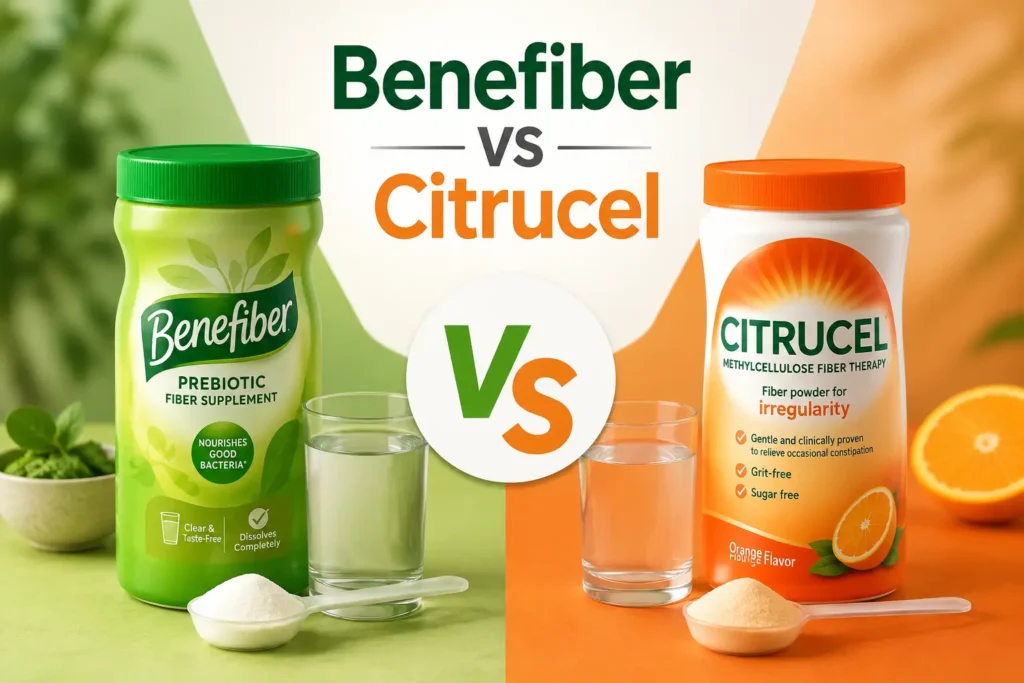
Benefiber and Citrucel are both soluble fiber supplements, but they come from different fiber sources with different personalities in your gut. Benefiber uses wheat dextrin, a fermentable fiber that dissolves invisibly in liquid and doubles as a mild prebiotic. Citrucel uses methylcellulose, a non-fermentable fiber that adds firm bulk to stool without feeding gut bacteria — which usually means less gas.
If constipation is your main problem and gas is a concern, Citrucel’s non-fermentable fiber tends to be the gentler, more predictable choice. If you want a fiber source that also supports gut bacteria and mixes just as invisibly, Benefiber is the better fit — as long as your gut tolerates fermentable fiber well. Neither is automatically “stronger” than the other; they solve slightly different problems.
Table of Contents
Benefiber vs Citrucel: The Fast Comparison
| Feature | Benefiber | Citrucel |
| Active fiber | Wheat dextrin | Methylcellulose |
| Fermentable? | Yes (partially fermentable) | No (non-fermentable) |
| Gas/bloating risk | Moderate, more likely at higher doses | Lower — a common reason people switch to it |
| Texture in water | Dissolves clear, no grit | Dissolves clear, slightly thicker than Benefiber |
| Taste | Virtually tasteless | Mild, sometimes available in orange flavor |
| Prebiotic effect | Yes — feeds gut bacteria | No — passes through largely unfermented |
| Best known for | Easy daily fiber top-up | Constipation relief with minimal gas |
| Available forms | Powder | Powder and caplets |
| Wheat/gluten note | Made from wheat starch; not marketed gluten-free | Not wheat-derived |
This single table answers the question most people actually type into Google: “which one will make me less gassy and still fix my constipation?”
What Is Benefiber?
Benefiber’s active ingredient is wheat dextrin, a soluble fiber extracted from wheat starch. It dissolves completely and invisibly in liquids or soft foods, without changing taste or texture — the reason many people choose it over grittier fiber powders.
Wheat dextrin is a fermentable fiber, meaning gut bacteria break much of it down in the colon. This fermentation feeds beneficial bacteria, giving Benefiber a mild prebiotic effect. The tradeoff is that fermentation also produces gas as a byproduct, which is why some people notice more bloating with Benefiber than with non-fermentable fibers.
For a deeper look at this ingredient specifically, see wheat dextrin.
What Is Citrucel?
Citrucel’s active ingredient is methylcellulose, a semi-synthetic fiber derived from plant cellulose. Unlike wheat dextrin, methylcellulose is non-fermentable — gut bacteria mostly can’t break it down. It passes through the digestive tract largely intact, absorbing water and adding firm, consistent bulk to stool along the way.
Because it isn’t fermented, Citrucel typically produces less gas than fermentable fibers like wheat dextrin or psyllium. This makes it a common recommendation for people who’ve tried other fiber supplements and found the bloating hard to tolerate.
Citrucel is recognized as a bulk-forming laxative, similar in classification to Metamucil, but with a different fiber source and a gentler gas profile.
The Core Difference: Fermentable vs Non-Fermentable Fiber
This is the detail most comparison articles bury or skip, even though it explains almost everything else about how these two products feel in your body:
- Wheat dextrin (Benefiber) ferments in the colon → feeds gut bacteria → produces some gas as a byproduct → offers a mild prebiotic benefit.
- Methylcellulose (Citrucel) does not ferment → passes through mostly unchanged → adds bulk without feeding bacteria → produces less gas, but also skips the prebiotic effect.
Neither trait makes one fiber objectively better. If your priority is minimizing gas, non-fermentable wins. If your priority is supporting gut bacteria alongside regularity, fermentable fiber has an edge. This tradeoff — gas control vs. prebiotic support — is the real decision at the center of “Benefiber vs Citrucel,” more than raw effectiveness.
Our guide to soluble vs. insoluble fiber covers the broader fiber categories if you want the fundamentals before comparing brands.
Effectiveness for Constipation
Both products are approved, evidence-supported options for relieving occasional constipation, but they work through slightly different mechanisms.
Citrucel (methylcellulose) adds firm, consistent bulk to stool by holding water without fermenting. This steady bulking action is one reason it’s often recommended for people with IBS or sensitive digestion, where gas from fermentable fibers can worsen symptoms.
Benefiber (wheat dextrin) softens and adds some bulk to stool as well, but its effect leans more toward general digestive support and feeding gut bacteria than dedicated constipation treatment. It’s often described as gentler and slower-acting for regularity compared to more bulk-forming options.
Practical takeaway: if constipation relief is your primary goal and you’re sensitive to gas, Citrucel’s non-fermentable mechanism usually makes it the more predictable choice. If you want a general fiber top-up with a bonus prebiotic effect and mild constipation support, Benefiber can work well.
For supplement options specifically built around constipation relief, see best fiber supplement for constipation.
Gas, Bloating, and IBS Considerations
This is the single biggest reason people search “Benefiber vs Citrucel” instead of just buying either one.
- Benefiber can cause noticeable gas, especially when starting at a full dose. This comes directly from wheat dextrin’s fermentation in the colon.
- Citrucel is generally the gentler option for gas-sensitive people, since methylcellulose isn’t fermented by gut bacteria.
- For IBS specifically, many clinicians and patient resources point toward non-fermentable fibers like methylcellulose over fermentable ones, since fermentation byproducts can aggravate bloating and discomfort in sensitive guts.
If gas is your main concern and neither of these feels right after trying them, it’s worth knowing that psyllium-based products can go either direction depending on the person — see our fiber supplement that doesn’t cause gas guide for a broader comparison across fiber types.
Taste, Texture, and Daily Usability
Both products are designed to mix cleanly into liquids without the thick gel texture associated with psyllium-based supplements like Metamucil.
- Benefiber dissolves completely clear and is essentially tasteless, making it easy to add to coffee, water, or soup.
- Citrucel also dissolves without major grit, though some users describe a very slightly thicker consistency than Benefiber. Citrucel is also available in caplet form, which Benefiber currently is not, giving pill-preferring users an option.
If ease of daily use matters as much as the health effect, both are strong choices — the caplet option is a genuine point in Citrucel’s favor for people who dislike mixing powders altogether.
A Better Decision Framework Than “Just Pick One”
Instead of guessing, run through these four questions:
1. Is gas or bloating a major concern for you?
- Yes → Citrucel’s non-fermentable fiber is the safer starting point.
- Not really → Either product is reasonable.
2. Do you have IBS or a highly sensitive gut?
- Yes → Non-fermentable methylcellulose (Citrucel) is generally easier to tolerate.
- No known sensitivity → Fermentable wheat dextrin (Benefiber) is fine to try.
3. Do you want a prebiotic benefit alongside fiber?
- Yes → Benefiber’s fermentable fiber feeds gut bacteria; Citrucel doesn’t.
- Not a priority → Citrucel’s simplicity may be preferable.
4. Do you prefer powders or pills?
- Only want powder → Both work.
- Want a pill option → Citrucel offers caplets; Benefiber is powder-only.
Running through these four questions gets most people to a confident answer faster than reading ingredient panels alone.
Common Mistakes People Make With Either Supplement
- Starting at the full dose immediately. Both fibers, especially fermentable ones like wheat dextrin, are more likely to cause gas when the dose jumps too fast. Start low and increase gradually.
- Not drinking enough water. Both supplements rely on water to bulk stool properly; skimping on fluids reduces effectiveness and can worsen constipation.
- Expecting same-day results. Most bulk-forming fiber supplements take one to three days of consistent use to show a noticeable effect.
- Assuming “less gas” means “no gas.” Citrucel typically causes less gas than Benefiber, but individual reactions vary, and any new fiber can cause some adjustment period.
- Ignoring medication timing. Both fibers can interfere with how well certain medications absorb if taken at the same time; spacing doses by a couple of hours is a simple fix.
Frequently Asked Questions
Which causes less gas, Benefiber or Citrucel? Citrucel generally causes less gas because methylcellulose isn’t fermented by gut bacteria. Benefiber’s wheat dextrin is fermentable, which can produce more gas, especially when starting out or increasing the dose quickly.
Which is better for IBS, Benefiber or Citrucel? Citrucel’s non-fermentable fiber is often better tolerated by people with IBS, since fermentation byproducts from fibers like wheat dextrin can sometimes worsen bloating in sensitive guts. Individual tolerance still varies, so this isn’t a guarantee for everyone.
Can I switch between Benefiber and Citrucel without a taper? Yes. Both are fiber supplements with different active ingredients, so there’s no dependency or withdrawal concern when switching. It’s still wise to start at a lower dose when trying a new fiber source.
Does Citrucel work faster than Benefiber? Neither is designed to work “fast.” Both typically take one to three days of consistent use to noticeably improve regularity. Onset speed depends more on your hydration, dose, and gut health than on the brand itself.
Is one of these more natural than the other? Wheat dextrin (Benefiber) is a processed starch derivative from wheat. Methylcellulose (Citrucel) is a semi-synthetic fiber made from plant cellulose. Neither is a whole, unprocessed food source of fiber, and neither has been shown to be unsafe when used as directed.
Can I take Benefiber and Citrucel together? Some people combine fiber sources, but there’s little reason to combine these two specifically since they serve overlapping purposes. If you want both a prebiotic effect and firm bulking action, it’s more useful to talk to a doctor about the right combination and dosing for your situation rather than guessing.
Final Verdict
Benefiber and Citrucel both solve the same basic problem — not enough fiber, and irregular bowel movements — but through different mechanisms. Citrucel’s methylcellulose is non-fermentable, which usually means less gas and a more predictable experience for constipation and IBS-sensitive guts. Benefiber’s wheat dextrin ferments in the colon, offering a mild prebiotic benefit at the cost of somewhat higher gas risk for some users.
If gas tolerance and IBS sensitivity are your main concerns, Citrucel is generally the safer starting point. If you want a fiber source that also feeds gut bacteria and you tolerate fermentable fiber well, Benefiber is a solid daily option. For a broader view of how these two compare against psyllium-based options like Metamucil, see our guide to Metamucil vs Benefiber, or explore how to choose a fiber supplement for the full decision process.
This article is for educational purposes only and does not replace personalized medical advice. Talk to a healthcare provider before starting any new supplement, especially if you have IBS, a diagnosed digestive condition, or take regular medication.