
Soluble fiber dissolves in water and turns into a gel-like substance as it moves through your digestive tract. This gel slows digestion, which helps steady blood sugar and lower cholesterol. Insoluble fiber doesn’t dissolve in water — it stays mostly intact, adding bulk to stool and speeding up how quickly food moves through your gut. In short: soluble fiber feeds and slows, insoluble fiber bulks and moves. Most whole plant foods contain a mix of both, and you need both types for a well-functioning digestive system.
If you’re trying to decide which one you need more of, or you’re comparing supplements built around one type or the other, this guide breaks down exactly how they differ, what each one does in your body, and how to combine them properly.
Table of Contents
What Is Dietary Fiber, Exactly?
Fiber is a type of carbohydrate found in plant foods — fruits, vegetables, whole grains, legumes, nuts, and seeds. Unlike other carbohydrates, your body can’t fully break fiber down or absorb it. Instead, it travels largely intact through your stomach, small intestine, and colon.
That might sound like fiber does nothing, but the opposite is true. Because it isn’t absorbed, fiber gets to do jobs that other nutrients can’t: it feeds gut bacteria, regulates how fast sugar enters your bloodstream, adds bulk to stool, and helps carry waste out of the body.
Fiber is split into two broad categories based on one simple property: does it dissolve in water or not. That single difference explains almost everything about how each type behaves in your digestive tract.
Soluble Fiber: How It Works
Soluble fiber dissolves in water and forms a thick, gel-like substance in your stomach and small intestine. This gel does three main things:
- Slows digestion, which means you feel full longer and sugar enters your bloodstream more gradually
- Traps cholesterol-containing bile acids, prompting your liver to pull more cholesterol out of your blood to make new ones
- Feeds beneficial gut bacteria through fermentation in the colon, which produces short-chain fatty acids linked to gut and metabolic health
Because soluble fiber slows the pace at which food leaves your stomach, it’s the type most associated with steadier blood sugar and lower LDL (“bad”) cholesterol.
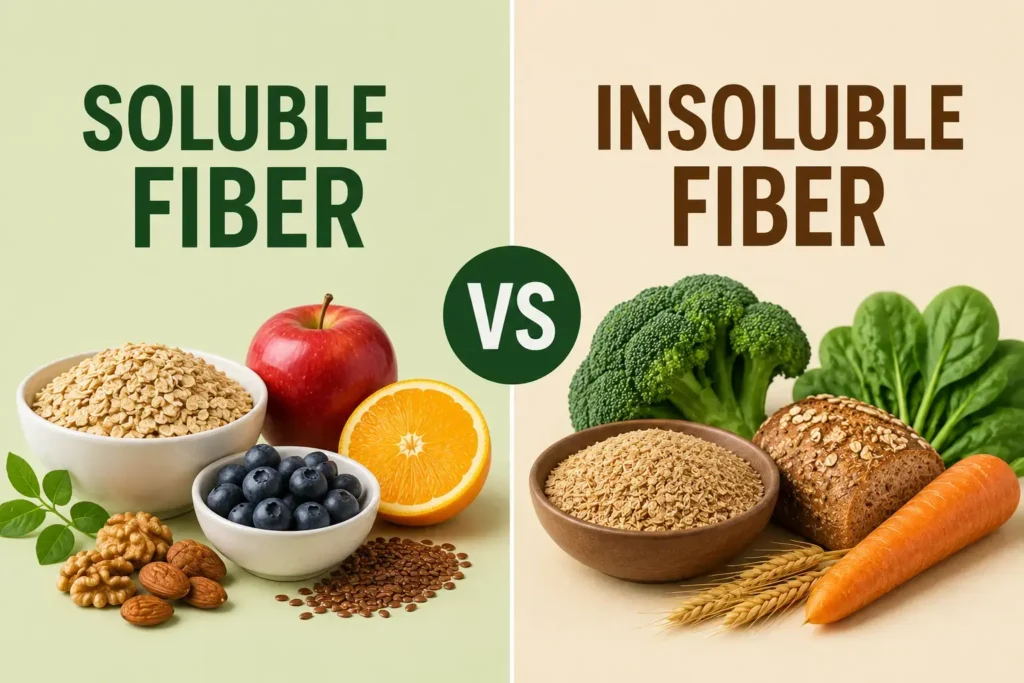
Common Soluble Fiber Foods
- Oats and oat bran
- Beans, lentils, and peas
- Apples, pears, and citrus fruits
- Bananas and avocados
- Carrots
- Barley
- Psyllium husk
If cholesterol or blood sugar control is your main concern, this is the fiber type worth prioritizing. Our guide to the best soluble fiber supplement breaks down which options are best absorbed and most gentle on digestion, and psyllium husk — one of the most researched soluble fibers — has its own dedicated page if you want a deeper look.
Insoluble Fiber: How It Works
Insoluble fiber doesn’t dissolve in water. Instead, it acts almost like a scrub brush and a sponge combined — it adds physical bulk to stool and helps water stay within it, which keeps stool soft and easier to pass. This bulk also presses against the intestinal walls, which stimulates the muscle contractions (peristalsis) that move waste through your colon.
That’s why insoluble fiber is the type most people reach for when constipation, irregularity, or sluggish digestion is the issue. It doesn’t get fermented as heavily by gut bacteria as soluble fiber does, so it passes through largely unchanged — which is exactly what gives it its bulking effect.
Common Insoluble Fiber Foods
- Whole-wheat flour and wheat bran
- Nuts and seeds
- Beans (many legumes contain both fiber types)
- Cauliflower, green beans, and potatoes (with skin)
- Dark leafy greens
- Fruit and vegetable skins
If irregularity is your primary concern, our page on the best fiber supplement for constipation explains which fiber types and forms work fastest, and the dedicated insoluble fiber guide covers this type in more depth.
Soluble vs Insoluble Fiber: Side-by-Side Comparison
| Factor | Soluble Fiber | Insoluble Fiber |
| Dissolves in water | Yes | No |
| Texture in digestion | Forms a gel | Stays mostly intact |
| Main digestive effect | Slows digestion | Speeds up transit, adds bulk |
| Best known for | Lowering cholesterol, steadying blood sugar | Relieving constipation, regularity |
| Fermented by gut bacteria | Highly fermentable | Minimally fermentable |
| Effect on stool | Softer, more gel-like | Bulkier, adds weight and volume |
| Common food sources | Oats, beans, apples, psyllium, barley | Wheat bran, nuts, vegetable skins, whole grains |
| Common supplement forms | Psyllium husk, inulin, glucomannan | Wheat dextrin, methylcellulose (partially) |
Pros and Cons of Each Type
Soluble Fiber
Pros
- Helps lower LDL cholesterol
- Supports steadier post-meal blood sugar
- Increases feelings of fullness, which can support weight management
- Feeds beneficial gut bacteria
Cons
- Too much, too fast can cause gas and bloating
- Doesn’t directly relieve constipation the way insoluble fiber does
- Some sources (like inulin) can cause more fermentation-related discomfort in sensitive people
Insoluble Fiber
Pros
- Effective for relieving and preventing constipation
- Speeds up transit time, which may reduce time toxins spend in the gut
- Adds satisfying bulk and texture to meals
Cons
- Can worsen symptoms in people with active IBS flare-ups or certain inflammatory bowel conditions
- Less effect on cholesterol or blood sugar
- Needs adequate water intake to work properly — without it, it can worsen constipation instead of relieving it
Do You Need Both? (Yes — Here’s Why)
Almost no whole food is purely one type of fiber. An apple, for example, has soluble fiber in its flesh and insoluble fiber in its skin. Beans contain a meaningful amount of both. This is by design — your digestive system relies on the two types working together, not in isolation.
- Soluble fiber slows things down just enough to let sugar and cholesterol be processed more gradually.
- Insoluble fiber keeps things moving so waste doesn’t sit in the colon too long.
Focusing entirely on one type while ignoring the other is one of the most common mistakes people make when trying to “fix” a specific fiber-related complaint. Someone constipated might load up on soluble fiber gummies and see little improvement, when what they actually needed was more insoluble bulk. Someone trying to lower cholesterol might eat plenty of insoluble bran and wonder why their numbers haven’t moved.
If you’re unsure where to start, a fiber source that naturally contains a blend of both — rather than an isolated single-type supplement — is often the simplest way to cover your bases. Our roundup of the best fiber supplement compares blended and single-type options side by side.
How Much Fiber Do You Actually Need?
Total daily fiber recommendations (combining both types) from the National Academy of Medicine are:
- 25 g/day for women 50 and younger
- 21 g/day for women over 50
- 38 g/day for men 50 and younger
- 30 g/day for men over 50
There’s no separate official target for soluble versus insoluble fiber specifically — the guidance is for total fiber intake, with an emphasis on getting it from a variety of whole foods rather than a single source. Most adults in the U.S. fall well short of these numbers, often getting only half the recommended amount.
Common Mistakes People Make With Fiber
Increasing intake too quickly. Jumping from a low-fiber diet to a high-fiber one in a few days is the number one cause of gas, bloating, and cramping. Increase gradually over 2–3 weeks.
Not drinking enough water. Both fiber types rely on water to work correctly. Soluble fiber needs water to form its gel; insoluble fiber needs water to keep stool soft. Adding fiber without adding fluids can make constipation worse, not better.
Assuming all fiber supplements are the same. A psyllium-based product behaves very differently from a wheat-dextrin or methylcellulose one. If you’re constipated, you want more of the bulking (insoluble-leaning) effect; if you’re managing cholesterol, you want the gel-forming (soluble) effect. Check our best fiber supplement for women and best fiber supplement for weight loss pages for goal-specific comparisons.
Ignoring food sources in favor of supplements. Whole foods provide fiber alongside vitamins, minerals, and antioxidants that isolated supplements don’t. Supplements are useful when diet alone isn’t enough, but they shouldn’t fully replace fiber-rich foods.
Taking fiber supplements with medications at the same time. Fiber can interfere with the absorption of certain medications. Take fiber supplements at least 1–2 hours apart from medications unless a healthcare professional advises otherwise.
Which Type Should You Focus On? A Simple Decision Framework
Use this quick framework to figure out where to put your attention:
- Struggling with constipation or irregularity → Prioritize insoluble fiber (wheat bran, vegetables, whole grains), paired with plenty of water.
- Managing cholesterol or blood sugar → Prioritize soluble fiber (oats, psyllium, beans, barley).
- Trying to feel fuller for longer / support weight goals → Soluble fiber has the stronger appetite-regulating effect, though both types add to overall satiety.
- Not sure / general gut health → Focus on total fiber from varied whole foods first, since most produce naturally contains both types together.
- Diarrhea-predominant digestive issues → Soluble fiber can help by absorbing excess water and firming up stool.
If you’d rather not calculate ratios from food labels, a daily fiber supplement formulated with a blend of both types can simplify things — particularly if your diet is inconsistent day to day.
Frequently Asked Questions
Is psyllium husk soluble or insoluble fiber? Psyllium is mostly soluble fiber, though it contains a small amount of insoluble fiber too. It’s one of the most studied fibers for both cholesterol reduction and improving stool consistency, which is why it works for both constipation and diarrhea. See our full psyllium husk comparison for specific product picks.
Which type of fiber is better for weight loss? Soluble fiber tends to have a stronger effect on appetite and fullness because the gel it forms slows stomach emptying. That said, total fiber intake — not just one type — is what’s most consistently linked to weight management in research.
Can too much insoluble fiber be bad for you? Yes, in certain situations. People with active flares of inflammatory bowel disease, or those with strictures or narrowed intestines, are often advised to reduce insoluble fiber temporarily, since the bulk and roughage can aggravate irritated tissue. This should be guided by a healthcare professional.
Do fiber supplements contain both soluble and insoluble fiber? It depends on the product. Psyllium husk supplements lean soluble. Wheat dextrin and inulin are also mostly soluble. Some blended formulas combine multiple fiber sources to provide both types in one dose — check the label or product page to see the specific fiber source used.
What happens if I only eat soluble fiber and no insoluble fiber? You may notice good cholesterol and blood sugar support but slower bowel regularity, since soluble fiber alone doesn’t add the same bulking effect. This is why whole, varied plant foods — which naturally combine both types — tend to outperform single-type approaches.
Does cooking food change its fiber type or content? Cooking can soften fiber and make it easier to digest, but it generally doesn’t convert soluble fiber into insoluble fiber or vice versa. Peeling fruits and vegetables, however, does remove a significant amount of their insoluble fiber, since much of it is concentrated in the skin.
Final Verdict
Soluble and insoluble fiber aren’t competing categories — they’re two tools that solve different problems. Soluble fiber’s gel-forming action makes it the better choice for cholesterol and blood sugar management. Insoluble fiber’s bulking action makes it the better choice for regularity and constipation relief.
Rather than picking a side, the healthiest approach is to get both from a varied diet of whole plant foods — fruits, vegetables, whole grains, legumes, nuts, and seeds — and drink enough water to let either type do its job properly. If your diet consistently falls short, a well-chosen fiber supplement can help close the gap; browse our best fiber powder, best fiber pills, and best fiber gummies comparisons to find a format that fits your routine, or start with a natural fiber supplement if you prefer whole-food-based ingredients over synthetic ones.
This article is for educational purposes only and is not a substitute for medical advice. Speak with a healthcare professional before making significant changes to your fiber intake, especially if you have a digestive condition.