
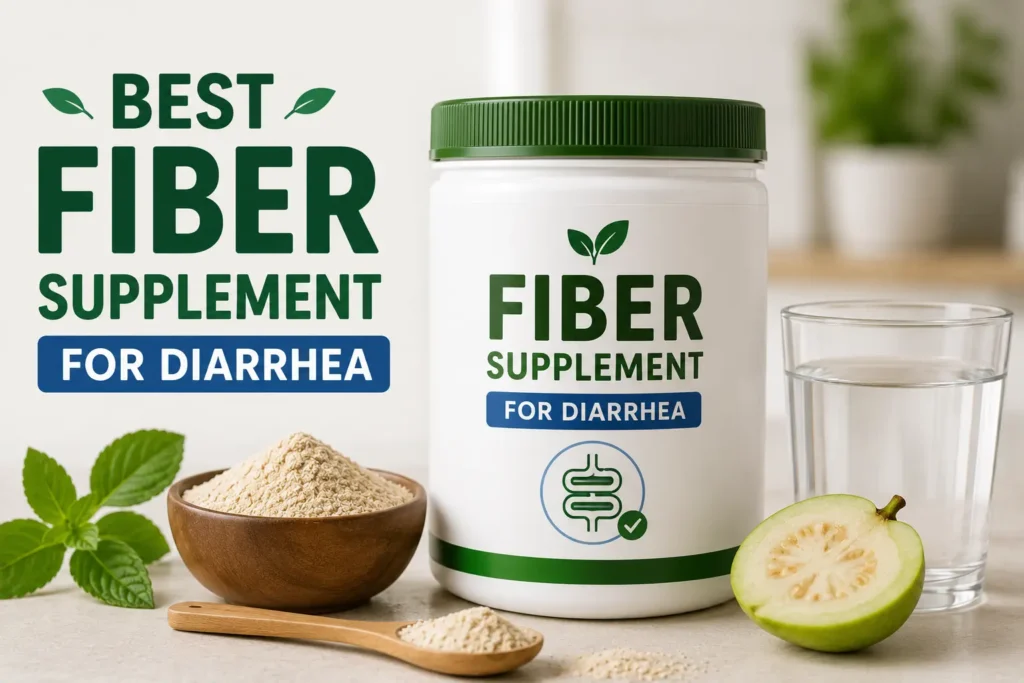
The best fiber supplement for diarrhea is a soluble, gel-forming fiber like psyllium husk. Soluble fiber absorbs excess water in the gut and forms a gel that firms up loose, watery stools, while also slowing down how quickly food moves through the colon. Insoluble fiber (like wheat bran) does not have this effect and can sometimes make loose stools or bloating worse.
If you only remember one thing from this guide, remember this: not all fiber supplements work for diarrhea, and picking the wrong type can backfire.
Diarrhea that is severe, bloody, accompanied by fever, or lasting more than a couple of days needs medical attention rather than a supplement. This article is educational and does not replace advice from a doctor or dietitian.
Table of Contents
Why Fiber Type Matters More Than the Brand
Most articles on this topic jump straight to product recommendations. That’s a mistake, because the brand of fiber supplement matters far less than the type of fiber inside it.
Fiber falls into two broad categories:
- Soluble fiber dissolves in water and forms a thick, gel-like substance in the gut.
- Insoluble fiber does not dissolve; it adds bulk and passes through the digestive tract largely intact.
For diarrhea specifically, soluble fiber is the one that matters. Its gel-forming ability lets it soak up excess fluid in the intestines, which is exactly what’s happening during a bout of loose stools. Insoluble fiber, on the other hand, speeds up transit time and adds roughage — helpful for constipation, but not what you want when stools are already moving too fast.
This is the central idea behind choosing a fiber supplement for diarrhea, and it’s the piece most buying guides gloss over.
For a deeper breakdown of the two categories, see our guides on soluble fiber, insoluble fiber, and soluble vs. insoluble fiber.
How Soluble Fiber Actually Firms Up Loose Stools
It helps to understand the mechanism, not just the recommendation.
- Water absorption: Soluble fiber, especially psyllium, absorbs many times its weight in water and swells into a viscous gel.
- Excess fluid trapping: During diarrhea, the intestines are carrying more water than usual. The fiber gel binds that extra fluid instead of letting it pass straight through as watery stool.
- Slower transit: The thicker, gel-like content moves through the colon more slowly, giving the gut more time to reabsorb water and nutrients.
- Bulkier, more formed stool: The end result is a stool that holds together instead of being loose and watery.
This is often called a “stool-normalizing” effect, and it’s the reason the same fiber that helps constipation can also help diarrhea — the gel works in both directions depending on what the gut needs.
The Best Fiber Types for Diarrhea (Ranked)
| Fiber Type | Best For Diarrhea? | Why |
| Psyllium husk | ✅ Best overall | Strongest gel-forming ability; most researched for stool normalization |
| Partially hydrolyzed guar gum (PHGG) | ✅ Good alternative | Gentle, low-gas, well tolerated in sensitive guts |
| Acacia fiber | ✅ Good, mild option | Slow-fermenting, low bloating risk |
| Pectin | ⚠️ Situational | Some gel-forming benefit, but less evidence than psyllium |
| Inulin / chicory root | ❌ Avoid during flare-ups | Ferments quickly, can worsen gas and loose stools |
| Wheat bran / insoluble fiber blends | ❌ Not recommended | Speeds transit, may aggravate loose stools |
Among these, psyllium husk stands out because it has the largest body of research behind it for stool normalization, and clinical guidelines for IBS increasingly single it out over other fiber types for this specific use.
To compare products, see our dedicated guides on psyllium husk and the best psyllium husk supplements.
Best Fiber Supplement for Diarrhea: Format Comparison
Once you’ve settled on soluble fiber (ideally psyllium), the next decision is format. Each has trade-offs.
| Format | Pros | Cons | Best For |
| Powder | Most flexible dosing, mixes into water or food, usually cheapest per gram | Requires mixing, some find the texture unpleasant | People who want precise, adjustable doses |
| Capsules/Pills | Convenient, no taste, easy to carry | Need several capsules to match one powder dose; slower onset | People who travel or dislike mixing powders |
| Gummies | Easy to take, pleasant taste | Often lower fiber per serving, may contain added sugar | People who struggle with taste/texture of powder |
| Wafers/Cookies | Familiar food-like format | Limited fiber per serving, added sugar in some brands | People who prefer a food-based option |
For a closer look at each format, see our guides on fiber powder, fiber pills, and fiber gummies.
How to Take Fiber for Diarrhea (Practical Steps)
Getting the type right isn’t enough — dosing and technique matter too, and this is where most people go wrong.
- Start low. Begin with a small dose (roughly 1 teaspoon of psyllium powder, or the lowest labeled dose) rather than a full serving.
- Mix thoroughly and drink right away. Psyllium thickens quickly; letting it sit turns it into a hard gel that’s unpleasant to drink.
- Follow with a full glass of water. Adequate fluid is essential — taking fiber without enough water can worsen constipation later or, in rare cases, create a blockage risk.
- Give it time. Some people notice firmer stools within a day; for others, especially with ongoing loose stools, it can take a few days of consistent use.
- Reassess after a few days. If loose stools continue beyond 2–3 days, or worsen, stop and speak with a healthcare provider rather than increasing the dose.
- Don’t stack multiple fiber types at once. Adding a second fiber supplement on top of the first increases the risk of bloating and gas without added benefit.
Common Mistakes People Make
- Choosing insoluble fiber blends because the label says “fiber” without checking the type.
- Taking a full adult dose right away instead of easing in gradually.
- Not drinking enough water, which can undo the benefit and cause new problems.
- Using fiber for diarrhea caused by infection or food poisoning without medical guidance — fiber manages a symptom, it doesn’t treat the underlying cause.
- Giving up too early, expecting an instant fix rather than a gradual firming effect.
- Combining fiber with anti-diarrheal medication without checking for interactions or timing conflicts.
When Fiber Is Not the Right Answer
A fiber supplement is meant to help manage occasional or mild, ongoing loose stools — not replace medical care. You should talk to a doctor instead of self-treating with fiber if you have:
- Diarrhea lasting more than 2 days in adults (or 24 hours in young children)
- Blood or mucus in the stool
- Fever, severe abdominal pain, or signs of dehydration
- Diarrhea following recent antibiotic use
- Unexplained weight loss alongside chronic loose stools
- A known digestive condition where fiber has previously worsened symptoms (some structural bowel conditions, for example, require avoiding certain fiber types)
Fiber supplements are a supportive tool for managing mild or chronic loose-stool symptoms; they are not a treatment for an underlying illness, and evidence for their use in acute infectious diarrhea specifically is limited.
Fiber Supplement vs. Fiber-Rich Foods for Diarrhea
Whole foods can also supply soluble fiber (oats, bananas, applesauce), but during an active diarrhea episode, a measured supplement dose is often easier to control than trying to estimate fiber content from food. Foods are a better long-term strategy once symptoms settle, since they add other nutrients alongside fiber.
See our full comparison in fiber supplements vs. fiber foods and our high-fiber foods guide.
Pros and Cons of Using Fiber Supplements for Diarrhea
| Pros | Cons |
| Non-drug, widely available option | Not fast-acting like anti-diarrheal medication |
| Works in both directions (firms loose stools, softens hard ones) | Wrong fiber type can worsen symptoms |
| Generally well tolerated long-term | Requires adequate water intake to work safely |
| Backed by a reasonable body of clinical evidence, especially for IBS-related loose stools | Limited evidence for acute infectious diarrhea |
Frequently Asked Questions
Does Metamucil help with diarrhea? Metamucil is a psyllium-based product, and psyllium is the soluble fiber most associated with firming up loose stools. Choosing a plain, unflavored version limits added sugars or sweeteners that could aggravate a sensitive gut.
Is Benefiber good for diarrhea? Benefiber is typically wheat dextrin, a soluble fiber, but it doesn’t gel the way psyllium does, so evidence for its stool-firming effect in diarrhea is weaker than for psyllium.
How fast does fiber work for diarrhea? Some people notice firmer stools within a day; others need a few days of consistent, correctly-dosed use before seeing a reliable change.
Can too much fiber cause diarrhea instead of helping it? Yes. Increasing fiber intake too quickly, especially fast-fermenting fibers like inulin, can cause gas, bloating, and looser stools rather than firmer ones.
Is psyllium husk safe every day? For most healthy adults, daily use at a moderate dose with adequate water is considered well tolerated, but anyone with swallowing difficulties, bowel strictures, or other digestive conditions should check with a doctor first.
What’s the difference between fiber for diarrhea and fiber for constipation? The fiber itself can be the same (soluble, gel-forming fiber like psyllium), but the goal and dosing approach differ — for diarrhea you’re aiming to firm and slow things down, while for constipation the focus is softening and stimulating regularity. See our best fiber supplement for constipation guide for that side of the picture.
Final Verdict
For most people dealing with loose or watery stools, a plain, unflavored psyllium husk supplement is the most evidence-backed choice, started at a low dose and increased gradually with plenty of water. Partially hydrolyzed guar gum and acacia fiber are reasonable alternatives for those who find psyllium too thickening or gritty. Insoluble fiber and fast-fermenting prebiotic fibers like inulin are best avoided during an active flare-up.
If loose stools are frequent, severe, or come with other warning symptoms, a fiber supplement is not a substitute for medical evaluation.
Related Guides
- What is a Fiber Supplement?
- How to Choose a Fiber Supplement
- Best Fiber Supplement for Gut Health
- Best Fiber Supplement for Bloating
- Best Daily Fiber Supplement
- Best Natural Fiber Supplement
This article is for educational purposes only and is not a substitute for professional medical advice, diagnosis, or treatment. Always consult a qualified healthcare provider about persistent or severe digestive symptoms.